The Hormuz Shock: How a Strait Closure Could Trigger an LPG crisis
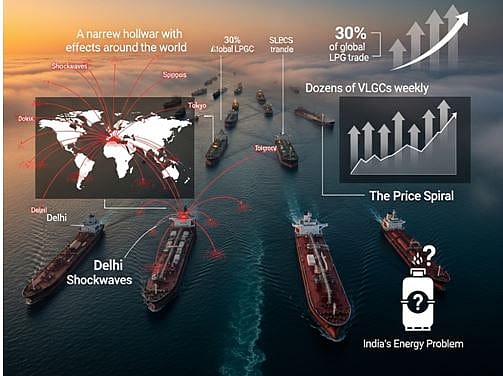
There aren't many places in the world where energy politics are as quiet and powerful as the Strait of Hormuz. The small body of water that separates Iran and Oman is only 33 kilometers wide at its narrowest point. It is the most important energy choke point in the world. This corridor moves more than a fifth of the world's oil exports and a lot of its liquefied petroleum gas (LPG) shipments every day.
For years, experts have said that any trouble in the Strait of Hormuz would send shockwaves through the world's oil markets. But most people don't think about another weakness: LPG, the fuel that runs kitchens, heats homes, and feeds Asia's petrochemical industry. If the Strait of Hormuz were to close, even for a short time, the shock waves from the LPG would be felt in communities far beyond the Persian Gulf.
LPG mainly relies on sea routes, while crude oil benefits from strategic reserves, a variety of transportation networks, and pipeline options. The Persian Gulf is the main source of LPG exports around the world. Qatar, Saudi Arabia, the United Arab Emirates, and Kuwait are the main countries that send goods to Asian markets. Most of these goods have to go through the Strait of Hormuz before they can get to places like India, China, Japan, and South Korea.
Because of this structural dependence, the strait is more of an energy lifeline than a shipping lane.
A narrow hallway with effects around the world

Travel Issue 2026
15 May 2026 - Vol 04 | Issue 71
The Cultural Traveller
About 30% of all the LPG that is traded around the world goes through the Strait of Hormuz. There is a lot of traffic on this route; every week, dozens of very large gas carriers (VLGCs) bring millions of tons of propane and butane to Asian ports. The issue is that there aren't many good choices. There are some oil pipelines that go around Hormuz, like Saudi Arabia's East-West pipeline to the Red Sea. However, there is no similar infrastructure for LPG exports on the same scale. If the strait is closed, Gulf LPG supplies won't be able to get to the open ocean in real life.
The immediate effect would be a backlog of tankers stuck in the Gulf and a sudden drop in the amount of goods available around the world.
The economy of LPG
LPG has a strange place in the energy hierarchy. It doesn't get nearly as much attention from politicians as crude oil or natural gas, even though it is very important in everyday life. LPG cylinders are the main way that people cook in their homes in Asia. Governments have spent a lot of money to make LPG more available as a cleaner alternative to coal and firewood.
India is the best example. Government programs have made LPG much more widely available over the past ten years, bringing it to hundreds of millions of homes. Because of this, India is now one of the biggest importers of LPG in the world, getting most of its supply from the Gulf.
If something happened in Hormuz, people in the US would immediately be worried about energy. Deliveries of cylinders could be late because of a lack of supplies, and the government's subsidy burden would grow as international costs rise. In countries where LPG is commonly used for cooking, these kinds of problems have big effects on society and politics.
The Price Spiral
When things aren't clear, energy markets move quickly. Prices go up and down because there could be problems in the Strait of Hormuz. The Saudi Aramco Contract Price is the most important price that determines LPG prices in Asia and around the world. If shipments stopped, merchants would quickly look for cargo from other US or West African suppliers. Prices could rise quickly because of the sudden change in demand, especially in the Asian spot market.
The whole economy would be affected by these kinds of price increases. LPG is not just a fuel for homes; it is also an important raw material for the petrochemical industry. East Asian petrochemical complexes need to import propane and butane on a regular basis to make plastics, synthetic fibers, and industrial chemicals. A supply shock in LPG could start a chain reaction in manufacturing that affects everything from car parts to packaging materials.
Strategic Weakness
If Hormuz were to close, it would show how weak the global LPG supply system is at its core. Even though the fuel is becoming more important, the infrastructure that makes it possible to trade is still mostly in one place.
The fact that the United States is now a major exporter of LPG has added some variety. American shale production has made Gulf Coast ports major suppliers for Asian markets. But this solution also has some problems. The distances for shipping are longer, the rates for shipping are higher, and the number of tankers available around the world is limited.
Also, changing providers during a crisis is not always easy. Contracts, shipping schedules, and the infrastructure at ports all have an effect on the flow of LPG trade. In fact, major supply problems can lead to a time of extreme market instability before a new balance is found.
India's Energy Problem
The strategic effects are more important for India right now. The country's quick growth in the use of LPG, which was encouraged by rules aimed at replacing biomass cooking fuels, has led to better health and environmental outcomes. But it has also made people more dependent on imported LPG.
About two-thirds of India's LPG use comes from imports, and a big part of that comes from suppliers in the Gulf. A long-term problem in the Strait of Hormuz would put both energy security and fiscal stability at risk.
New Delhi has started looking for ways to make this weakness less of a problem, such as by locating new sources and making LPG storage better. But location has its own limits. The Gulf is still the easiest and cheapest place to get supplies.
A Key Moment in the Age of Energy
The Strait of Hormuz has long been a sign of how weak the world's energy system is. A gas corridor that gives millions of Asian families energy every day is also what people call an oil chokepoint. If tensions in the area got so bad that the strait had to be closed, the effects would go far beyond tanker routes and commodity markets. The shock would affect kitchens in places as far away as Delhi and Tokyo.
In the end, the lesson of Hormuz goes beyond politics. It's about the quiet infrastructure that makes contemporary living possible, like shipping lanes, tankers, and supply systems that transfer fuels across oceans without anyone noticing them. When those arteries get tighter, the effects spread quickly, perhaps all the way to the stove in the kitchen.