The global consequences of the assassination of Ali Larijani
On the night of 17 March 2026, the monthly lunar cycle was 27 days old. The illuminated surface of the moon was at 3%. It was a waning crescent. Suddenly, the night sky over Tel Aviv turned white. There was no lightning; there were no fireworks; only dozens of missiles, streaking across the darkness in tight, deliberate formations. Each one carrying a message written in fire. A message that read, “We remember, we grieve, and now we answer.” That night, the IRGC launched what Iranian state broadcaster IRIB TV called the most intense, most coordinated, most devastating strike package in 18 days of war till date. And if anyone thought they understood why that happened, they were wrong. The real story behind that then seemingly unending salvo was not just about ballistic missiles and radar screens. It was about a man, a phone call that never came, a seat at a table that will never be filled again, and the remnants of a regime that just decided it had nothing left to lose.
The confirmation came from Iranian authorities themselves, which made it impossible to dismiss as propaganda. Ali Larijani was dead, killed in an Israeli operation that also eliminated Gholam Reza Soleimani, the commander of the Basij Force, the internal security apparatus that had crushed Iranian street protests for decades
And when that news broke inside the IRGC command structure, the response was not grief. It was mathematics. They counted the losses. Khamenei gone. Larijani gone. Soleimani gone. And they drew a single conclusion. The strategy of measured proportional response was over

Zeroing In on ECI
09 Oct 2026 - Vol 05 | Issue 41
Constitutional legitimacy versus political opportunism
IRGC Aerospace Force Commander Brig. Gen Seyyid Majid Mousavi did not issue a press release. He did not schedule a press conference. He appeared briefly on state television and said something that was translated instantly by every major monitoring service around the world. He said the attacks that night would make the enemy’s sky more “spectacular.” That phrase alone, more spectacular, should have triggered every alarm in every defense ministry from Washington to Riyadh. Because in the language of Iranian military communication, spectacular is not a metaphor. It is a targeting order.
Within hours of that statement, radar systems across Israel lit up simultaneously. Iron Dome batteries across central Israel began engaging. The cities of Tel Aviv, Ramat Gan, Rishon LeZion, and Be’er Sheva all activated emergency alert systems.
And then the sky filled with light.
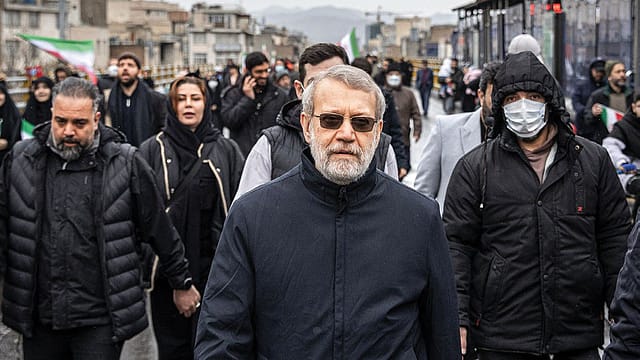
Following the killing of Ali Khamenei, one man kept appearing on IRIB TV, walking through the streets of Tehran during the Quds Day rally on 13 March, shaking hands, speaking to cameras, projecting calm. That man was Ali Larijani, former speaker of the Iranian Parliament, Secretary of the Supreme National Security Council. Between Khamenei’s formal supreme authority and the chaotic factional reality of the institutions below him, there existed for decades a figure who operated in the space that organizational charts cannot map. A figure who held relationships across every political faction simultaneously. A figure who could walk into any room inside the Islamic Republic’s power structure and be treated as a legitimate interlocutor by everyone in it. That figure was Ali Larijani.
Born in 1958 into one of the Islamic Republic’s most consequential families, his father was a Grand Ayatollah. The Larijani family is woven into the institutional fabric of the Islamic Republic at a depth that most political families and most political systems never achieve. When the Israelis removed Ali Larijani from that picture, they did not remove one branch of the institutionally entwined family. They removed the branch from which several others were hanging. Ali Larijani built a Rolodex, an understanding of obligations, a map of who owed what to whom that no other living figure in the Islamic Republic possessed.
Defense analysts describe this as salvo saturation in vengeance. The first wave forces air defense systems to engage, burning through interceptor missiles. The second wave arrives before the systems can reload. The third wave finds gaps and targets.
Now, here is where the economic dimension of this war becomes impossible to ignore. Because the story of 17 March’s strikes cannot be separated from the story of what is happening to global energy markets. With the most intense retaliatory strike package by Iran, of the war now confirmed, and Iranian Army Chief Amir Hatami on record warning of a response that will be, in his words, decisive and regrettable, the prices for crude oil tell a story that no headline has yet fully captured. We are approaching a price point not seen since the worst moments of the 1973 oil embargo.
And the consequences of that number are not abstract. They are sitting in every household’s bank account, every airline’s balance sheet, every shipping company’s fuel surcharge calculation, and every central bank’s inflation forecast.
When this war began on 28 February, Brent crude oil was trading in a range that most energy economists considered elevated but manageable. Today, it is trading at $110 per barrel and has seen a high of $120 a barrel.
As the Sun moves into Aries on 14 April, it triggers the biological deadline for corn and soybean planting across the US Midwest. Every day that passes without nitrogen becoming affordable and available, narrows the window for corn. USDA (US Department of Agriculture) projects corn falling to 94 million acres from 98.8 million this coming April. Soybeans rising to 85 million from 81.2 million. The seeds that go into the ground in the next three weeks will determine America’s grain harvest in October. And they will also determine the price of ethanol.
The USDA Prospective Plantings report converts farmer intentions into official data; every acreage number, every corn-soy ratio, every nitrogen-dependent calculation becomes a published fact that traders, governments, and food agencies will use to model global supply for the next twelve months. The number arrives in 10 days by 31 March 2026.
The FAO Food Price Index (FFPI) is a monthly measure of international prices for five major food commodity groups: cereals, vegetable oils, dairy, meat, and sugar. Based on a 2014-16 average of 100, it serves as a key indicator of global food market volatility. As of February 2026, the index stood at 125.3 points, marking a rise of 0.9% over January. By 1 April, we will have the first global reading that captures post-Hormuz closure commodity prices across cereals, vegetable oils, dairy, meat, and sugar. The 2022 peak was 159.7 in March 2022 after the war started in Ukraine. This reading will incorporate oil above $100, urea at $610, LNG halted, packaging repriced, and freight surcharges of $500 to $1,500 per container. The number that emerges will determine whether the UN declares a global food emergency in fifteen days.
Methanol was at 2,960 CNY/T on 20 March 2026. Over the past month, Methanol's price has risen 31.67%, and is up 12.29% compared to the same time last year, according to trading on a contract for difference (CFD) that tracks the benchmark market for this commodity. Methanol feeds the solvent chain for paracetamol, ibuprofen, metformin, and antibiotics. Once buffers deplete, the shortage becomes a patient access crisis for the 47 percent of US generics that originate in India.
China is drawing down commercial reserves at up to 1,000,000 barrels per day. The draw down sustains refinery operations for 4 to 6 weeks from 19 March. Mid-April to late April is the exhaustion window. After that, China faces three options: accelerate Russian pipeline imports, reroute at a massive premium, or crack open the strategic petroleum reserve. The third option reprices every commodity on the planet as it significantly alters Chinese manufacturing costs.
Two Korean Chaebols, SK Hynix and Samsung, hold two to three months of helium inventory. Late May to early June is the depletion window. South Korea imports 64.7% of its helium from Qatar. Ras Laffan is offline as a result of Iranian attacks. If helium buffers deplete before alternative supply arrives, semiconductor fabrication faces rationing. The AI hardware supply chain hits a physical wall measured in months, not quarters.
Solvency II is a harmonized EU-wide regulatory regime for insurance and reinsurance companies, effective since 1 January 2016, designed to ensure policyholder protection and financial stability. It imposes risk-based capital requirements, strict governance standards, and increased transparency across three pillars to ensure firms can withstand significant financial shocks. Solvency II requires 30 to 60 days of zero incidents before P&I clubs can reinstate war risk coverage. Even after a ceasefire, the insurance normalization takes 6 to 16 months based on the Red Sea precedent of 26 months and counting. The logistics system lags the financial relief rally by the longest duration of any variable in this crisis
To the world, the Hormuz blockade was just an oil story. Soon after, it became an LNG story. On 18 March, Israel struck Iran’s South Pars offshore gas field and Iran immediately retaliated by attacking Qatar’s giant Ras Laffan liquefied natural gas (LNG) facility. Iran’s South Pars and Qatar’s North Field share the same geological reservoir, the largest gas deposit on earth at roughly 1,800 trillion cubic feet. But Iran produces approximately 2 billion cubic feet per day from its side. Qatar produces 18.5 billion. Iran’s side funds a fraction of its budget. Qatar’s side funds 80 percent of government revenue and the world’s largest LNG export operation. Trump’s threat of destroying the entirety of South Pars if Iran attacked Qatar again, would eliminate Iran’s gas production while risking catastrophic reservoir pressure migration that could damage Qatar’s North Field for decades.
If this damage assessment holds at this point, the war becomes a civilization-input story that lasts half a decade to overcome. There is a difference between a shipping shock and a capacity shock that global markets have not yet priced. A shipping shock only traps molecules for a defined period. The oil exists, the gas exists, the tankers are anchored, and when the Strait reopens, the molecules flow again.
However, a capacity shock destroys molecules. The liquefaction trains that convert gas into LNG are physically damaged. The molecules cannot be produced even if every ship in the world is available to carry them. Qatar Energy’s CEO Saad Sherida Al-Kaabi told Reuters that damage to Ras Laffan was severe. Repairs to impaired liquefaction capacity could take 3 to 5 years. Force majeure was declared on 4 March and has since escalated as the damage assessment worsened through 18 and 19 March. Long-term contract buyers including Italy, Belgium, South Korea, and China face multi-year delivery disruptions. Shell declared force majeure on cargoes it resells from Qatar Energy. The global market must now confront a possibility it has refused to model: that roughly 17 percent of Qatar’s 77 million tons per annum capacity is not delayed but structurally impaired. Yukio Kani CEO of JERA, Japan’s largest power generation company stated that the global LNG market does not have the spare capacity to bridge the gap if Hormuz-linked supply is meaningfully lost.
95 nations have reported petrol price increases since the war began on 28 February. Ras Laffan is not just LNG. It is helium, urea, methanol, polyethylene, and sulfur. The downstream implications from the Ras Laffan impairment runs through semiconductor fabrication, pharmaceutical synthesis, phosphate fertilizer production, food packaging, and desalination. Europe’s post-2022 gas security was built on Qatari LNG replacing Russian pipelines. A structural impairment does not merely make gas expensive. It makes gas unavailable to industry. That is how an LNG shock becomes a global deindustrialization shock.
On 20 March 2026, the world entered day 21 of Operation Epic Fury. And by now, the US Centcom pretty much has annihilated Iran. In just 3 weeks, US forces have struck over 7,000 targets across Iranian territory. More than 6,500 combat sorties have filled the skies above Iran around the clock without pause, without mercy.
The targets were not random. They were calculated, precise, and devastating. Command and control centres levelled. IRGC headquarters turned to dust. Intelligence sites gone. Integrated air defense systems ripped apart. Ballistic missile launch sites reduced to scrap metal.
But the strikes did not just destroy hardware. They destroyed leadership. And that brought vengeance in retaliation. How long will this go on?