The Electricity-Air Pollution Nexus: What Indian Cities Know but Don’t Say
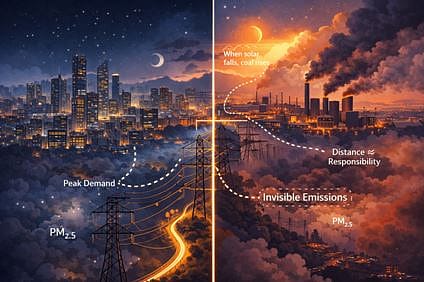
There is a silent contradiction at the heart of India's urban growth story, which is rarely mentioned in official papers or public statements. Cities celebrate increased power usage as a sign of progress, but the same increase is quietly tightening the grip of air pollution. The relationship is neither accidental nor completely acknowledged. It is structural, deeply rooted in the way India powers its cities.
Spending a day tracking electricity demand curves from the Central Electricity Authority reveals a pattern. Urban demand spikes are abrupt, predictable, and becoming more difficult to control. What is less evident, however, is how grid operators respond in the background. When demand increases, particularly during peak summer afternoons or late nighttime hours, the system may not seamlessly transition to clean reserves. It almost naturally turns to coal.
This is not a failure of intent; it is a limitation of the system. Renewable energy in India, particularly solar energy, is abundant but intermittent. It peaks during the day and then lowers just as urban demand begins to rise in the evening. Wind patterns are both seasonal and unpredictable. Storage options are restricted. In this gap between demand and clean supply, there is a reliance that few officials publicly acknowledge: coal remains the most dependable backup.
The outcome is a type of "invisible emissions." Unlike automobile pollution or construction dust, which are immediate and localized, energy generation emissions are geographically and politically dispersed. A city like Mumbai can cut on-road emissions and control construction but still experiencing declining air quality since the electricity it uses is produced hundreds of kilometers away in coal-rich regions.

Exclusive: To the Heavens and Back
19 Jun 2026 - Vol 04 | Issue 76
Shubhanshu Shukla relives the space odyssey that put India into orbit
There isn't much talk about when these emissions happen either. During peak electricity demand, not only does generation go up, but it also affects which plants are used. Base-load plants run all the time and are often more efficient. Utilities often use older, less efficient "peaking" units or ramp up facilities that would normally run below capacity when demand spikes. These units usually have higher emission intensities, which means that using more power during peak times costs more in terms of pollution.
So, not all electricity is equally "dirty"—the time is very important.
This time-based aspect is mostly missing from public debate. When measuring air pollution, daily or seasonal averages are often used. When measuring electrical demand, total usage is used. The two don't usually agree on an hourly basis. But these hourly changes are where the most important things happen.
Think about the busiest time of night. There is a lot of stress on the grid right now because solar power is going down, and homes are using more electricity for lights, appliances, and cooling systems. This is when coal-fired electricity really starts to rise. It is also the time when the air starts to settle down, which slows the spread of pollutants. The overlap is not a coincidence; it is a part of the system.
Winter adds another layer. Temperature inversions in northern India keep pollutants close to the ground. At certain times, even small increases in emissions can have a big effect on the quality of the air. It also makes people less responsible. When the air quality in a city gets worse, different sectors and jurisdictions share the blame. Even though their emissions directly cause pollution in cities, power plants are not under the control of cities. The end result is a lack of clear responsibility for the connection between electricity and pollution.
Data fragmentation makes this problem worse. Agencies like the Central Pollution Control Board don't often put together air quality data with real-time information about how much electricity is being made. Satellite-based estimates and private databases add more information, but it's hard to analyze because the resolution and methods are different. The link between electricity use and pollution is still unknown and easy to deny without synchronized, high-resolution data. But when these datasets are lined up, even at the most basic level, the signals are hard to miss. When there is a lot of electricity needed, PM2.5 levels are often too high, especially in places that rely on thermal power. The connection isn't perfect or universal, but it's strong enough to need further study.
The consequences are severe. If power use makes air pollution worse, we need to do more than just cut down on obvious sources of pollution. It means thinking about when and how we use electricity again. There is also the issue of telling stories. People say that electricity is a sign of progress, and they are right. It makes it possible for businesses, schools, and doctors to work. But the story doesn't say much about how bad it is for the environment. This strategic framing hides the link between electricity and pollution, even though the effects in the air are becoming clearer.
India's cities aren't the only ones facing this problem, but the speed and extent of urbanization make it much more serious. The need for electricity will keep growing. The question is whether the system that was made to handle this demand will change quickly enough to keep the air quality from getting worse in the future.
For now, the relationship is an open secret that data analysts know about but that policymakers don't talk about very much. The lights stay on, the air gets worse, and the link between the two stays just out of sight.