The Economics of Inaction: What TB Is Really Costing India
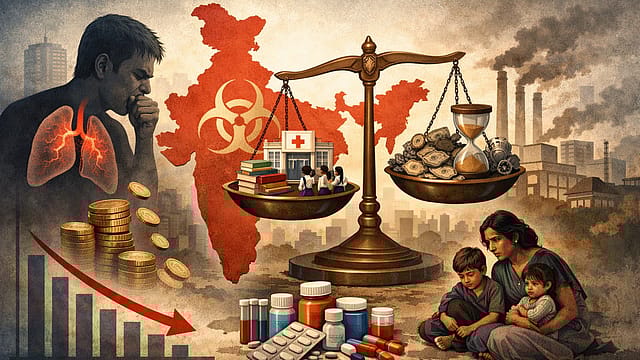
Our health systems are designed to manage disease at scale, but their performance is often shaped by how early conditions are identified and how consistently care pathways are followed.
Tuberculosis continues to expose gaps at both levels.
In India, TB is widely understood as a public health burden. What is less visible is how delays in detection and interruptions in care translate into economic effects outside the health system.
These effects are not always measured directly, but they follow a consistent pattern.
India accounts for nearly a quarter of global TB cases, with a large proportion among individuals in their working years.

Zeroing In on ECI
09 Oct 2026 - Vol 05 | Issue 41
Constitutional legitimacy versus political opportunism
In most households, income depends on continuous participation in work. When illness interrupts that continuity, the effect is immediate. At a system level, when this happens across millions of cases, it begins to show up differently.
Estimates suggest that between 2021 and 2040, tuberculosis could result in cumulative GDP losses of $146.4 billion in India, alongside more than 62 million incident cases and 8.1 million deaths if current gaps persist.
These numbers reflect not only disease burden, but the way detection and care pathways currently function.
The Hidden Economic Drain of a Preventable Disease
The most visible burden of TB is clinical. The less visible burden is financial.
For many families, a TB diagnosis sets off a chain reaction. The patient often loses weeks or months of work.
In informal and daily-wage employment settings which still employ a significant share of India’s workforce, such illness directly translates into lost earnings. There is rarely the cushion of paid leave, employer-backed insurance, or income continuity.
This loss is rarely limited to one individual. In many households, one person’s illness shifts caregiving responsibilities onto others, often women, who may themselves withdraw from work.
Children’s education can be interrupted as household resources are redirected toward care and survival.
Evidence from India shows that despite free treatment under government programmes, the average out-of-pocket and indirect cost per TB patient can reach nearly ₹32,000, with almost 45% of patients facing catastrophic expenditure relative to annual income.
Much of this is driven not by treatment fees, but by lost wages and productivity.
When multiplied across millions of cases, the macroeconomic impact becomes impossible to ignore.
Why Delayed Detection Multiplies Financial Loss
The most expensive TB case is often the one diagnosed too late.
Delayed detection increases not only clinical severity but also economic damage.
A person who remains undiagnosed continues to work while symptomatic, often at reduced productivity, before eventually dropping out of the workforce altogether.
By the time diagnosis happens, the disease may require longer treatment, hospitalization, or management of complications.
Every missed or delayed diagnosis adds three interconnected costs: the patient's lost income, the increased risk of transmission to others, and the substantially higher expense of treating the disease at an advanced stage.
Research in India shows that patients often consult multiple providers before receiving a confirmed diagnosis, prolonging both financial and health burdens.
From an economic standpoint, delayed diagnosis acts similarly to deferred infrastructure maintenance: the cost of resolving the problem increases exponentially over time.
The Productivity Case for Early Intervention
Preserving productivity is one the most compelling economic case for the eradication of tuberculosis.
Early detection of tuberculosis (TB), especially through proactive screening and AI-enabled chest X-ray interpretation in high-burden settings, allows patients to start treatment sooner, recover faster, and return to work with less discomfort.
This means less time lost from work, decreases hospitalization cost, and lowers cases of transmission. A 2025 study estimated that each TB related death in India results in an average non-health GDP loss of over $23,000, with the heaviest burden falling on younger working-age men.
Therefore, investments in technology-enabled triage, rapid screening, and community outreach should be viewed as mechanisms to protect productivity rather than as costs associated with the health sector.
TB Elimination as a Fiscal Strategy Over Welfare Agenda
India’s ambition to eliminate TB cannot remain confined to welfare discourse. This is not about social spending alone. It is about economic resilience as well.
Every rupee invested in earlier diagnosis, stronger surveillance, and treatment adherence has downstream returns in preserved labour output, reduced healthcare burden, and improved household stability.
Historically, scaling up TB control in India has already demonstrated measurable economic returns, including millions of disability-adjusted life years saved and deaths averted.
The policy conversation must therefore shift from how much TB elimination costs to how much continued inaction costs the economy.
Because the answer, increasingly, is far more.
Ending TB is an Economic Reform Imperative
The welfare of India's workforce is inherently linked to the country's growth ambitions. Tuberculosis directly impacts household earnings, productivity, and economic resilience in addition to being a public health concern.
Every missed diagnosis leads to wasted years of productivity, unstable finances, and increased obstacles to the advancement of the country. For this reason, eliminating tuberculosis must be viewed as an essential component of economic reform rather than a welfare agenda.
Protecting human capital, enhancing livelihoods, and preserving India's long-term economic narrative all depend on smart investments in early detection and systemic efficiency. It is more than just a medical expense.