The Cost of a Broken Chain: When food inflation signals systemic breakdown
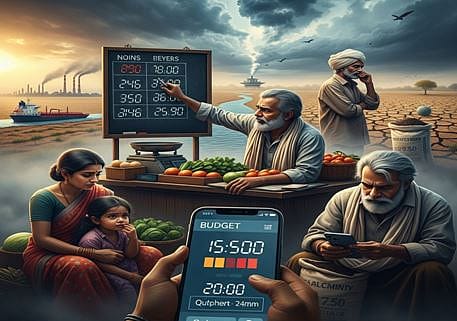
Prices are often used to talk about food inflation, which changes because of monsoons, markets, and promises from ministers. But what India is going through right now is more than just a case of inflation; it is the slow breakdown of a stressed food chain. The country's food system is being tested at every level, from the soil to the supply chains, from input dependency to climate shocks.
The effects are clear in everyday situations: a vegetable vendor changing prices in the middle of the day, a family adjusting its monthly budget, and a farmer wondering if the next season will make up for the losses of the previous one. Food prices are going up because many problems are happening at the same time, not just one.
The Agricultural Base: Uncertain and Uneven
The base of the food chain, agriculture, has become less stable. In India, where a large part of farming still depends on monsoon rhythms, climate unpredictability is no longer an exception. Heat waves happen earlier, rain falls in bursts instead of cycles, and bad weather that isn't normal for the season destroys crops more and more often.
The result is not usually a total crop failure, but rather a slow decline in the stability of yields. The amount of wheat grown goes down one season, the amount of pulses grown goes up and down the next, and the amount of horticulture grown goes up and down. Prices are affected right away by this volatility.

The Liberation of Bengal
05 Jun 2026 - Vol 04 | Issue 74
A silent revolution ends the reign of fear
At the same time, the cost of growing things has gone up a lot. The cost of fertilizers, diesel, electricity, and labor, all of which are needed for modern farming, has gone up. A lot of farmers, especially small ones, are making less money even though the risks are going up. Prices for consumers don't usually stay the same when the cost of inputs goes up.
The Invisible Web: Global Dependencies
In India, problems with storage and distribution can make prices more unstable. Prices could go up too much if there isn't enough of something, but prices don't always go down when there is too much of something. Intermediaries are very important, and when things are uncertain, their margins can grow.
Prices for basic things like tomatoes, onions, and pulses keep going up, which is a sign that there are bigger problems in the system. They show a food chain that doesn't stay strong.
Chokepoints like the Strait of Hormuz show how closely food and energy systems are connected. Higher oil prices make transportation more expensive, which makes food more expensive. Wars like the Russia-Ukraine War have also affected the world's supplies of food and fertilizer, making markets tighter and prices go up. India's dependence on fertilizers from other countries makes it even more vulnerable. When prices go up around the world or supply lines break down, farmers feel the effects right away. Subsidies may help ease the pain, but they don't fix the main problem.
The Fertilizer Question: Productivity vs Dependency
India's farming has been successful for a long time because it uses a lot of chemicals to help plants grow. They have helped keep food safe for decades and made crops grow well. But there are problems with this success. Using too many synthetic inputs has harmed the soil's health, making it less fertile and more reliant on them over time. Farmers often need more fertilizer to do the same amount of work, which is bad for the environment and bad for business. There are more and more efforts to promote bio-inputs and environmentally friendly practices, but the change is not easy or quick. Farmers need to know that other options won't lower production. Policies need to change the incentives, and markets need to change too. The fertilizer problem will stay that way until then, stuck between the need for productivity and the need for sustainability.
A structural change, not just inflation
What is going on is not a temporary problem but a permanent change. Climate change, wars over land, reliance on inputs, and problems in the market are all changing the food economy. Policymakers now have more problems than just controlling inflation with short-term measures like banning exports or releasing buffer stocks. These answers might help for a little while, but they don't get to the heart of the problem.
The next step is harder: make a food system that can handle shocks, doesn't depend on outside factors that are hard to predict, and is more in line with how things really are.
The significance of resilience
In this case, resilience is more than just a slogan; it's a need. It means putting money into climate-adaptive farming, getting inputs from more than one source, making local supply chains better, and slowly switching to more environmentally friendly farming methods.
It also means that policy priorities need to be changed. Subsidies that now encourage the use of chemicals need to be changed to support soil health and long-term productivity. Infrastructure needs to cut down on losses after harvest, and markets need to be more open and efficient.
Conclusion
The supply chain that brings food to stores is under a lot of stress, which is why food prices are going up. There are weaknesses in each link—soil, inputs, transportation, and markets—and when you put them all together, they make a system that is harder and harder to stabilize.
If you only think of food inflation in terms of prices, you're missing the bigger picture. It is, in short, a sign of how stable the system is—or isn't.
In the next few years, the question will be how to not only lower the cost of food but also make the supply chain that brings it stronger.