The Changing Environmental Costs of Urbanization in India
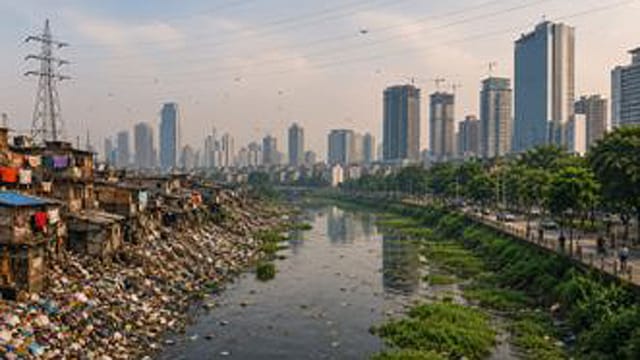
The cities in India are expanding at an unprecedented rate. The country’s economic development has been characterised by a specific process of urbanisation, with millions of people moving to the cities to find jobs, education and a better life. Forecasts suggest that urban population growth in India will continue to grow rapidly over the coming decades and that cities will play an important role in India’s growth story. But beneath the tale of economic progress and infrastructure development is a growing environmental problem that India can no longer afford to ignore.
The environmental fall-out of rapid urban growth is beginning to show up in Indian cities. Increasing air pollution, declining green spaces, shrinking wetlands, depletion of groundwater, urban flooding, heat stress and a rise in garbage creation are hallmarks of a development paradigm that often prioritises short-term growth over ecological sustainability. Cities such as Delhi, Bengaluru, Mumbai and Kolkata are grappling with the challenge of balancing economic growth with environmental resilience. One of the most obvious consequences of unbridled urbanisation is the degradation of natural ecosystems. Wetlands, lakes, woodlands and open spaces, once biological buffers, are being replaced slowly by roads, housing complexes, commercial infrastructure and industrial corridors. In many cities, the rapid urban growth has encroached on natural drainage systems, increasing the susceptibility of urban areas to monsoon flooding.

Zeroing In on ECI
09 Oct 2026 - Vol 05 | Issue 41
Constitutional legitimacy versus political opportunism
Bangalore is a classic example of such a transition. The city, once famous for its interconnected lake systems and temperate climate, was urbanized and has caused extensive degradation of wetlands and stress on groundwater. Flooding situations due to heavy rains are much more common. It portrays the environmental impact of reckless growth and indifference to ecology. Such trends can be seen in Chennai, Mumbai, Gurugram and Hyderabad where infrastructure development has often come at the cost of environmental sustainability. Urban flooding has become one of the most glaring signs of ecological imbalance in Indian cities. Periodic urban disasters occur due to the combination of inadequate drainage infrastructure, concretisation and wetland encroachment along with extreme rainfall events due to climate change. Roads become streams, transport systems fail, and the areas most vulnerable economically are hardest hit. They are becoming matters of structural urban governance, once thought of as rare weather events.
Air pollution is a further significant environmental problem related to urbanization. Cities in India are often some of the most polluted in the world. Major factors in bad air quality include vehicle exhaust, construction dust, burning garbage, coal-fired power generation, and industrial activity. Pollution affects everyone but poorer communities are often more exposed because of poor housing and location in industrial areas or along routes of traffic.
The public health consequences are severe. Increasing levels of pollution lead to respiratory disorders, cardiovascular problems and deterioration in the overall quality of life. Children and the elderly are especially vulnerable. Poor enforcement, fragmented administration and infrastructural deficits continue to hamper many cities and prevent major pollution abatement despite occasional government action.
Also, with continued urbanization in India, water stress is worsening. As populations grow and consumption increases, pressure on water infrastructure already under stress increases. Lots of cities depend heavily on pumping ground water, leading to rapidly falling water tables. Periodic water shortages have been experienced in Bengaluru, Chennai and Delhi in recent years, raising concerns about long-term urban water security. At the same time, pollution of rivers, lakes and groundwater reserves cuts the supply of safe drinking water. Untreated sewage, poor waste management and industrial discharge are polluting urban water bodies across the country. The degradation of rivers like the Yamuna is a larger failure of governance in integrating urban growth and ecological conservation.
Waste generation is another problem on the rise. Every day, India's developing cities produce huge amounts of solid waste, much of it still badly managed. Overflowing landfills, plastic waste and poor recycling infrastructure are becoming identifying features of many urban environments. Fires at landfills, methane emissions, and toxic waste leaks all increase the threat to the environment and to public health.
Urban vulnerabilities are being exacerbated by climate change. Heatwaves are getting stronger and longer . The urban heat island effect is worsened by replacing green space with concrete structures . Cities absorb and retain heat more easily, resulting in much higher temperatures than the surrounding countryside. The extreme heat is taking an increasing toll on the health of millions of people living in informal settlements with limited access to cooling, water and adequate housing.
Urbanisation is also altering energy use and emission patterns. Cities are expanding their environmental footprint, with infrastructure growth, increasing car ownership, greater electricity consumption and large-scale construction activities. Urbanisation is crucial to India’s pursuit of economic growth and industrialisation. But without long-term planning, cities could become major sources of environmental degradation and climate danger. But the environmental crisis that comes with urban expansion is not only about population growth. It is also closely related to failures in governance and lack of good planning. Most Indian towns still grow without considering ecological carrying capacity, climate resilience or sustainable land usage. Urban planning processes are often segmented, reactive and driven by short term political or commercial interests.
Wetlands need to be protected, urban water bodies need to be restored, green spaces need to be expanded, waste management systems need to be improved and sustainable public transportation investments need to be made. We need resilient infrastructure for climate change, better environmental regulations, better governance processes in cities. Urban development in the future also needs to be affordable, equitable access to public services and inclusive adaptation to climate change. Such actions can be based on better resource management, pollution monitoring, renewable energy integration and climate forecasting tools. Technology cannot substitute for poor governance or unsustainable development policies.
Ultimately, the future of India’s cities lies in their ability to grow without compromising the ecological systems on which they depend. Urbanisation is vital to economic growth but the environmental costs of unrestrained growth are increasingly hard to ignore. Continuing present trends could not only lead to infrastructure challenges for India’s cities in the decades to come, but also more serious environmental and public health issues. The challenge for India is not whether urbanisation should continue, but whether it can be environmentally sustainable, socially inclusive and resilient in an era of accelerated climate change.