The Next India-China Contest Will Be Fought Over Lithium, Not Ladakh
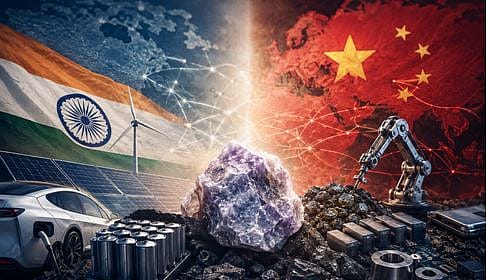
Geography has defined the India-China competition for decades. The 1962 war, the Doklam standoff, and the horrendous Galwan Valley skirmishes have made the Himalayas the main theater of geopolitical conflict between the two most powerful nations of Asia. With each new road along the Line of Actual Control (LAC), with each military deployment in Ladakh, with each diplomatic deadlock, the perception has grown that territorial conflicts would shape the future of the bilateral relationship. But already a quieter, and perhaps more important, struggle is starting. It is not happening on the frozen peaks of the Himalayas but in Argentina’s lithium riches, the Democratic Republic of Congo’s cobalt mines, Indonesia’s nickel deposits, and China’s rare earth processing plants. The primary geopolitical struggle of the energy revolution will be over who controls the minerals that power electric vehicles, batteries, renewable energy systems, and advanced defense systems, not who owns the oil fields. This is a major strategic shift for India. And the task is not only border defense but also the protection of access to key minerals that will determine economic competitiveness, technological leadership, and national security in the twenty-first century. Oil has been a major factor in the geopolitics of the 20th century. Oil impacted international politics, as demonstrated by the Gulf Wars, the strategic importance of the Strait of Hormuz, and the founding of OPEC. Countries scrambled to secure oil resources, pipelines, and sea lanes because oil security meant energy security. The global energy transition is quickly redrawing the map. Governments are moving fast to decarbonize, and electricity is taking over from petroleum as the major energy carrier. Lithium, cobalt, nickel, graphite, and rare earth metals are vital resources for electric vehicles, battery storage, renewable energy infrastructure, semiconductors, artificial intelligence, and defense electronics.
The International Energy Agency projects that under ambitious clean-energy scenarios, the demand for essential minerals could more than triple by 2040. The challenge is not simply resource availability but also processing capability, unlike oil. Here, China has been stealthily building one of the greatest strategic advantages of modern times. China understood the strategic importance of critical minerals long before other major economies. Rather than focus on domestic reserves, Beijing has invested throughout the entire value chain from overseas mining and refining of raw materials to making batteries, electric cars, and renewable technology. Chinese companies now dominate lithium refining, cobalt processing, and rare earth separation, along with a large chunk of the global battery manufacturing industry. Higher state investment, favorable industrial policy, and overseas acquisitions in Africa, Latin America, and Australia have helped companies such as CATL and BYD become global industrial giants. China’s edge is not in having the most deposits but in having the industrial ecosystem to turn raw minerals into high-value products. The integration provides Beijing with great leverage over global clean energy supply chains. Recent export restrictions on gallium, germanium, and certain rare-earth technologies demonstrate that critical minerals, like oil, can serve as a strategic weapon. This poses a major risk for India. The government has set a target of 500 GW of non-fossil fuel capacity by 2030, promoted electric transportation, manufactured green hydrogen, and emerged as a global manufacturing hub. These goals will require huge amounts of battery materials, but India is still heavily import-dependent for many of these critical inputs.

Zeroing In on ECI
09 Oct 2026 - Vol 05 | Issue 41
Constitutional legitimacy versus political opportunism
The discovery of lithium resources in Jammu and Kashmir raised hopes that India may cut its import dependence. But the discoveries in geology do not automatically translate into strategic autonomy. Commercial extraction takes a year of exploration, environmental approvals, infrastructure development, and processing facilities. Even if local production becomes economically viable, India’s reserves are unlikely to be able to meet future demand. Additionally, lithium is only one piece of a much larger supply chain. Renewable technologies use rare earth metals in permanent magnets and wind turbines, and batteries require graphite, cobalt, nickel, manganese, and some specialized chemical processing. Resource finds are of little strategic value without domestic refining capacity and manufacturing ecosystems. India has tried to recalibrate its foreign policy in the light of these issues, vis-à-vis resource security. This is a major change: the establishment of Khanij Bidesh India Limited (KABIL), becoming an observer in the Minerals Security Partnership, MoUs with Australia on critical minerals, and increased interaction with Argentina, Chile, and African producers. Increasingly, critical minerals are seen as an important pillar of economic diplomacy, not a mining concern.
This is a sign of a broader change in world geopolitics. Resource-rich areas such as Africa's and Latin America’s so-called “Lithium Triangle” of Argentina, Bolivia, and Chile have become arenas of strategic competition. Over the last 20 years, China has invested heavily in these places: in infrastructure, in mining contracts, and in industry. Western countries worried about dependence on Chinese supply chains are acting with efforts including the US-led Minerals Security Partnership and the European Union’s Critical Raw Materials Act. India is late to the race, but with a huge advantage. Its democratic institutions, growing manufacturing base, and increasing partnerships with the likes of Australia, Japan, the United States, and France hold the potential to diversify and build resilient supply chains. The Quad, which was originally focused on maritime security, is now broadening its cooperation to cover technology, semiconductors, and supply chain resilience, all of which are directly connected to critical minerals. Buying assets in mining abroad will not be enough to fix India’s predicament. China's dominance wasn't simply about buying mines. It was built on long-term investment in refining technology, battery chemistry, logistics, manufacturing, and research. The real geopolitical asset is not the mineral itself but the industrial ability to transform into strategic products. Hence, India needs a holistic critical mineral policy that is more than just exploitation. Investment in improving infrastructure, battery recycling, better materials science, and alternative technologies such as sodium-ion batteries might help to ease future vulnerabilities. A circular economy that recovers precious minerals from end-of-life batteries and electronic waste is also key, which can reduce dependence on imported raw materials.
It is also important to consider the environmental dimension. The scramble for vital minerals could be about to echo the exploitative politics of the fossil fuel age. Mining projects often fuel fears about losing biodiversity, water scarcity, and indigenous rights. If the clean-energy transition just shifts environmental costs from oil-producing regions to mineral-abundant locations, it threatens to undermine its own sustainability aims. As India seeks to distinguish itself from cutthroat resource-based competition, it should emphasize responsible mining and open government in its international engagement. The fallout is more than economic. Advanced batteries, rare earth magnets, and specialist electronic components are becoming ever more important in defense technology. Artificial intelligence infrastructure requires reliable electricity systems with battery backup. Renewable energy adoption, electric mobility, and digital infrastructure are all interconnected aspects of national security. In this case, supply-chain resilience is no longer an industrial policy issue but a strategic requirement. The India-China rivalry would likely continue along the Line of Actual Control. Territorial issues remain unresolved, and military competition will likely continue. But to concentrate just on the Himalayas might be to miss the bigger transformation that’s taking place. In the coming decades, the balance of power will be influenced not only by military strength but also by technological dominance, industrial robustness, and mastery over the resources that fuel both.
Every era has its strategic resource in history. Coal was the fuel for the industrial revolution. The twentieth century was the century of oil. Critical minerals will be the geopolitics of the clean energy era. The nations that develop robust supply chains and sophisticated manufacturing systems and break away from strategic dependencies will shape the future of global economic leadership. That means India has a challenge that is more than matching China dollar for dollar in its mine investments. This is about building an integrated ecosystem that ties together mineral diplomacy, industrial policy, technological innovation, and strategic relationships. The next phase of the geopolitical struggle will be less about controlling discrete resources and more about dominating the industries they enable.
The confrontation between India and China will continue to be seen in the mountains of Ladakh. But the deeper battle for influence, prosperity, and strategic autonomy may be fought far from the Himalayas in labs developing next-generation batteries, refineries processing lithium, ports shipping critical minerals across the oceans, and diplomatic corridors where tomorrow’s energy alliances are being forged. The road to geopolitical dominance in an era of clean energy doesn’t only lie in contested borders but also in the minerals that will power the future of the world.