Smart Cities: Mission Accomplished Or Promise Unfulfilled?
The monsoon season is the best time to gauge a city. You instantly get a complete picture — the good, the bad and the ugly. If you are in Mumbai, you get a taste of all three, from poor housekeeping to infrastructure deficits.
Come to think of it, only some parts of Mumbai — Marine Drive, Peddar Road and Nepean Sea Road — are clean as a whistle. The rest of the city is an eyesore: dirty, filthy, strewn with garbage, accompanied by a constant stench and perennial waterlogging in several pockets. Not to mention the open gutters. Slums, which occupy nearly 24% of Mumbai's land area, house more than 50% of its population.
For years, successive chief ministers of Maharashtra promised to transform Mumbai into another Shanghai. We are still light-years away from Shanghai.
Mumbai is deteriorating and degenerating on almost every front. Every time a plane lands or takes off, the aerial view is depressing — endless stretches of blue plastic sheets covering slum settlements. It is certainly not a pretty picture.

Zeroing In on ECI
09 Oct 2026 - Vol 05 | Issue 41
Constitutional legitimacy versus political opportunism
The international media loves such images — anything that portrays India in a poor light.
If the country's so-called financial capital continues to deteriorate and hit new lows every year, what must the situation be like in other Indian cities? More importantly, how successful has PM Narendra Modi's Smart Cities Mission been?
When PM Modi announced the scheme, it dominated front pages for months. But over time, it appeared to peter out and virtually disappeared from the media's radar.
So, I did a bit of digging and discovered that the government has actually covered considerable ground. It even released a detailed note marking the completion of 10 years of the Smart Cities Mission. My bad — I had completely missed it.
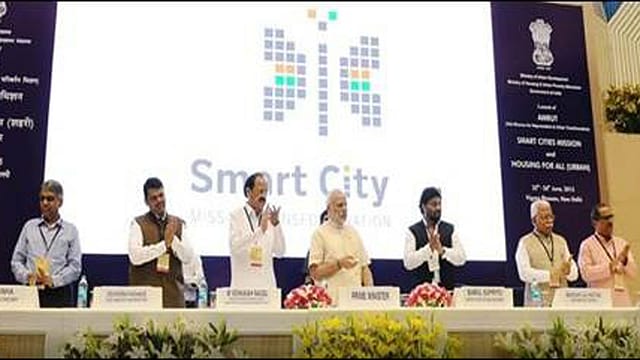
The Mission was launched on June 25, 2015. At the launch, PM Narendra Modi said: "Hundreds of small cities have a key role in achieving the resolve of a developed India by 2047. Our government is upgrading basic facilities in such urban centres to improve ease of living."
It was certainly a visionary thought. But how much of that vision has translated into reality on the ground?
Even before the Mission began, the World Bank had cautioned that smart cities were not simply about information technology. They required alignment of governance, investment, institutions and sound urban management.
The idea behind the Smart Cities Mission was to improve the quality of life through smart and sustainable solutions. By focusing on key areas such as infrastructure, governance and social development, the Mission sought to transform urban living across the country.
The key focus areas included:
• Reliable water and electricity supply
• Sanitation and solid-waste management
• Efficient public transport and mobility
• Affordable housing
• Digital connectivity and e-governance
• Safety and security
• Healthcare and education
• Clean air, public spaces & environmental sustainability
Based on these criteria, 100 cities were selected, and every effort was made to improve the quality of life by providing efficient services, robust infrastructure and sustainable solutions.
According to a Press Information Bureau note, as of May 2025, 94% (7,555 projects) of the total 8,067 projects, amounting to Rs 1,51,361 crore, had been completed. Another 512 projects worth Rs 13,043 crore were in advanced stages of implementation. The government has also released 99.44% of the total allocated funds of Rs 47,652 crore. This suggests that the Modi government has been monitoring the Mission on a real-time basis.
Interestingly, the Smart Cities Mission followed two distinct approaches.
First, each of the 100 selected cities identified a specific area for intensive development, with the idea that the model could later be replicated across the city.
Second, every city implemented Pan-City Projects — technology-driven solutions designed to improve infrastructure and public services. For instance, Chandigarh implemented India's largest and densest pan-city Public Bicycle Sharing (PBS) system, comprising 310 docking stations and over 2,500 bicycles. The system has helped reduce traffic congestion while promoting healthier lifestyles.
However, this approach attracted criticism from the Parliamentary Standing Committee. It observed that pan-city projects constituted less than half of all projects in 76 of the 100 cities. The Committee argued that city-wide development should take precedence over isolated "smart pockets".
Each city attempted to build upon its own strengths by introducing systems and processes that were sustainable, environmentally friendly and cost-effective.
Some of the Mission's visible achievements include:
• Operational Integrated Command & Control Centres in all 100 cities
• More than 84,000 CCTV cameras installed
• Over 1,740 km of smart roads
• 713 km of cycle tracks
• 9,433 smart classrooms across 2,300 govt schools
• 1,320 public-space projects across 84 cities
• Technology-enabled waste management systems in over 66 cities
• SCADA-based monitoring of water supply networks
• Wastewater treatment and reuse projects
• Intelligent traffic mgmt systems & public bicycle-sharing programmes
The government also created Special Purpose Vehicles (SPVs) to ensure that projects were not stalled due to financial constraints.
But the Mission also had its shortcomings.
One criticism was that mayors and municipal corporations continued to have inadequate authority over city administration. Many argued that they needed greater powers to effectively manage urban development.
The Parliamentary Standing Committee also found that many smaller cities lacked the institutional capacity to plan and execute projects worth thousands of crores. Eight of the 15 lowest-ranked cities during its review were from the Northeast.
Another major concern was the frequent transfer of CEOs heading Smart City SPVs, often before projects had matured. The Committee recommended fixed tenures, observing that the lack of leadership continuity adversely affected implementation.
Surprisingly, private-sector participation remained weak. Nearly half of the smart cities failed to execute even a single project under the Public-Private Partnership (PPP) model. In several cities, mayors, councillors, MLAs and MPs were often seen pulling projects in different directions, resulting in delays and lack of coordination.
Should India take a leaf out of China's or Amsterdam's playbook?
Amsterdam developed its smart-city programme through close collaboration among government, universities, businesses and residents. Its projects focused on energy efficiency, mobility, circular-economy practices and neighbourhood-level innovation.
China, meanwhile, has transformed cities such as Shenzhen, Hangzhou and Shanghai into global benchmarks. India can certainly learn from China's speed of infrastructure execution, its integration of land use with mass transit, and the development of new urban districts around economic clusters.
Ultimately, the real question is this: Have these 100 selected cities actually become more liveable, more efficiently governed and more financially sustainable? More importantly, has the quality of life of their residents genuinely improved?
That, in the end, is the real litmus test.