The Strait Is No Longer Enough: Why Asia’s Energy Security Must Outgrow Hormuz
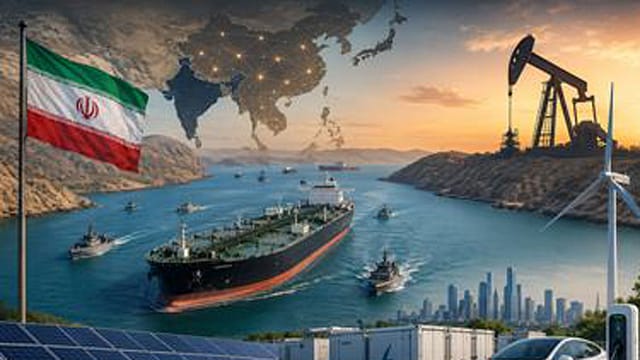
For decades, the Strait of Hormuz has been the world’s premier energy corridor. Every Gulf crisis has proved one old assumption: keep Hormuz open and the global economy will keep running. But the recent geopolitical turmoil in the Middle East suggests that this premise is becoming more and more tenuous. As the military swings between aggression and diplomacy, the lesson from Asia is no longer to secure a particular maritime chokepoint. It’s knowing that real energy security cannot be based on one source. The continuing crisis between Iran, the United States, and other regional actors has brought the Strait of Hormuz once again to the center of world attention. At its narrowest point the waterway is only 33 kilometers wide, but it carries about one-fifth of the world's oil supplies and much of the world's liquefied natural gas. Earlier this year, when tensions flared, insurers raised premiums, shipping companies diverted tankers, and energy markets responded swiftly. More recently, tensions have moved from Hormuz to the Red Sea, with attacks on Saudi energy facilities and increased threats to marine trade, showing that instability is no longer confined to one location. This is more than just another Asian-Middle Eastern problem. This is meant as a strategic warning.
The vast majority of Gulf oil is imported by China, India, Japan, and South Korea. Their manufacturing, transportation, and electrical markets still depend heavily on hydrocarbons shipped through Hormuz. Even short interruptions lead to higher freight costs, volatile oil prices, inflationary pressures, and higher fiscal burdens on importing countries. Although governments keep strategic petroleum reserves to cushion short-term shocks, no reserve can ever fully compensate for the structural dependence of the country on imported fossil fuels. One major difference between the current crisis and past oil shocks is that during the 1973 oil embargo and 1991 Gulf War, there were few economically viable alternatives to imported crude. The technologies of renewable energy have developed over time. In many Asian markets, solar and wind are among the cheapest sources of new power generation, battery storage is expanding fast, and electric mobility is slowly eating into oil demand in transport. The geopolitical argument for renewables is now as strong as the environmental one. Traditionally energy security has been understood in terms of supplier diversification. Countries tried to buy oil from a number of producers, negotiate long-term contracts, and build larger strategic reserves. But there is only so much you can diversify within a fossil fuel system. Much of the oil coming from Saudi Arabia, Iraq, Kuwait, or the United Arab Emirates passes through the same vulnerable maritime corridor. Alternative export routes are available such as pipelines through Saudi Arabia and the UAE, but the total capacity of these routes is not enough to compensate for Hormuz in case of a prolonged stoppage.

Zeroing In on ECI
09 Oct 2026 - Vol 05 | Issue 41
Constitutional legitimacy versus political opportunism
The current crisis has shown that Asia’s major weakness is not only geographic but also technological. As long as economies are heavily dependent on imported oil, events thousands of kilometers away in the geopolitical arena will continue to affect domestic inflation, industrial competitiveness, and economic growth. India is a good example of this difficulty. It is heavily dependent on imports for its crude oil needs, nearly 85%. As such, it is very vulnerable to foreign supply disruptions. Each sustained rise in oil prices widens the current account deficit, puts pressure on the rupee, and raises transportation and manufacturing costs across the economy. India has diversified its supplier base by importing oil from Russia, but the Middle East remains a critical part of its energy mix. So changes in the Gulf continue to have direct domestic effects. But India is among the best-placed countries to respond strategically. Climate policy is frequently mentioned for its rapid deployment of solar power, its ambitious target of 500 GW of non-fossil fuel electricity capacity, investments in battery manufacturing, the promotion of electric transportation, and its green hydrogen efforts. But they are increasingly being recognized as national security strategies. Every gigawatt of renewable power we add cuts our need to import fuel in the future. Every electric bus replacing diesel use reduces the transmission of geopolitical shocks into the domestic economy.
China has begun to crunch the numbers. Russia remains the world’s biggest importer of oil, but it’s also the world leader in solar manufacturing, battery production, and electric vehicles. Beijing seems to grasp that leading in renewable energy technologies offers strategic advantages that go well beyond cutting emissions. Managing renewable supply chains reduce the risk of fossil fuel failures and enhance geopolitical power in emerging industries. Japan and South Korea face more difficult circumstances due to a lack of domestic renewable resources and available land. But both have increased their investment in offshore wind, hydrogen technology, battery innovation, and advanced nuclear energy. They are not seeking complete independence from energy, which is impossible, but increasing resilience to external shocks. And the implications go beyond the energy market. The landscape of geopolitical conflict is shifting. The world has long been shaped by oil fields, pipelines, and shipping routes. The battle is increasingly about lithium, rare earth resources, battery manufacture, semiconductor fabrication, and electrical grids. Countries that can dominate clean energy supply chains could gain strategic advantages like those of oil producers. This doesn't mean oil is becoming irrelevant. Aviation, petrochemicals, heavy industry, and maritime transport will all continue to rely on hydrocarbons for years, if not decades. Renewable energy, however, does not remove all geopolitical risks. Critical minerals are geographically concentrated, and battery supply chains are forging new strategic links. But these vulnerabilities are quite different from dependence on a single maritime chokepoint, which is vulnerable to military confrontation.
The current turmoil also puts a strain on a long-held belief: that military strength by itself can guarantee energy security. The world's most powerful navies can't eliminate every threat to commercial shipping or permanently quiet regional wars. Markets can be destabilized even without an official blockade by insurance costs, commercial decisions, and political uncertainty. Recent events have shown that instability in one chokepoint is starting to spill over into other chokepoints from Hormuz to Bab el-Mandeb, making the task of ensuring global oil flows more difficult. The lesson for policymakers across Asia extends beyond the immediate war. Reopening Hormuz after each crisis should not be the goal. It should be diminishing the strategic implications of any future disruption. History remembers crises for the developments they prompted, not the disruptions they caused. The 1970s oil shocks had a direct impact on fuel economy standards, strategic petroleum reserves, and nuclear energy policies in the industrialized world. This current turmoil in the Gulf is perhaps another such tipping point. If Asia continues to treat each Strait of Hormuz crisis as a separate event, it will be trapped in a cycle of recurring vulnerability. But if governments see the current turbulence as a sign that imported fossil fuels are a strategic liability, they may be able to accelerate the move towards a more resilient energy system. The Strait of Hormuz will remain one of the world’s most important waterways for years to come. But the safe passage of oil tankers along a narrow Gulf route is no longer a reliable gauge of Asia’s long-term energy security. How quickly the region builds an energy economy; that means the closure of that route poses no threat to its future, which will increasingly decide it.