Stranded in Greece: Indian Sailors Caught in a Global Shipping Crisis
Michalis began his maritime career right after military service. Born in 1983 in Kalabaka, “as far from sea travel as you wish,” he was put into the navy and quickly developed a love for life on the waves. He joined a shipping company as soon as he finished his service and spent 20 years in the merchant navy.
“It gave me a family, life, and until now, great life,” he told me at a side street cafe in Piraeus. “Now, I’m already a month without work and it could be more.”
Recent Ukrainian attacks on Greek ships were just the latest in a sustained and deliberate assault on Greece’s economy. In the multiple sanctions packages levied by the EU against Russia, Greece has rightly fought her corner on points that would bode badly domestically. Athens blocked this 21st package over a measure to stop shipping of Russian Arctic gas.

Zeroing In on ECI
09 Oct 2026 - Vol 05 | Issue 41
Constitutional legitimacy versus political opportunism
Defending their national interests bought Greece a one-year reprieve, but the ire of Kiev and the increasingly aggressive enforcers of what Ukraine wants. The attacks on Greek ships, despite warnings by Washington not to, partially pushed home the point that Greece can ‘be gotten’.
“For 2023 I sailed between Russian and Ukrainian and Turkey and Greek and all over the [Mediterranean]. We had inspections [by Russians and Ukrainians] and all was good. But we now see changes, even our Indians [sailors] won’t make the trips.”
I asked prominent Greek maritime agency Samios if recent Ukrainian attacks had had any effect on business.
“Not as much as Hormuz,” came the reply.
Hormuz Hurt
He was very quiet, polite, and almost apologetic. Michalis introduced him as “the best engine man I ever know.” Simon, born in Goa but raised in Mumbai, looked in his mid-60s, but he was younger than me, by a decade. He has a wife and five kids at home and told me he had been to Dublin and Knock. Knock, dear reader, is the location of a Marian shrine in the west of Ireland and pilgrimage hub.
“I finished my contract with [an agency] and was to pick [up] a new ship, with Michalis, to sail back and to Dubai and on to my home. The agency say to wait,” he said while sipping a rather strong cappuccino.
It’s not an unusual thing for a maritimer to be ‘between ships’, though Simon has been stuck in Greece for five weeks and the agency, in Jeddah, are being awkward.
“If he flies home, he’ll have to pay himself to fly to wherever his next ship is,” Michalis, who has given Simon his spare room, explains. “He’s not the only one from India stuck here, right?”
Simon nodded and told me of less fortunate individuals who are struggling. The Indian Embassy in Athens has had maritimers contact them, according to one diplomat speaking in a non-official capacity, the situation surrounding Hormuz following the US and Israeli attacks on Iran have “seen an increase in citizens contacting the mission.” The person clarified that these citizens are from “shipping and many sailors.”
‘Outdoor accommodation’
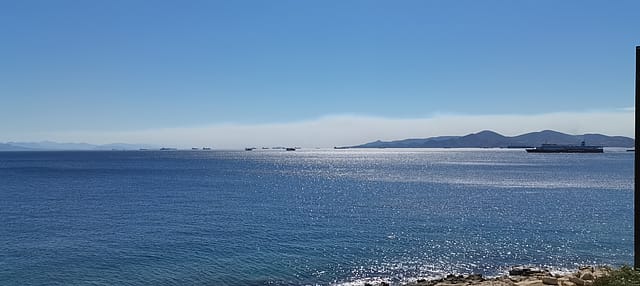
I asked Simon about a phenomenon I noticed on the coast road out from Piraeus. In the morning and evening, I’d noticed men of Indian-origin sitting on the rocks next to the sea. They seemed to arrive after sunset and leave soon after sunrise.
“It was worse [earlier in the summer]. Many of them have gotten ships or left,” he said. I asked were they homeless. “No, yes. Yes. Some men were in hotels for a week, or two, then agencies stopped paying [as contracts had finished] and they found outdoor accommodation.”
“That is what we call it,” Michalis added, “and we [Greek merchant mariners] try to help.”
I asked how and how many Indians are in “outdoor accommodation.”
“We just check in on them, and some cafes give free meals,” he explained, including the place we were having coffee in. “It’s the least we can do and numbers, less, like Simon said. I’d say…”
“A dozen,” Simon finishes his sentence.
I approached one man I’d noticed a couple of evenings down on the rocks near the Peiraikē bus stop. He was reluctant to talk, until I brought up Simon’s name. He smiled and said he was ashamed to be stuck in Greece and that during the day he walked or got food from Simon and Michalis.
He has been stranded since June and that he hopes to leave soon. Sleeping outdoors was “pleasant” but he has told his family that he is still in a hotel. He didn’t want to give me more than that and I respected his privacy.
At a local kiosk, Said from Iraq told me that his boss, a former mariner, gives “the Indian sailor” free bottles of water. He also revealed that there are more in the city of Piraeus and “probably lots more in other port cities and Athens.”
When I mentioned this to the diplomat, he said that pride, shame, “or a mixture of all kinds of personality” prevents many from reaching out.
‘We live in hope’
Michalis, as we parted, said that the recent Ukrainian attacks on shipping probably won’t escalate, but the “mess in the [Persian] Gulf means we live in hope that this can be fixed.”
Some fans linked to Olympiacos FC in Piraeus, who work or worked in shipping, have also lent a hand to stranded sailors. There are also local churches helping out. They have to as there is a gray area that many men have fallen into. They are officially “between contracts,” as Michalis told me, and agencies or companies have no obligation.
In sensible times, mariners benefited from being able to sign off from one ship and up to another. As a former colleague from Croatia, who sailed for 30 years, told me back in 2010, “you come into port, your contract is almost up and then a few beers later and you’ve an offer to fly to Hong Kong to pick up a new ride and you earn yourself enough to build another [house] floor.”
However, in 2026, this is no longer the case and the evidence is in the number of adult men, professional sailors from ratings to officers availing of “outdoor accommodation” by the Aegean Sea. The barely visible victims of Zelensky, Trump and Netanyahu will continue to wait for their boats to come in.