Sabrimala and the Political Economy of Pilgrimage
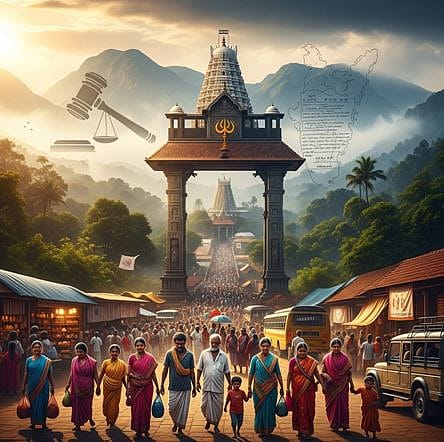
Much of the discussion around the Sabarimala verdict has revolved around faith versus feminism and tradition versus constitutional morality. However, a less explored—and possibly more troubling—viewpoint is that Sabarimala is more than just a holy destination; it is also an economic ecology. The verdict also had an impact on the political economy of pilgrimage, in addition to theology.
The Sabarimala Temple, which is overseen by the Travancore Devaswom Board, is at the center of the conflict. The Supreme Court of India ruled in 2018 that the exclusion of women aged 10 to 50 years was unconstitutional. The public argument centered on menstrual stigma and constitutional morality. What remained relatively unknown was how pilgrimage economies work—and how control over access determines authority, revenue, and political capital.
Pilgrimage as a way to build things
Sabarimala is one of the biggest places in the world where people go on pilgrimage every year. Before going up the hill temple, millions of people finish the 41-day vratham. During the pilgrimage season, a huge economic cycle takes place. This includes transportation services, local businesses, shops selling ritual items, temporary jobs, lodging networks, and state-run institutions.
The number and makeup of pilgrims may change when the rules for getting in change. Even if letting women in doesn't change the numbers much, it does change who the "ideal devotee" is. This, in turn, changes the stories we tell about tradition, legitimacy, and power.

Survival Instinct
22 May 2026 - Vol 04 | Issue 72
India navigates global economic turmoil with austerity and smart diplomacy
Control over ritual space means control over the power of institutions. Regulating pilgrimages is good for the Devaswom Board, the state government, and religious leaders. Entry restrictions are more than just spiritual rules; they are also rules that govern.
The State's Secular Paradox
The government of Kerala made sure that the 2018 decision was followed by sending police to make sure of it. This set up a basic paradox: the government runs temples in a secular republic but says it is neutral when it comes to religion.
Many Hindu temples in Kerala are run by statutory boards, which is different from completely private religious groups. This makes the difference between "religion" and "public authority" less clear. The Supreme Court didn't just change a custom; it also decided how a publicly funded institution should act. Because of this, the outcry wasn't just from religious people. It was also a response to the idea that holy power was becoming more centralized in the state. Defending "tradition" became a way for opposing parties to get voters to support them. Following through on the decision showed that the ruling establishment was serious about following the Constitution.
Because of this, the Sabarimala dispute has turned into a fight over who has the power to run the sacred capital: the courts, the executive branch, or religious leaders.
The Market for Devotion and Gender
Another issue that is not often talked about is how pilgrimage markets are set up based on gender. In the past, Sabarimala's ceremonial discipline was about men getting to know each other, living simply, and feeling like they were part of a group. The 41-day penance and hard travel made a group of men who were devoted to God. Women were not only kept out for religious reasons but also to keep a certain gendered pilgrimage atmosphere.
The opening entry could make that model less stable. Markets change when the population changes. As the number of devotees changes, so do the patterns of accommodation, the amenities, the ritual objects, and the security arrangements. Economic systems that are based on flows that favor men may not directly oppose change, but they may do so systemically.
This doesn't mean that the exclusion was meant to be bad for the economy from the start. Instead, conventions become part of material systems once they are institutionalized. Reform causes problems not only at the level of beliefs but also in the infrastructure.
Judicial Reform and Its Constraints
The Supreme Court's decision in 2018 was based on fairness and decency. It turned down the claim that Sabarimala believers are a separate religious group that is not subject to constitutional review. The Court did not, however, look closely at the temple administration's model of governance.
If temples are public institutions that the state regulates, then constitutional principles must be followed. If they are independent places of worship, the courts may be more likely to respect their decisions. Sabarimala illustrates an unresolved dichotomy in Indian secularism: selective state control versus assurances of non-interference.
Judges were careful when they sent the following case about bigger issues of religious freedom to a bigger bench. The Court seems to understand that the issue went beyond just one shrine. It talks about how religion is run in a postcolonial state, where the government often controls Hindu institutions but not always others.
Political Territory: Sacred Space
The protests that happened after the ruling weren't random; they were planned, controlled, and made worse on purpose. Sabarimala became a stage for the clash of different views of Kerala, including progressive, orthodox, majoritarian, and feminist.
But beneath the rhetoric was a more serious fight for control of the land. Sacred space fosters symbolic sovereignty. Whoever makes its rules has moral power over a society.
In this regard, Sabarimala acts as contentious civic land. Entry equals citizenship. Restriction is the process of creating boundaries. As a result, the ruling upended not only a ceremonial practice but also a whole ecosystem of power dynamics.
Instead of questioning whether tradition or equality should take precedence, perhaps the more radical question is, "How might religious organizations governed by public law be held democratically accountable?"
If the Travancore Devaswom Board is in charge of Sabarimala by law, should devotees, including women, be able to participate in the decision-making process? Should financial openness be given as much importance as changing rituals? Is it necessary to include gender-sensitive design in the planning of pilgrimage infrastructure?
The Sabarimala argument finally makes us look beyond the simple differences between faith and feminism and think about the basic processes that make sacred institutions work. When pilgrimage sites follow the law, problems with access always become problems of governance, openness, and democratic accountability. The 2018 decision changed not only a ritual boundary but also a well-established system of authority, money, and symbolic power. If Sabarimala is both a shrine and a public institution, the changes need to go beyond just letting people in. They also need to include fixing up the building. It's not just hard to choose who can go into the temple; it's also hard to choose who will shape its future.