The Big-Two Worry: How Trump and Xi will pay for the sins of war
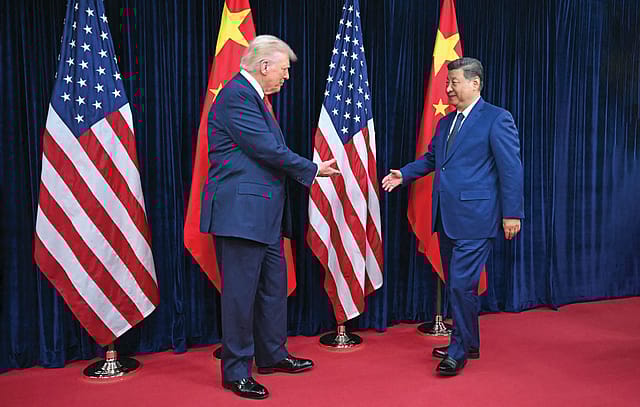
THE WORLD’S TWO most powerful leaders, US President Donald Trump and Chinese President Xi Jinping, are scheduled to meet in China at the end of March. The summit comes at a tense moment. The US-Israel military attack on Iran has long-term geopolitical consequences for both Washington and Beijing.
Trump has often spoken of his admiration for the Chinese leader. Xi is prepared to play the long game with America, which China hopes one day to replace as the world’s principal Great Power. But there are signs that the Xi-Trump bromance is cooling. After the Middle East conflict, the strategic loser could be China.
Beijing imports 12 million barrels of oil a day from various sources. Iran is among its biggest suppliers. Tehran supplied 90 per cent of its total crude oil output of 3.5 million barrels per day to China. That could change as the ground situation in post-Khamenei Iran evolves. The US attack on Venezuela had earlier deprived Beijing of another source of cheap crude oil paid for in yuan, not dollars. Most of Venezuela’s output of 900,000 barrels per day was shipped to China. That route is now closed.
The shadow boxing between the US and China is set to continue even as Trump and Xi seek a temporary rapprochement over trade and technology. China has key interests in the Middle East which are now in jeopardy. In 2021 it signed a $400 billion, 25-year investment deal with Iran at a ceremony in Beijing attended by China’s Foreign Minister Wang Yi and Iran’s Foreign Minister Mohammad Javad Zarif.

The Great Indian Male Makeover
03 Jul 2026 - Vol 05 | Issue 27
The craze for a perfect look is reshaping masculinity
China’s ambition of playing a larger role in the Middle East was on display when it choreographed a truce between Iran and Saudi Arabia. The signing of a security agreement in Beijing in 2023 between the two largest countries in the Middle East—with decades of Shia-Sunni hostility—was an indication of China’s objectives in the Middle East where, unlike the US, it has no military bases. What China does have across the Middle East and North Africa are extensive infrastructure projects under the Belt and Road Initiative (BRI). Those too could be affected if the US establishes control over Iran.
Both Beijing and Washington have hidden weaknesses. China faces a demographic nightmare as its average fertility rate plunges and the productivity of its ageing workforce falls. China’s $1.2 trillion annual trade surplus cloaks a structural problem: local overcapacity and shrinking domestic demand. As a result, Chinese exporters are forced to dump products across world markets at prices below cost. That has bankrupted several Chinese manufacturing companies.
Washington has its own set of problems. The economy is growing at a steady rate of 2.1 per cent annually but inflation is sticky and jobs scarce. President Trump’s favourability rating is its lowest ever at (-) 60 per cent. The Congressional midterm elections in November are an existential threat to Trump’s central agenda on immigration. Trump knows he is likely to lose the House of Representatives where Republicans have only a three-seat majority in the 435-seat House.
But Trump’s real worry is the Senate. The Democrats are making an audacious bid to turn the red state of Texas deep blue. That could put Trump’s 53-47 majority in the Senate at risk. Losing both the House and Senate would effectively hobble the Trump presidency two years before its scheduled end.
Rumbles of dissent too are growing against Xi’s economic management and hardline policies after he sacked dozens of military officers, including his senior most generals. When German Chancellor Friedrich Merz paid a state visit to China last month, he was greeted with dancing robots and an exhibition fight between two robot humanoids. To Merz’s visible mirth, one of the robots fell flat on its back even before the fight began.
The clock is ticking on Trump’s final term as president. Xi’s second term should have ended his presidency in 2022 but he bullied the Communist Party of China (CPC) to lift the constitutional limitation of two terms that had been in force in China since 1982. Xi’s third term ends in 2027. Getting a fourth term will make Xi the longest-serving Chinese president since Mao Zedong. For Trump there is no reprieve and no third term under the US Constitution. Confucian Xi, playing the long game, knows that.