Power Lines Instead of Borders: Can Electricity Succeed Where South Asian Diplomacy Has Failed?
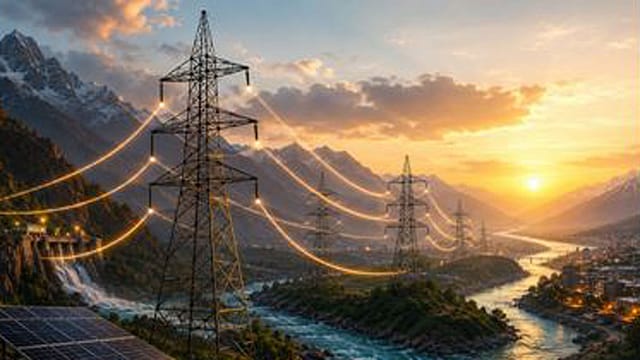
South Asia has been one of the least integrated regions in the world for decades . Political struggles have often overridden the economic rationale. Trade is constrained, regional institutions are static and borders remain obstacles rather than bridges. The quiet revolution doesn’t take place on highways or shipping lanes, but through transmission towers that crisscross the Himalayas and Gangetic plains. Electricity is beginning to cross borders more freely than politics.
India now imports hydro power from Bhutan, buys surplus power from Nepal, exports power to Bangladesh and is considering further energy cooperation in the BIMSTEC area. New transmission corridors promise to link countries that have previously disagreed on almost everything else. This growing electrical market is not just an energy story. This is geopolitics of a new kind. In the 21st century, power lines may be the new pipelines for influence.
Another form of regional integration
Despite its geography, South Asia has long had an economic failure. Trade within the region is only 5% of total trade, much lower than the share in Southeast Asia and Europe. Political enmity, especially between India and Pakistan, has rendered institutions such as SAARC largely toothless. But energy presents a different chance. Electricity is driven by economic necessity, unlike most political concerns. Nepal has a huge hydroelectric potential but a limited domestic demand The demand for power in Bangladesh is increasing but indigenous energy resources are limited. Bhutan has turned its hydropower exports into a major source of revenue for the country. Meanwhile India needs flexible electrical sources to support its rapidly growing renewable energy potential.

The Second Life of Sanskrit
10 Jul 2026 - Vol 05 | Issue 28
Being classical has become cool
The combined strengths form the framework for a regional electricity market. Unlike the oil resources and gas pipelines which underpinned traditional energy diplomacy, trade in electricity relies on interconnected grids that can coordinate supply and demand across national borders. In many ways it is the basis of dependence.
India’s quiet energy diplomacy
India’s maritime policy in the Indian Ocean and its contest with China have attracted much attention, especially in view of infrastructural projects like the India-Middle East-Europe Corridor. There has been little focus on diplomacy with electricity. In the last decade, New Delhi has been steadily expanding its cross-border transmission infrastructure. Bhutan is India’s oldest and most successful energy relationship, with the Bhutanese economy built around hydropower exports. After years of political hesitancy, Nepal has emerged as a major exporter of electricity to India during the monsoon season, while Bangladesh has become increasingly dependent on imports of Indian electricity to supplement domestic generation.
Such projects are often referred to as development partnerships. They’re also strategic investments. Electricity produces a long-run economic interdependence. Power trade is not underutilized like roads and ports but works on a regular basis. Revenues are generated on a continuous basis. Grid operators work together in real time. Governments have a vested interest in the energy security of each other. Power lines are difficult to weaponize unless you’re putting money into both sides. This results in a unique stabilizing influence.
The China Factor
You can’t talk about regional infrastructure without talking about China. Beijing’s Belt and Road Initiative has transformed Asia’s transport and energy infrastructure. Hydroelectric dams, transmission projects and investments in renewable energy are becoming more and more important elements of China’s geopolitical footprint. South Asia is no different. China has heavily invested in Nepal’s infrastructure, financed energy projects in Pakistan through the China-Pakistan Economic Corridor and grown its economic presence in Bangladesh and Sri Lanka.
India’s response has largely been on connectivity. But electricity allows a more subtle kind of competitiveness. India can position itself as South Asia’s energy market, and can develop ties that are not only of infrastructure financing, but of a continuous economic exchange. Trade in electricity is a permanent economic relationship, not a one-off construction project. Power does not reside in possession, but in trust.
Renewables add to the value of regional cooperation
The transition to renewable energy strengthens the case for cross-border electricity markets. Solar generation is highest during the day. Hydropower can respond rapidly to changes in demand. Wind production is dependent on the weather. There is no one country with the best combination of resources. A wider, interlinked grid allows countries to better manage variability. Bhutan’s hydropower can be used to boost India’s solar generation. The seasonal surplus in Nepal may help stabilize regional supplies. Bangladesh can get access to cleaner power without having to rush to build more fossil-fuel capacity. Regional integration is thus a means to ensure energy security. As countries set ambitious decarbonisation targets, integrated energy systems will become increasingly beneficial. The geopolitics of renewable energy is not only about the need for lithium or rare earths. It’s also about sharing electrons.
The missing link
Positive developments notwithstanding, the power market in South Asia is far from being fully integrated. Infrastructure decisions remain under political pressure. The transmission capacity is still limited. The regulatory structures differ significantly from country to country. Mechanisms for cross-border electricity exchange are still in infancy.
And more crucially, Pakistan, the second biggest economy in the region – is entirely absent from this emerging network. Further political normalization is needed to complete the spatial configuration of South Asia’s electrical market. But this should not diminish the achievements of the past. While diplomacy may have failed, energy cooperation often persists.
From geographies of scarcity to geographies of relation
For most of the twentieth century the dominant theme of energy geopolitics was scarcity. Countries were fighting over oil reserves, shipping lanes and pipelines. Renewable energy changes the equation. Sunlight can’t be monopolised. Rivers cross borders. Electricity does not travel in tankers but in transmission networks. The strategic advantage is now more about the control of connectivity than fuel. The countries capable of integrating regional power markets will be more resilient, cheaper and geopolitically impactful. India appears to grasp this transition. Its investment in cross-border transmission facilities are no longer limited to electricity exports. They think about the stability of exports.
SAARC and beyond
South Asian history is often characterized by failures of regional collaboration. SAARC was paralyzed by political differences. Trade agreements produced few results. The pace of connectivity initiatives was sluggish. Another is electricity. Political disagreements are not resolved by power grids, but they do provide real incentives to cooperate. They care more about consistency than rhetoric. They turn neighbors into business partners.
It is an opportunity for India, not to re-imagine regional leadership through military might or diplomatic symbolism, but through shared infrastructure which generates economic benefits. Instead of contentious frontiers, interconnected grids could shape the future of South Asian geopolitics. If oil was the driver of 20th century geopolitics, electricity is likely to be the driver of 21st century diplomacy. In South Asia, the next big strategic corridor may not be a highway or shipping lane. Maybe it’s only a power line, creeping quietly over a boundary.