Being Modern and Ancient: Retrieving Bharat from obsolete ideas of India
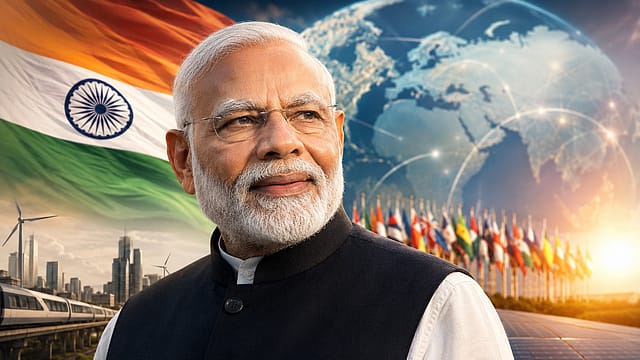
NARENDRA MODI HAS just completed 12 years in office, surpassing Jawaharlal Nehru’s record as India’s longest-serving, continuously elected prime minister. The comparison is instructive, because it was Nehru who first set the terms for what independent India’s education system would look like, terms Modi has spent over a decade trying to rewrite.
Nehru’s vision of India was shaped by Western modernity, and he sought to build the nation through an education system steeped in that ideal. But this created an unintended fracture: an ‘India’ that emerged through English-medium schooling in the cities, and a ‘Bharat’ that took shape through mother-tongue education in rural and semi-urban India.
Nehru’s India was modern, English-speaking and Western in inspiration. As Swami Vivekananda observed, a nation is built through its education, meaning the form and content of schooling shapes the character of the people it produces. The Nehruvian model of education, only lightly modified, persisted for decades.
A succession of committees carried that vision forward: the Radhakrishnan Commission (1948-49) on university education, the Mudaliar Commission (1952-53) on secondary education, the Durgabai Deshmukh National Committee on women’s education, the Kunzru Committee (1959-63), the Sampurnanand Committee on emotional integration, the Kothari Commission (1964-66), the National Policy on Education of 1968, the National Policy on Education of 1986,
the National Knowledge Commission (2005), and the Yashpal Committee (2009). Each, in its own way, reinforced the Nehruvian idea of India. Some did acknowledge the importance of regional languages and Indian traditions, but never as a central part of the system’s long-term vision.
Modi, through his years of social and political work, came to see the widening gulf between Bharat andIndia. HisresponsewastheEkBharat, Shreshtha Bharat initiative, conceived as part of a longer journey towards a Viksit Bharat by 2047. As prime minister, he set out to recover an “idea of Bharat” that had been overshadowed by the dominant Idea of India—one built on respect for India’s own culture, languages, roots and traditional knowledge. Recognising that this required rethinking education itself, his government introduced the National Education Policy of 2020 (NEP 2020), drafted after consultation with the public, scholars, educators, parents, youth and students, and now being implemented across the country’s education system.
NEP 2020 seeks to root education, teaching and pedagogy in Indian traditions and social values. It is reshaping how India is portrayed in textbooks. The textbooks being developed under the policy give space to folk knowledge that earlier curricula largely overlooked; Indian knowledge systems now sit alongside other forms of knowledge, rather than outside them. Modi has also placed sustained emphasis on decolonising India’s intellectual and institutional life and this is reflected in the Panch Pran where he speaks of freeing both governance and the mind from colonial habits of thought. The hope is that grounding knowledge in Indian roots will help build the confidence required to engage with the developed world on equal terms. His call to be “vocal for local” and to move from “local to global” has likewise begun to shape research and teaching.
This emerging idea of Bharat, in contrast to Nehru’s idea of India, draws on Indian thought, ways of seeing the self and the world, mother-tongue education, and the moral and spiritual resources of Indian society—elements largely absent from the pre-2014 educational landscape.
Influenced chiefly by Vivekananda and Aurobindo, Modi’s educational vision aims to retrieve a Bharat long obscured by the amnesia of colonial rule.
Modi envisages a generation equipped with both science and spirituality, tradition and modernity, technology and creativity— global citizens carrying what he calls a Bhartiya Manas, an Indian heart and mind. The education ministry has already implemented several key elements of NEP 2020. Once the policy is fully rolled out, its true impact on Indian society, culture and development will become clear.