Climate Change May Make Next Food Crisis Global
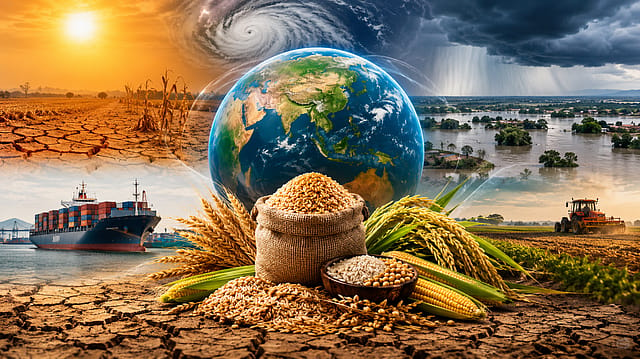
When we picture a food crisis, we picture a single failed harvest. A drought in one country, a flood in another, empty fields and rising prices somewhere we can point to on a map. That image is comforting because it is local; local problems feel solvable. It is also going out of date. One of the food shocks the world should worry about most will not begin on any one farm. It will begin upstream, in the machinery of ocean currents and jet streams that quietly links a paddy field in Punjab to a wheat belt in France and a maize crop in the American Midwest.
The modern food system rests on a single unspoken bet: that bad harvests stay local, not global. If Australia's wheat harvest falters, Canada's may help make up the gap. If India's monsoon weakens, other exporters can partly fill the gap. The planet has always offered a kind of insurance. This was because the odds of every major growing region failing in the same year looked remote. Correlated shocks are not new, and the world has lived through them before. What is changing is how likely and how costly they are becoming. The phenomenon has a name among agricultural economists: synchronous, or multiple, breadbasket failure.

Losing Memory
16 Oct 2026 - Vol 05 | Issue 42
The making of a medical and social emergency
Handful of Bread Baskets
Consider why the exposure is rising. Humanity has narrowed its plate to a dangerous degree. Maize, wheat and rice now dominate the world's food-energy supply. Together they provide close to half of the calories people eat. Their production sits in a handful of breadbaskets: the American Midwest, the Black Sea, western Europe, the Indo-Gangetic plain, the Southern Cone. These regions are not weather-independent in relation to one another.
The links between them are partly physical and partly a matter of a warming atmosphere. Planetary patterns such as the El Niño-Southern Oscillation, the Indian Ocean Dipole and the wandering jet stream can tilt several breadbaskets toward heat or drought in the same season. A hotter baseline, meanwhile, makes extreme heat more common everywhere at once. Parched soils feed back into higher temperatures. The mechanisms differ, but the result is the same. Failures the system once treated as independent are becoming more correlated.
Simultaneous Drought
The research has moved from theory to warning. One study of the world's major maize-producing regions put the chance of simultaneous drought across them this century at between 52 and 60 per cent, the figure rising with higher emissions. A June 2026 assessment by the Council on Strategic Risks and the Woodwell Climate Research Center reported figures that Indian readers should find particularly concerning. Measured against 2010, the report projects that by 2040 the risk of a given year's crop failing will roughly double for Indian wheat. For Indian rice it will rise as much as sixfold, and French and German staples see comparable jumps. History shows what happens when these losses occur simultaneously. When several breadbaskets failed at once, global production of a staple crop has fallen by as much as a fifth.
We do not have to wait for 2040 to see the mechanism at work. In 2022, drought struck Europe and the United States at the same time, floods drowned a third of Pakistan's rice crop, a brutal spring heatwave scorched Indian wheat, and war choked the Black Sea. The lesson was not that a single climate event caused all of it. It was that several shocks, some climatic and some not, arrived together in a system with almost no slack left. Prices spiked as a result.
This year offers a quieter version of the same story. Oxford Economics has argued that recurring heatwaves have now overtaken geopolitical conflict as the biggest driver of food inflation, a phenomenon it calls "climateflation," after record June temperatures wiped out an estimated nine million tonnes of European grain. Brazilian coffee growers, meanwhile, have warned that El Niño-related weather could cut their yields by 15 to 20 per cent. Neither event is a catastrophe on its own. Taken together, such shocks drain the buffer.
India’s Outlook
For India, this carries a double edge. As an importer, the country is exposed. It buys most of its edible oil abroad. Leans on foreign supply for pulses, so a shock in Indonesian palm oil or Canadian lentils lands directly on the Indian plate. As an exporter, India matters to everyone else. It is the world's largest rice exporter, historically around two-fifths of the global trade, so when a weak monsoon pushes New Delhi to curb rice or sugar exports to protect its own consumers, the tremor is felt from West Africa to the Gulf. India is simultaneously a potential casualty of the next food shock and a potential amplifier of it through its own trade policy.
This points to the real question. This is not about the weather. Climate change need not destroy every harvest to trigger a global food crisis. It only has to make several normally independent risks arrive together — in a system that has lost its spare capacity. The climate is the trigger. The architecture of the food system decides whether the trigger becomes a crisis.
The useful parallel is the financial crisis of 2008. It lies not in the mechanics but in the architecture. That collapse happened because a system optimised relentlessly for efficiency had quietly turned fragile. Everything was interconnected. Nobody held slack, and a shock meant to stay contained spread everywhere at once. The global food system has been built along the same lines: lean, concentrated, exquisitely efficient and therefore brittle. The insurance that geography once provided is thinning as the climate begins testing several breadbaskets together.
A Systemic Answer
If the problem is systemic, the answer has to be too. Three shifts matter most. The first is to treat climate monitoring as food-security infrastructure. The same science that forecasts an El Niño can flag correlated risk across breadbaskets months ahead, and the useful question it should answer is no longer only whether India faces a drought, but which other major producers are likely to be under stress in the same season. The second is to rebuild strategic redundancy: reserves sized for a synchronised bad year rather than an average one, sourcing that does not lean on a single supplier for a single crop, and regional cooperation on stockholding so that a neighbour's gap does not become a bidding war. The third is to make production itself more resilient. This means heat-tolerant and short-duration varieties, water security, and a serious push to widen the calorie base beyond three fragile staples. India's own hardy millets are among them.
There is a governance trap to avoid as well. An export ban is a rational move for any single government trying to feed its own people. When every government reaches for the same lever at once, the collective response turns a shortage into a panic. A food crisis born in the climate system will demand the one thing the world rarely manages. This is coordination in the middle of a shock, when every instinct says hoard.
The next serious food crisis, when it comes, will not announce itself as a climate story. It will arrive dressed as inflation, as a run on rice, as an export ban and a queue outside a ration shop. Its origin, though, will lie far upstream, in the warming oceans and shifting winds that have quietly stitched the world's granaries together. We can keep treating each failed harvest as a local misfortune. Or we can see the pattern for what it is, a systemic risk hiding in plain sight. Rebuild the buffers before the buffer is gone.
Divya Singh Rathore is a Senior Policy Professional. Abhishek Bharti is an Assistant Professor, University of Delhi.