China’s Kill Box- The Strait of Hormuz
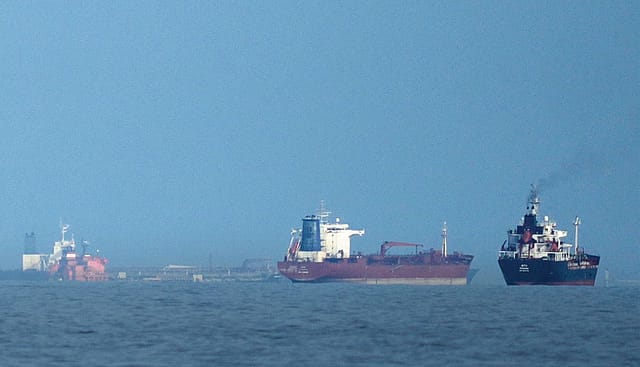
The conflicts in the Middle East have always been about land, religion, and resources. But this time in 2026, the current Iran war is perhaps about something even more fundamental: the future of money. As crude oil and LNG carrying super tankers sit idle in the Strait of Hormuz waiting for passage clearance, one thing is becoming terrifyingly clear. America's war against Iran may be moving away from the battlefield towards the halls of global finance, one transaction at a time.
The Strait of Hormuz is a waterway between the Persian Gulf and the Gulf of Oman and from there to the broader Arabian Sea in the Indian Ocean. On its north coast lies Iran and on its south coast lies the Musandam Peninsula which is shared by the UAE and Oman. The strait is about 167 km long, with a varying width from about 97 km to 39 km. The Persian Gulf is essentially a closed body of water. It has one exit. That exit is the Strait of Hormuz. During 2023–2025, 20% of the world's LNG and 25% of seaborne crude oil trade passed through the Strait annually.

The Health and Wellness Issue
25 Sep 2026 - Vol 05 | Issue 39
There's no alternative route, no bypass, no way to get crude oil or LNG out of the Persian Gulf without going through that strait. And the countries that produce the vast majority of that crude oil and LNG, Saudi Arabia, the UAE, Kuwait, Iraq, Qatar, and Bahrain, sit entirely within the Persian Gulf basin.
Qatar deserves particular mention in the context of gas carriers because Qatar is the world's largest exporter of LNG. The enormous LNG tankers that carry Qatari gas to customers in Europe, in Asia, in markets across the world all have to pass through the Strait of Hormuz every time they leave port.
Iranian fast boats, mines, shore-based anti-ship missiles, and naval forces have all been used at various points in current history to threaten, harass, or attack shipping in the Strait and the surrounding waters.
The Islamic Revolutionary Guard Corps Navy, which is separate from Iran's conventional navy and operates with a doctrine specifically oriented toward asymmetric and harassment tactics, has refined its capability to threaten Hormuz traffic over decades of study and exercise.
And only days ago, the United States Navy used very explicit terminology to describe the Strait of Hormuz. Not privately. Not in a classified memo buried in a Pentagon drawer. But in briefings delivered directly to energy industry leaders—the people who move the world’s oil, the people who decide what a barrel costs tomorrow morning. They were told: “The Strait of Hormuz is a kill box.”
For those unfamiliar with military terminology, a kill box is not just a dangerous area. It is a space where a defending force has positioned weapons, sensors, and overlapping fields of fire in every direction so that anything entering that space can be hit from all sides at once—with no safe way in and no safe way out.
Why was the Strait transformed into a Kill Box?
In 2018 the Shanghai International Energy Exchange launched what is called the Petro-yuan contract. For the first time in history, oil futures could be bought and sold in Chinese currency on a Chinese exchange. The Petro-yuan contract was never meant to replace the dollar overnight. It was meant to build the plumbing, the accounts, the settlement systems, the currency swap agreements, and the financial relationships that would make yuan oil payments possible when the moment came. China was not building a replacement system overnight. They were building a backup system quietly over years while nobody paid serious attention.
By 28 February 2026, when the Iran war started, that backup system was ready and the Strait of Hormuz became the most important piece of an emerging puzzle.
Iran’s leverage is geographic over Saudi oil, Emirati oil, Kuwaiti oil, and Qatari gas. All of it moves through the Strait. Iran does not need to close the Strait to have power over it. They just need to make the rules of passage uncertain. Because uncertainty in energy markets is almost as damaging as an actual blockade.
When shipping companies do not know if their tanker will make it safely through the Strait, insurance costs explode. When insurance costs explode, freight rates go up. When freight rates go up, oil prices go up. When oil prices go up, inflation follows. And all of this happens before a single additional missile is fired.
This is Iran’s real weapon. If you pay in yuan your passage is guaranteed. Continue paying in dollars and the uncertainty remains. It is one of the most elegant economic traps ever constructed in a war zone. And the evidence suggests it was not built in desperation. It was built deliberately, patiently, and in coordination with Beijing. China’s alternative payment system, CIPS — the Cross-Border Interbank Payment System — processed the equivalent of US $245 trillion in yuan-denominated transactions in 2025 alone. That is a 43% increase from the year before. The trap was set.
Since 28 February 2026, available figures show that by 15 March, 11.7 million barrels of Iranian crude oil have moved from Iranian ports to Chinese refineries. Not through the normal channels. Not through the international shipping system that runs on dollar payments and Western insurance but through a shadow fleet of ships and every single barrel of that crude oil was settled outside the US dollar. That is enough oil to power a country the size of France for over a month.
On 5 March, The International Group of 12 P&I (Protection & Indemnity) Clubs providing marine liability cover for 90% of the world’s ocean-going tonnage, withdrew their cover for shipping transiting through the Strait. That is the market responding to a structural shift in how risk is being calculated in the Strait of Hormuz. When the insurance system pulls back, the dollar-based shipping system begins to fracture. Because the existing petrodollar system does not just run on currency agreements. It runs on the assumption that the United States can guarantee safe passage for dollar-denominated oil shipments anywhere on earth. Before 28 February 2026, that guarantee was backed by the US Navy, aircraft carriers, and the Fifth Fleet stationed in Bahrain. But right now, that guarantee is being tested in real time.
According to Lloyd's List Intelligence, only 77 ships transited the Strait of Hormuz in the first half of March 2026. In the same period last year, 1,229 ships made that same passage. That is a 94% collapse in traffic. Over a thousand cargo vessels are sitting anchored outside the strait right now waiting. The insurance market has walked away. No shipping company on Earth will send crews through those waters at any price the global economy can currently sustain.
On 13 March, which also happened to be a Friday, the US announced that it had attacked the Kharg Island oil terminal. The island is 25 kilometres off the coast of Iran and 483 kilometres northwest of the Strait of Hormuz. Administered by the adjacent coastal Bushehr Province , Kharg Island provides a sea port for the export of up to 90% of Iran's oil products, as well as supplying storage for up to 30 million barrels (5 million cubic metres) of crude oil, and is therefore strategically important. The island lies close to several offshore oil fields, including the Faridun, Darius, Cyrus, and Ardeshir fields.
The US released declassified footage showing it destroyed over 90 military targets on the island. US CENTCOM obliterated every military asset on Kharg: mine storage, missile bunkers, air defences, radar, the runway, a garrison of 250 to 500. All levelled. However, all 55 crude storage tanks were left unmolested. TankerTrackers.com confirmed that 2.7 million barrels of crude oil were loaded on 16 March. The US restraint was arithmetic, not mercy. Striking the terminal would send Brent past $150 and punish US consumers more than Tehran.
Iran's response was to resume loading tankers at the Jask terminal on the Gulf of Oman, south of the strait, bypassing the entire choke point entirely for its own exports while keeping the choke point closed for everyone else. The military target was struck. The economic infrastructure adapted within 48 hours.
The very same day, in the middle of a shooting war with missiles flying, tankers burning, oil prices fluctuating between $100 to $ 105 a barrel, an Iranian spokesperson told CNN that the Strait of Hormuz would stay open, but there was a condition. Oil had to be paid for in yuan, not dollars. Yuan.
The room went quiet because anyone who understood what that meant knew this was not a military threat. This was something far more dangerous. This was a direct attack on the system that has kept the US powerful for the last 50 years. Not with a weapon, but with a currency. Iran did not fire this shot randomly. They knew exactly what they were doing. They picked the one choke point on earth where 25% of the world's crude oil and 20% of the world’s LNG passes through every single day. And they attached a condition to it. Pay in yuan or we decide what happens next.
Iran also announced that oil production on Kharg Island remained fully operational. This claim was equally calculated. While this fact told the world that Iranian crude remains available it also projected a macho resilience to 90 million Iranians whose internet has been shut down. But here is what makes this more dangerous than either side admits. Some of that oil loaded into super tankers is leaving. The Strait of Hormuz is not a blanket blockade. It is a permissioned chokepoint. And the negotiating position — the Strait opens when the currency changes — remained intact throughout. The war was supposed to force the Strait open. Instead, the Strait is being offered back to the world on Iran's terms, in China's currency, at the price of 52 years of petrodollar architecture
And Iran, by sitting on the choke point for 25% of global crude oil and 20% of global LNG and announcing that yuan is the passage condition, has just handed China the single most powerful accelerant for yuan internationalization that any Chinese policy document could have imagined.
On 15 March, a Pakistan flagged, Karachi-bound tanker named Aframax became the first non-Iranian vessel to transit with its AIS transponder broadcasting since the war began. Indian tankers received safe passage after three Jaishankar-Araghchi calls. Chinese-flagged tankers continue transiting under yuan settlement. The question war raised was precise: if Ali Khamenei’s Mosaic Doctrine gives 31 IRGC provincial commands full autonomy, how do they coordinate on who passes and who does not without contradicting each other? The answer is they do not coordinate. They do not need to.
The Ali Khamenei mosaic determined 31 commands do not communicate to each other about individual ships because they execute the same instructions. Hormuz is controlled by Hormozgan and Bushehr provincial commands, whose naval sub-units handle radio hails, AIS checks, and flag verification. The other 29 autonomous commands follow unquestioningly, while maintaining autonomy in their domains. Friendly nations notify Iran diplomatically. The vessel activates its AIS transponder as a visible clearance signal. The local Hormozgan naval unit grants radio passage.
US Defence Secretary, Pete Hegseth, is at a podium saying war is hell. Trump is on Truth Social saying the mission is succeeding. The oil market is pricing in a world where 25% of global supply requires yuan to access.
And somewhere in Beijing, in a room that does not hold press conferences and does not issue statements, a calculation that was made years before this war began is proving correct. China did not fire a single missile in this war. China does not need to. The war is doing China's work for it.