Can India’s cities endure yet another summer of extreme heat?
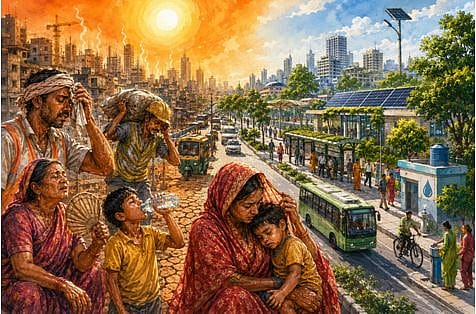
In Indian cities, extreme heat has ceased to be an isolated environmental problem and has become a chronic urban disaster. Every summer seems to be hotter than the last, with prolonged heat waves disrupting daily life, straining public infrastructure and posing risks to public health across the country. The fast-growing urban centres of India – from Delhi and Jaipur to Kolkata and Hyderabad – are heating up, laying bare their vulnerabilities.
This summer has been a stark reminder of how climate change is reshaping urban India. In northern and central India, temperatures above 45 degrees Celsius have become more frequent, but the humidity levels in coastal towns create far more hazardous conditions. The India Meteorological Department has warned time and again that climate change will make heatwaves more frequent, longer and intense. However, most Indian towns are not prepared for the social, economic and infrastructure impacts of excessive heat.

The Vanguard
21 Aug 2026 - Vol 05 | Issue 34
BJP Rearmed for 2029
Urbanization has greatly exacerbated the problem. India’s cities are growing fast, often without adequate planning or climate-sensitive infrastructure. The replacement of green spaces with concrete structures in a cyclical pattern has created “urban heat islands” where temperatures stay well above those of rural areas surrounding them. By day, roads, buildings, glass facades and asphalt absorb heat and store it, so that densely populated urban areas are uncomfortably hot even at night.
Millions of Indians are facing deadly, not just uncomfortable, heat. Heatwaves have serious public health consequences, particularly for the elderly, children, outdoor workers and economically vulnerable populations. Long periods of excessive heat significantly raise rates of heat stroke, dehydration, respiratory diseases and cardiovascular problems. Street vendors, construction workers, sanitation workers, delivery workers, traffic cops and other informal workers are sometimes exposed to extreme heat for hours without any proper protection or cooling facilities.
The economic implications are equally troubling. Heat stress affects labor productivity, particularly in sectors that depend on outdoor work. Projections for the world suggest that India may experience large economic losses over the decades to come from productivity reductions driven by rising temperatures. Roads are closed, traffic is disrupted and the demand for electricity jumps as people and businesses turn on their air conditioning and other cooling devices. India's power system is already feeling the strain during the peak summer months. Middle-class households have turned to air conditioning more and more, helping to push demand for electricity to record levels in a number of states. More cooling access could offer some temporary relief, but also adds to concerns about energy security and pollution. Coal-fired power plants are still the main source of electricity, so higher demand for cooling could increase reliance on fossil fuels just as India is trying to move to cleaner energy sources.
But at the same time, access to cooling is staggeringly uneven. Informal settlements in large parts of urban India are still overcrowded, poorly ventilated, have tin roofs and limited electricity connections. In low-income neighborhoods, surviving extreme heat often means living in hazardous conditions with few inexpensive cooling options. That growing “cooling inequality” is one sign of how climate change is hitting the poor harder than anyone else. Water scarcity exacerbates urban heat stress. In extreme summers, cities often see increased demand for water and declining levels of groundwater and stressed reservoirs. Bengaluru, Chennai and other cities have already faced severe water shortages in recent years.
Urban planning remains one of the weakest links in India's climate response chain. Most cities continue to place a higher priority on short-term infrastructure development than on long-term climate resilience. Many urban centers are losing their green cover, wetlands are vanishing and natural drainage systems are being encroached upon. This kind of ecological deterioration not only leads to monsoon flooding but also raises summer heat.
The urban heat dilemma in India ties into broader environmental justice issues. Those who contribute least to climate change are often the most vulnerable to its impacts. Informal settlements with poor access to healthcare, energy, water and housing infrastructure are particularly susceptible to excessive heat. Climate threats could worsen existing social and economic inequality in cities unless inclusive adaptation plans are put in place. Technology can help manage urban heat. Cities can adapt better through climate modeling, AI-based weather forecasts, cool roofing materials, heat-resilient building designs, and smart urban planning systems. Increasing the number of public cooling centers, expanding urban tree cover, encouraging the use of reflecting construction materials, and improving public transportation could all help to alleviate urban heat stress.
But technological fixes won’t be enough. India's cities need a fresh look at urban development. Future urban planning, housing policy, infrastructure design and public health management need to prioritise climate resilience. Heatwaves should not be considered episodic seasonal phenomena, but instead should be understood as long-term urban hazards requiring ongoing institutional response.
The question is not just whether India’s cities will survive another summer of extreme heat. The bigger worry is whether urban India can adapt fast enough to a climate reality that’s already changing the way people live, work, commute and survive. The economic, social and environmental cost of inaction will only increase as the temperature rises.
India’s urban future will be increasingly determined by how well its cities cope with climate stress. Building heat-resilient cities is not an environmental goal anymore, but it will be critical for economic stability, public health, and social sustainability in the coming decades.
How well cities in India deal with climate stress will increasingly determine its urban destiny. Creating heat-resilient cities is no longer simply an environmental goal. Over the coming decades, it will be critical to economic stability, public health and social sustainability. If urgent investments are not made in climate-sensitive infrastructure, sustainable housing, public cooling systems and inclusive urban design, extreme heat could turn Indian cities into sites of growing inequality, declining productivity and recurrent public health problems.