Bondage on Display: The cost of human trafficking is borne by humanity itself
SOMEWHERE, AS YOU read this, a human being is being sold. Not metaphorically. Not historically. Not in a sepia photograph from a more savage century. Today. Now.
A woman is promised work and disappears. A child exchanges a classroom for labour. A girl is transported across states and married to a stranger. A mother works beneath a debt designed never to be repaid. And we continue with our day. Perhaps that is the most frightening part.
I first met Jigyasa Mishra in Mumbai. She had organised a conversation on queer literature and queer lives, with me and another queer author. What I remember most is her energy: childlike, an innocence surviving everything her journalism had made her see.
She was open. Hungry. Curious. Unmistakably non-judgmental. That is Jigyasa for you. Which makes Bearing Witness, her exhibition opening July 30 at Kalamkar, Bikaner House (in Delhi), arresting. Here is a woman with wonder intact who has spent six years looking at things that should destroy wonder. Human trafficking. Bonded labour. Forced marriage. Exploitation.
Originally from Bihar and based in Lucknow, Jigyasa is an award-winning independent journalist, multimedia storyteller and artist. She has reported across six Indian states. Her work has appeared in Al Jazeera, NPR, Vogue India and the People’s Archive of Rural India. She was mentored by P Sainath.
But résumés feel inadequate here. She reported through pregnancy. Later, she travelled with her infant to villages and rescue sites, going where suffering was real but attention fleeting. “I have always felt these were very important stories that remain underreported,” she says. “Some were never approved by editors, so I am telling them through art.”
There is something devastating in that sentence. Some stories were never approved.
But suffering does not cease because an editor says no. A trafficked woman does not become free because her story misses a news cycle. Pain does not require publication to be true. And so Jigyasa paints.
Among the works in Bearing Witness are nine black-and-white ink paintings inspired by a young woman from Birbhum, West Bengal. Promised employment, she was trafficked into bonded labour inside a Gurugram apartment. She was rescued only last month.
She told Jigyasa: “I was not even fed one-fourth of what their pet dog was fed.”
Read that again. A dog was fed. A woman was not.
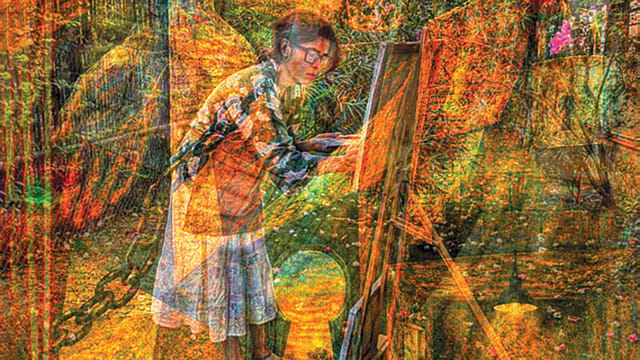
The exhibition turns ground reportage into photographs, paintings and immersive installations. Footprints travel across cloth. Chains suspend ordinary objects in darkness. Baskets lie broken. Mud clings. A schoolbag hangs where childhood seems to have been arrested. This is journalism given another body.
We speak of trafficking as though it happens to other people, in other places, behind other doors. We say “vulnerable communities”, tidy language distancing us from untidy horror. But every trafficked person is somebody’s child. Somebody’s sibling. Somebody’s neighbour. Somebody who laughed too loudly, hated a vegetable, loved a song, dreamed of a different tomorrow.
Somebody like us.
We could be trafficked. We could be the parent waiting for a child who does not return. The sibling searching. The neighbour who noticed something and said nothing. That last possibility should haunt us.
Human trafficking extracts a price from its victim, but its moral cost is borne by all humanity. Each time a person is bought, sold, starved, chained or stripped of agency, our civilisation is diminished.
We cannot become numb. Bearing Witness asks us to do something difficult. It asks us to stay. From July 30 to August 2, go to Bikaner House. Stand before Jigyasa Mishra’s work. Follow the footprints. Look at the chains. Allow discomfort to do its work. Go because some stories cannot end with publication. Go because another person’s dignity concerns you. Go because silence, too, leaves footprints. And history is always watching where we chose to stand.