BRICS Expansion and the Politics of Alternative Global Order
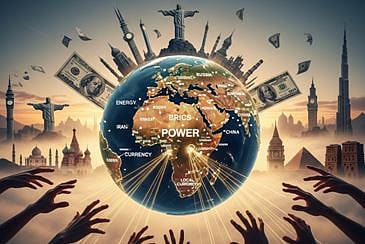
The BRICS group, which started out with Brazil, Russia, India, China, and South Africa, announced its growth at the 2023 BRICS Summit. This was seen as a big step toward changing how the world is run. The fact that Saudi Arabia, Iran, the United Arab Emirates, Egypt, and Ethiopia all took part showed that they wanted more than just economic cooperation. It hinted at the creation of a new world order that would challenge, if not replace, the Western-led international system.
The story of BRICS's growth, on the other hand, isn't just about building institutions. It's about the politics of not being happy, the search for freedom, and the problems with making a strong group in a world that is very unequal and broken up.
Energy, Money, and Power
Joining BRICS is as important to many of the new members as it is to their plans. It shows a willingness to join a platform that promises to give the Global South a stronger voice, even if the benefits aren't clear right now. BRICS is a political statement that says the current world order is no longer good enough.
The Identity Project
11 Sep 2026 - Vol 05 | Issue 37
Amit Shah leads the mission for a national demographic correction
Energy geopolitics is one of the most important areas that will be affected by the growth of BRICS. The group now controls a large part of the world's energy resources thanks to major oil producers like Saudi Arabia and the UAE, as well as countries with a lot of energy like Iran. This has led to talks about how the BRICS could change the way the world buys and sells energy and make people less dependent on banks controlled by the West.
The US Dollar is a very important part of this topic. The dollar has been the main currency for international trade and banking for decades, which has given the US a lot of structural power. BRICS has been looking into other options, like trading in local currencies and the idea of a single currency. These ideas are still in their early stages, but they show a bigger goal to get rid of the dollar in the global economy.
But there are many problems on the way to financial freedom. Because the BRICS countries have different political priorities and economies, it is hard for them to work together. Also, the global financial system is very well-established, and any changes to it will require ongoing cooperation and new ways of doing things.
China's Shadow, India's Balancing Act
The rise of BRICS makes people worry about how power works within the group, especially China's role. China is the biggest economy in the group, so it has a lot of political and economic power. Its vision of a multipolar world often fits with its main strategic goals, which include projects like the Belt and Road. This puts India in a tough spot. India wants to improve global governance, but it is worried about China's power in BRICS. Adding new members to the group could weaken China's power, or it could strengthen it by giving it more partners.
This difference makes it harder to make decisions and less likely that people will work together. BRICS doesn't have a clear institutional framework or common security commitments like NATO does. So, its effectiveness depends on how well its members can find common ground on important issues. This gets harder as the group gets bigger.
Also, geopolitical rivalries between members can make it harder for them to work together. For example, the ongoing border disputes between India and China show how weak BRICS cooperation is. In the same way, different views on global wars and trade policies can cause problems within the organization.
An alternative or an addition?
The essential question remains: does BRICS represent a legitimate alternative to the current global framework, or is it simply an extension of it?
BRICS doesn't seem to be a replacement for Western institutions right now; it seems more like a parallel platform. The New Development Bank and other projects like it give people more choices than traditional banks, but they aren't as big or strong. Just like that, efforts to boost trade in local currencies haven't had a big impact on global money flows.
The BRICS are not tearing down the current system; they are helping it change slowly. It shows that the world is becoming more multipolar, which means that power is spread out among many centers instead of being concentrated in one group. In this way, BRICS is more of a way to talk about this change than an end point.
The politics of what could happen
The importance of BRICS expansion is not in what it does but in what it stands for. It represents the politics of possibility, which says that different kinds of global government are both needed and possible.
BRICS gives countries in the Global South a place to voice their concerns and question existing power structures. It sets up a place for experimentation, where new ways of working together and designing institutions can be tried out. It also stresses how hard and inconsistent these kinds of projects can be.
The future of BRICS will depend on how well it can deal with these problems. Can it do more than just make big claims and actually deliver? Can it keep a single vision while also balancing the needs of its many members? And, most importantly, does it offer a truly open and fair model for global governance?
Conclusion
The growth of the BRICS is a turning point in world politics. It shows that the international order is becoming more pluralistic and contested, with new actors and ideas challenging old norms. But setting up a new global order is not easy or certain. It will take more than just new ideas in institutions; it will also take political will, trust, and long-term cooperation between different groups.
In this way, BRICS is still a work in progress, not a finished project. It shows that the world is changing and looking for new ways to organize power in a world that is more complicated and connected.