Blackouts in a Renewable Future: Are We Ready?
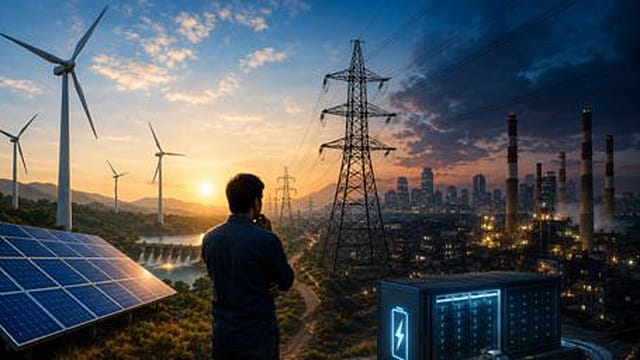
India’s story of energy transition is often told as a story of unstoppable progress. Solar parks dot deserts, beaches are lined with wind turbines, and officials celebrate every new milestone for renewable energy. The country has become one of the fastest growing clean energy markets in the world with ambitious plans to overhaul the electricity industry and wean itself off fossil fuels. But there’s a much less talked about problem under the optimism: what happens when the sun doesn’t shine, when the wind doesn’t blow, and when electricity use keeps growing?
That’s important because clean electricity is only part of the future of energy. It’s also important that power is available every second of every day. Blackouts remain a relevant issue in modern energy systems, as demonstrated by recent experiences across the world, especially when systems are challenged to cope with changing patterns of generation and consumption. As India heads towards a renewable future, it has to confront an inconvenient truth. Building renewable capacity is only the first step. Building a resilient grid that can handle that capacity is a much harder problem. The problem is in the nature of renewable energy. Solar and wind are weather-dependent. Coal or natural gas plants can be dispatched on demand. Solar production drops sharply after sunset and wind generation can change suddenly. This variation is not a flaw of renewable energy but a characteristic of it, which demands meticulous planning and flexibility of the system.

Zeroing In on ECI
09 Oct 2026 - Vol 05 | Issue 41
Constitutional legitimacy versus political opportunism
The problem becomes clearer in the time of high demand. India’s power consumption has reached fresh highs in back-to-back summers as the country faces intensifying heatwaves. Air conditioners, cooling systems, water pumps and industrial facilities place undue stress on the grid. Demand is often highest in the evening when solar power drops off and supply and demand are mismatched. Such a phenomenon, commonly referred to as the “duck curve”, has already raised broad concerns in several countries. The high solar generation during the day leads to less reliance on conventional power sources. But as the sun goes down , power use remains high and solar production drops quickly . Then grid operators have to quickly bring up other sources of power. If backup capacity is not enough, power outages become more likely.
International experience gives great insights. California, which leads the world in renewable energy, has had issues with grid reliability during times of extreme heat. Europe faces similar challenges of reconciling high decarbonisation targets with energy security concerns. The massive power outages affecting parts of Europe due to geopolitical shocks showed how fragile modern energy systems can become if resilience is overlooked. The dilemma is the same but the situation in India is unique. The capacity for renewable energy is expanding quickly, but the infrastructure that supports it is lagging behind. Transmission is still one of the biggest obstacles. Renewable energy projects are often sited in remote areas relative to the main centres of consumption. For instance, solar systems in Rajasthan and Gujarat have to supply power to cities and industries hundreds of kilometers away. Renewable energy can be produced, but without sufficient transmission capacity it cannot be used effectively.
The country has heavily invested in projects such as the Green Energy Corridor to upgrade transmission networks and allow renewable integration. These are major investments, but demand continues to grow quickly. But building generation capacity without building grid improvements creates vulnerabilities that may become more apparent in years to come. Another important part of the puzzle is energy storage. The ability to store the electricity generated during periods of surplus from renewable sources and deliver it at times of peak demand could dramatically change the reliability equation. Battery technology has improved dramatically in the last decade and prices have come down significantly. However, large scale storage deployment is still limited compared to future requirements. Another promising alternative is pumped hydro storage. India has vast potential for such projects that store energy by pumping water between reservoirs at different heights. But environmental, legal and financial issues often arise during project development. Renewable-rich networks often still depend heavily on conventional power units for balancing services due to insufficient storage capacity. This leads to an ironic situation in which coal is needed, not because of a shortage of renewable energy, but because of a lack of maturity of flexible infrastructure.
The importance of natural gas is also the subject of increasing debate. Gas is a fossil fuel, but it can provide the flexibility needed to complement intermittent renewable energy. Gas-fired power plants have been used as transition technologies by several countries in constructing renewable energy and storage systems. India faces big decisions on how to embed such technology in its long-term decarbonisation goal. Besides infrastructure, climate change generates new threats to power systems. Extreme weather events are becoming more frequent and more severe. Heatwaves increase electricity consumption and lead to reduced efficiency in transmission systems and thermal power plants. Floods can also damage substations and transmission lines. Cyclones threaten coastal energy infrastructure.
That is, the same climate problem driving the energy transition is threatening power infrastructure. It raises an important policy question. Is energy planning simply about building out renewable capacity, or is it also about resilience and reliability? The answer is becoming more clear. Megawatts alone are not energy security. The question is whether there is energy there when households, hospitals, factories and key services most need it. The Indian government has shown extraordinary ambition in ramping up renewable energy deployment. The country is on track to become one of the most important success stories of the global clean energy revolution. Ultimately, success will be measured not only by the amount of installed capacity, but also by the performance of the system.Energy transitions are not driven by policy statements or investment figures, they are felt by consumers. They see them as the simple expectation that the lights will come on when you flip the switch.
India’s vision of a sustainable future is not only essential but also achievable. But future blackouts can be prevented only if investments are made in transmission networks, energy storage, grid modernisation, forecasting technology and climate resilience on a scale comparable to the spending in generation. The era of energy transformation is moving forward. The question is no longer if renewable energy can replace fossil fuels. But the question is whether power systems can change fast enough to allow the replacement, without sacrificing reliability. Maybe the real challenge of the twenty-first century is not the mass generation of clean electricity. It might be making sure that clean electricity is always there when we want it. This is the difference between an energy system and an energy transition. This is a distinction India cannot afford to overlook.