Beyond Solar Panels: Why Data is Becoming the New Fuel
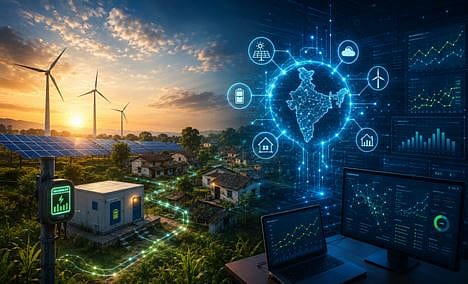
Any conversation about India’s renewable energy transition usually starts with gigawatts. It is mostly news about solar parks, wind farms, transmission lines and bigger targets. But the next energy revolution in the country may be defined by something far less visible: data, not the number of solar panels installed. The emergence of AI-powered renewable energy systems in places like Santavri, hints at what’s to come. Physical backbone of clean energy? Solar panels. But the increasingly decisive factor in whether renewable energy is efficient, reliable and economically viable is data drawn from smart meters, weather forecasts, battery sensors, electrical consumption patterns and machine-learning algorithms. India’s energy revolution enters a new phase where intelligence, not infrastructure, will determine success. The debate on renewable energy has been about generation for years. Governments measured progress in terms of installed capacity. Record-breaking auctions cheered investors. Policymakers have announced ambitious targets, including 500 GW of non-fossil-fuel generating capacity by 2030. But the most difficult problem has never been to generate renewable energy. It is possible.
Unlike coal-fired power facilities, solar and wind generation fluctuate with the natural environment. Clouds can cut sun output down in minutes. The speeds of the wind are random. At the same time, electricity demand varies hour by hour, depending on the weather, farming, factories and homes. The lack of adequate management systems causes this imbalance to become unstable, forcing grid operators to turn to conventional power sources as backup. This is where data is important. Each smart meter in a home records consumption patterns. Each weather station records solar irradiance, cloud cover, humidity and wind speed. Battery management systems constantly monitor charging cycles, temperature and storage efficiency. Sensors placed on transformers and distribution lines sense voltage changes and health of the equipment. These data sets are worth it individually. When processed with artificial intelligence, they become the operating system of a modern energy network. An artificial intelligence platform can predict electricity consumption hours or even days ahead of time. It can predict when clouds will block solar power, determine the best time to charge batteries, spot problems before equipment fails, and distribute electricity more evenly across a microgrid. Energy systems shift from reacting to problems to anticipating problems . The result is a much smarter, cleaner renewable energy grid. This is a particularly important change for rural India. Villages had unreliable power for decades, frequent outages, and they used diesel generators during power outages. Renewable energy is generated intermittently, which is often seen as a supplementary rather than reliable primary option. Artificial intelligence shifts the calculation. In villages testing AI-powered renewable systems, algorithms constantly monitor electricity consumption by houses, irrigation pumps, schools and small businesses. The system does not distribute power evenly, but rather dynamically points it to where it is most needed. Maximize solar production to charge batteries and strategically discharge these batteries in the evening hours. Maintenance personnel are given advance notice of problems, not after failures occur.

Zeroing In on ECI
09 Oct 2026 - Vol 05 | Issue 41
Constitutional legitimacy versus political opportunism
The technology transforms decentralized renewable energy from a fixed infrastructure project into an adaptable ecology. The economic implications of this transition are equally significant. India loses billions of rupees every year due to transmission and distribution losses. Sometimes equipment faults are not found until they interrupt service. Wrong demand estimation and poor asset utilization are often the problems faced by rural utilities. All of these inefficiencies are solved by data-driven energy management. Predictive maintenance cuts the cost of repair. AI improves electricity buying demand forecasting Smart distribution reduces losses and extends the life of equipment. Utilities are taking a more proactive stance and spending fewer dollars on emergency response. For the customer, this means a more stable electricity supply, lower operating costs and a better integration of renewable energies in everyday life. Agriculture will be a huge beneficiary. Solar-powered irrigation pumps have become an essential component of India’s clean energy agenda, especially in schemes such as PM-KUSUM. Nevertheless, many pumps continue to operate inefficiently because they are not integrated with broader energy management systems. An AI-enabled platform can recommend when to irrigate based on weather forecasts, groundwater levels and availability of electricity. It can save energy, make the best use of the battery and prevent unnecessary pumping. Farmers receive not only electricity but also pragmatic advice that improves productivity and saves resources. Renewable energy is no longer just a source of power, but a platform for more intelligent rural development. The same logic applies to India’s fast growing electric mobility sector. Balancing electricity demand and renewable generation is required to charge electric vehicles. AI can predict how long a charge will take, relieving pressure on local grids and increasing the use of solar power. As EVs become more prevalent, effective energy management moves from optional to essential. The effects reach further than efficiency.
Energy security has been traditionally understood as the assurance of coal supply, oil imports or additional generating capacity. But in a more and more renewable economy, energy security is also a matter of how well information flows through the electricity system. Countries that are investing in AI-powered grids recognize that digital infrastructure is becoming as important as physical infrastructure. Now, in addition to solar panels and wind turbines, sensors, communication networks, cloud computing and cybersecurity are also strategic assets. India’s digital public infrastructure has a distinct advantage here. The country has demonstrated its ability to construct large-scale digital systems with platforms for payments, identity and governance. Applying similar concepts to energy management could lead to an integrated ecosystem in which distributed renewables assets communicate seamlessly with utilities, regulators and customers. However, this change raises some tough considerations. Who owns the massive quantities of energy data generated every day? What protections need to be put in place for consumers’ privacy? What cybersecurity is required to defend AI-driven energy systems from cyberattacks? Can small rural utilities afford advanced digital infrastructure? Will algorithmic decision-making remain transparent and accountable?
Ignoring these questions risks new vulnerabilities emerging as renewable deployment increases. In addition, systemic governance problems cannot be resolved by technology alone. Smart algorithms cannot compensate for inefficient distribution businesses, poor regulatory frameworks, or poor infrastructure development. Data is a powerful enabler, not a replacement for institutional reform. There is also a danger of creating a digital divide as part of the energy transition. Richer areas may be able to move quickly to AI-enabled power grids, while poorer areas are stuck with older infrastructure. Targeted public investment, capacity development and supportive legislation will be required to achieve equal access to intelligent energy systems. So the story that is happening in places such as Santavri is more than a local technical experiment. It's a bigger shift in how we think about energy. Coal, oil and natural gas generated industrial economies by making electricity. Renewable energy transformed the equation and sunshine and wind became the dominant resources. The next disruption has already arrived. The value of renewable energy is increasingly a function not just of how much is produced, but of how well it is managed.
In this new environment data is the invisible fuel that keeps renewable energy systems running smoothly. India has rightly been lauded for the magnitude of its renewable energy targets. But the next chapter will not only be written in solar parks across the deserts or wind turbines along the coasts. It will be written in streams of real-time data flowing through sensors, algorithms and intelligent networks discreetly choreographing each unit of electricity. The future of renewable energy won’t be built on silicon panels alone. It will be on silicon chips. And data may be India’s most valuable energy resource in the future.