Beyond Oil: India’s overlooked energy vulnerability in LPG and fertilizers
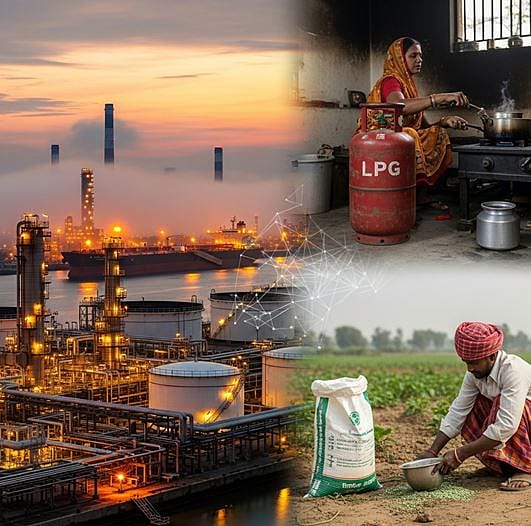
Discussions about energy in India usually go the same way. As oil prices go up and tensions rise in West Asia, the focus shifts to crude imports, strategic reserves, and the rising cost of gasoline. This concentration makes sense because India gets more than 85% of its crude oil from other countries, making it very vulnerable to shocks around the world.
But this focus on oil hides a more subtle, everyday weakness. India's energy security problem goes beyond gas stations and refineries. It reaches into kitchens and farms, where millions of homes and farmers depend on liquefied petroleum gas (LPG) cylinders and fertilizer. Oil is India's main energy concern, but LPG and fertilizer are two things it doesn't see.
The System of Daily Energy
India has come a long way in the last ten years toward making clean cooking fuel more widely available. The Pradhan Mantri Ujjwala Yojana (PMUY) has connected millions of homes, mostly in rural and low-income areas, to LPG. People have said that the switch from biomass to LPG is both a public health success and a sign of progress.
But this change has led to a new kind of dependence. India now gets a lot of its LPG from other countries. These imports come in on the same sea routes that carry crude oil, which are becoming more and more vulnerable to political instability. LPG is not just an economic product; it is something people need every day. Any interruption in the supply of LPG affects cooking, daily life, and quality of life, as well as prices.

Travel Issue 2026
15 May 2026 - Vol 04 | Issue 71
The Cultural Traveller
Cost versus Access
The LPG story also points out a deeper problem with India's energy policy: the gap between access and cost. Connections have grown quickly, but consumption has not been steady. Many families, especially those with the lowest incomes, have switched to traditional fuels like firewood and dung because LPG prices have gone up in recent years.
This isn't just a money issue. It shows that there is a problem with the way energy access is defined. People think that making a connection is a success, but making sure that people can use it consistently and cheaply is often forgotten.
India's reliance on LPG is more of a policy design problem than a supply problem in this sense. A system that relies on imported fuel must also take into account how prices change and how that affects society.
Fertilizers: The Energy Connection You Can't See
LPG shows how vulnerable India's energy supply is at the household level, while fertilizers show how vulnerable it is in agriculture. The fertilizer business in India is very closely connected to energy markets, especially natural gas. Gas is a very important raw material for making urea, which is India's most popular fertilizer. Imports fill the gap when domestic gas supplies aren't enough.
This leads to a tiered dependence. Gas is either brought in directly or mixed into fertilizers that are brought in. In every situation, global energy markets—and by extension, shipping routes—are very important.
The effects are big. Changes in the price of gas around the world and problems in the supply chain can both affect the availability and price of fertilizer. Because fertilizers are so important for farming, these effects can spread through food systems, lowering crop yields, farmer incomes, and, eventually, food prices.
The geopolitics of energy we use every day
LPG and fertilizers are especially vulnerable when there is political unrest around the world. Shipping routes can be affected by conflicts in West Asia, problems in the Red Sea, or instability at important maritime chokepoints. These things can also raise insurance costs and make supplies take longer to get to their destinations. These problems may not always make the news, but they have a big effect on markets at home.
Strategic stockpiles and pricing systems often help oil companies deal with these kinds of shocks. The buffers for LPG and fertilizers aren't as big. This imbalance shows that India's energy security system is seriously lacking. Oil has been securitized, or seen as a strategic resource that needs long-term planning. Other energy-related goods, on the other hand, are still subject to normal policy.
The final result is a hierarchy of attention, where some vulnerabilities are expected and dealt with, while others are still reactive.
The Drawbacks of Diversification
India has tried to make its energy supply less vulnerable by getting it from more than one source. This method has been most noticeable in crude oil imports, where sourcing has grown beyond traditional partners. But diversification has its limits
LPG and fertilizer supply chains are still connected to global markets, which are also connected to each other. Changing suppliers does not protect against price changes around the world or dangers at sea. In many cases, it just shifts dependence around.
Also, the logistics of transportation haven't changed much. Imports from West Asia, Africa, or anywhere else depend on marine routes that go through dangerous chokepoints. Diversification solves some of the problem, but not the main part of it.
Energy security is a whole system, not just one part of it
The way we think about energy security is one of the reasons why LPG and fertilizers are still blind spots. Policy frameworks frequently address energy in sectoral categories—oil, gas, electricity, and renewables—each with distinct objectives and priorities. But in reality, these industries are connected.
LPG links energy and the health of your home. Fertilizers link food security, energy, and farming. Problems in one area can quickly move to another.
In conclusion, seeing the blind spots.
People often talk about India's energy revolution as a story of ambition, with goals for renewable energy, global leadership, and technological progress. These are important stories, but they shouldn't take the place of the basics.
Conclusion
Everyday use, like in kitchens, farms, and local economies, is where energy security starts. This is where weaknesses are most clear and have the biggest effects.Recognizing LPG and fertilizers as essential to energy security is a move toward a better understanding of the issue as a whole.
The strength of an energy system is not only based on how much it produces or imports, but also on how well it supports the lives of the people who depend on it. And that means looking beyond oil to the other important blind spots. A better way to think about energy security would be as a system that includes production, transportation, cost, and end-use across all industries. This means working together across ministries, integrating policies, and being more aware of risk.