Ads That Made Us Smile & Became Part of Our Lives
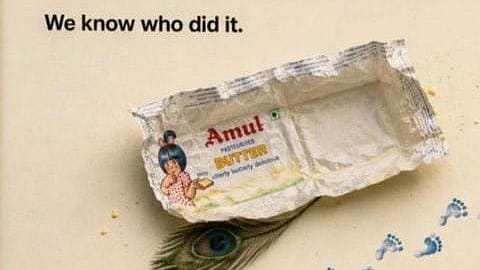
For over 60 years now, Amul ads — mostly billboards — have never disappointed India. They have been utterly butterly delicious. Without fail, they have delivered creative punches on big occasions, instantly bringing smiles to our faces. No wonder Amul is the taste of India.
The latest one, the Happy Janmashtami ad: We know who did it, was a perfect 10 in terms of timing, visuals and messaging. So simple and direct, it connected easily with people across all age groups. Not surprisingly, the ad went viral.
Undoubtedly, advertising has become an integral part of everyday life. Some ads have achieved something money alone cannot buy — immortality. Many of us still remember ads from our childhood even though some of those products have disappeared.
This is because some of those ads made us chuckle; their jingles were hummable like old Hindi songs and, in some cases, taglines such as Pepsi’s Yeh Dil Maange More became metaphors used in our everyday conversations.
The Modi Years
02 Oct 2026 - Vol 05 | Issue 40
A Nation Rebuilt
It suddenly crossed my mind that the recent Amul ad was not really about advertising effectiveness or creativity. It was about nostalgia, humour and language. Amul was part of our family; it had invaded our fridge eons ago. The ad triggered memories of advertisements that were popular during my school and college days — old classics that I had watched, hummed and quoted.
Amul’s topical campaign dates back to 1966, when Sylvester daCunha bagged the account and the Amul girl mascot was created with art director Eustace Fernandes. Interestingly, the Amul girl was conceived partly as an answer to the Polson butter girl, a popular brand mascot then. I read somewhere — I can't recall the source — that the basic formula behind an Amul ad has remained the same: one topical event + one visual joke + one pun + Amul butter.
The advertising agency daCunha Communications, now headed by Rahul daCunha, has turned the art and science of creativity into a fine craft.
Besides Amul, there are other brands like Fevicol that caught the imagination of an entire generation, thanks to the late Piyush Pandey.
One never gets bored of certain jingles or commercials — Fevicol and Naukri.com, for instance — even after watching them again and again. This kind of advertising grows on you.
I can distinctly recall slogans that became part of our everyday lingo or were used as metaphors: The Colgate Smile, The Complete Man (Raymond), Fair & Lovely, Fevicol ka jod — a metaphor for anything inseparable — Milan Supari’s Dil aur dimaag ki baat muh par laati hai, or Jenson & Nicholson’s print ad: Whenever you see colour, think of us.
There are many such lines that are timeless. HMT’s Timekeepers to the Nation is one of them.
Who can forget the iconic Made For Each Other campaign by ITC’s Wills Navy Cut cigarettes? The line became so famous that the phrase transcended cigarettes and entered matrimonial and romantic vocabulary. In fact, the title of the popular movie Ek Duuje Ke Liye was virtually a Hindi translation of that phrase. To cash in on its popularity, ITC also started the famous Made For Each Other contest in 1969. The contest was designed to find India’s most perfectly matched married couple. It stopped in 2004.
The cola segment was not far behind when it came to creative advertising. It churned out catchy lines like Thanda Matlab Coca-Cola, penned by Prasoon Joshi. He turned a generic Hindi expression into a brand association. The Aamir Khan campaign became a phenomenon and won Campaign of the Year at the AAAI awards.
Coke competitor Pepsi’s slogan Yeh Dil Maange More was equally popular. The line became part of our everyday lingo. Dispassionately speaking, commercials for both colas — as well as Thums Up — were popular and one did not get bored of watching them again and again.
This one by Frank Simoes has stayed with me. For Vimal Sarees, he wrote: A Woman Expresses Herself In Many Ways…One Of Them Is Vimal. Competitor Bombay Dyeing countered with an interesting, cheeky line: Five Yards Can Do Lots Of Mischief.
Equally memorable was: If you want to talk, you don’t have to walk, for the Superphone intercom ad. According to Business Today, the catchy slogan was written by legendary copywriter Kamlesh Pandey.
Nobody can deny the impact of the Hutch ad: Wherever You Go, Our Network Follows. It resonated well with the general public. The little pug following the boy did most of the selling. Even after Hutch became Vodafone, the dog remained embedded in our memory. Incidentally, few brands have changed names so many times that people may have forgotten the original — Max Touch to Orange, Hutch, Vodafone and, finally, Vi.
LIC’s Zindagi Ke Saath Bhi, Zindagi Ke Baad Bhi is, I would say, the mother of all slogans. The tagline is profound — one line says it all.
Similarly, the brand name Fair & Lovely continues to be used by many people to describe a girl who is fair and good-looking like a film star. But when the word “fairness” became controversial, the brand was renamed Glow & Lovely.
Let me turn to jingles. Some continue to be popular even 40 years later. Tandurusti ki raksha karta hai Lifebuoy — a whole generation grew up listening to it on the radio. To paraphrase a Mint story, the campaign dates to the 1960s. The extraordinary thing is that millions who haven't bought a red Lifebuoy bar in years can probably still complete the jingle. So true.
Washing Powder Nirma…Doodh si safedi… The jingle is infectious. Listen to it once and, inadvertently, you start humming it the whole day. It is among India’s most unforgettable jingles.
The Hamara Bajaj jingle, with its iconic line Buland Bharat Ki Buland Tasveer, touched an emotional chord as it sold an idea of Indian middle-class aspiration and national confidence.
The Bajaj Electricals jingle Jab main chhota ladka tha…roshni deta Bajaj was one of my favourites. It is a classic. Likewise, there was the Crompton Greaves ki chali hawa jingle.
And the sensational Liril ad created by the great Alyque Padamsee was a masterpiece. The jingle hardly had any words — it was just La…la la la la… The waterfall, Karen Lunel in a green swimsuit and that tune created the brand imagery. It was a very pleasant and refreshing ad for its time. Liril soap sold like hot cakes.
Even this one is hummable. I am talking about the egg campaign promoted by the National Egg Coordination Committee. The jingle Meri Jaan, Meri Jaan, Murgi Ke Ande continues to remain relevant.
Now let me turn to ad films that were fun to watch.
Top of the pops is Fevicol. The brand deserves a big pat on the back for making a boring adhesive product the talk of the town. Its humorous commercials have stayed in people’s minds forever. Its tagline, Yeh Fevicol ka jod hai, tootega nahi, was so creative that people across the social spectrum connected with it. Personally, I liked the overcrowded bus commercial and the unbreakable egg one. All credit to Piyush Pandey for making Fevicol a brand to reckon with.
Similarly, who can forget the housewife Lalitaji? Draped in a crisp white saree, Lalitaji would lecture the world on the difference between sasti cheez aur achhi cheez. And then she would deliver that famous line: Surf ki kharidari mein hi samajhdari hai. The tagline became hugely popular; people never got bored of watching Lalitaji. She really made us smile.
One of Naukri.com’s most famous and iconic commercials was the legendary Hari Sadu ad. Brilliant would be an understatement. The commercial made you chuckle even if you were seeing it for the 100th time. The one portraying the obnoxious boss Hari Sadu deserves an Oscar. In the ad, an employee spells out his boss’s name to a caller at the other end: H for Hitler, A for Arrogant, R for Rascal, I for Idiot. Period.
Similarly, the Pan Parag baraati commercial featuring veteran stars Ashok Kumar and Shammi Kapoor clicked with audiences because of its clever line: Baraatiyon ka swagat Pan Parag se kijiye.
Interestingly, these three- and four-decade-old ads are still remembered today despite the fact that there were no social media platforms like WhatsApp, Instagram, YouTube or Facebook to make them viral.
So, finally, the ultimate test of great advertising may not be how many awards it wins or how many millions are spent buying media space. It is whether, decades later, somebody says Hamara Bajaj, Made For Each Other, The Complete Man, Thanda Matlab Coca-Cola, Washing Powder Nirma or Tandurusti Ki Raksha… — and the person sitting next to him connects and instinctively completes the line.
That is when an advertisement stops being advertising and becomes folklore.