What the Trump-Xi Summit Means for the Future of Global Trade
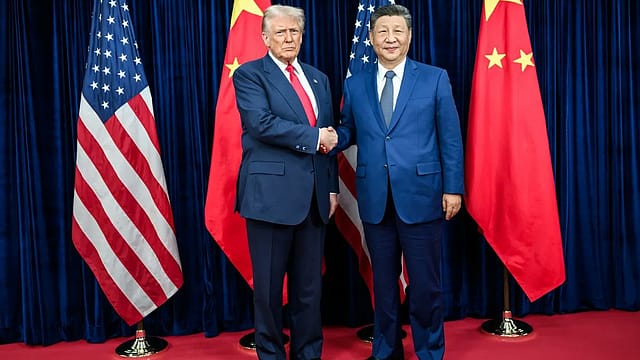
The Xi-Trump summit in Beijing is the most consequential bilateral meeting in years.
For the first time in nearly a decade, a sitting US president has arrived in China, with trade tariffs, rare earths, Taiwan, Iran, and artificial intelligence all on the agenda.
What emerges from these two days could recalibrate the architecture of global commerce between the world's two largest economies.
How Badly Did the Relationship Break Down?
US-China relations have deteriorated sharply since Donald Trump's first Beijing visit in 2017.
Technology restrictions tightened. China became the first major economy to retaliate against Trump's "Liberation Day" tariffs in April 2025.
According to Scott Kennedy of the Center for Strategic and International Studies, China enters this summit far more confident than in 2017, having absorbed and pushed back against much of Washington's pressure, as per CNBC.
Why Did Xi Invoke the ‘Thucydides Trap’?
Xi opened proceedings by raising the Thucydides Trap, the idea that a rising and an established power are historically prone to conflict.
According to CCTV's official broadcast, Xi asked whether both nations could avoid that fate.

Exclusive: To the Heavens and Back
19 Jun 2026 - Vol 04 | Issue 76
Shubhanshu Shukla relives the space odyssey that put India into orbit
Graham Allison, the Harvard professor who popularised the concept, reportedly told CNBC that the informal trade truce from their South Korea meeting last autumn could now become a formal agreement.
What Is the Real Economic Agenda?
Beyond diplomatic language, the summit targets tariff structures, rare earth access, and AI governance frameworks. Each carries direct consequences for global markets and manufacturing investment.
Why Does the Business Delegation Matter?
Elon Musk of Tesla, Tim Cook of Apple, and Jensen Huang of Nvidia joined Trump's delegation.
Their presence signals that corporate America, deeply exposed to Chinese supply chains and consumers, has a direct stake in whatever framework emerges.
How Have Tariffs Reshaped Supply Chains?
The 2025 tariff escalation has forced multinationals to restructure across semiconductors, electronics, and industrials.
The summit arrives mid-restructure, meaning its outcomes will either accelerate or partially reverse decisions already in motion.
What Can Realistically Come Out of Beijing?
No grand bargain is likely. However, formalising the trade truce and restoring regular dialogue channels would each be meaningful wins for US-China relations.
What Does the Road Beyond Beijing Look Like?
Xi is expected to reciprocate with a US visit, with further meetings at APEC and G20 events later in 2025.
Beijing 2026 is better understood as the opening of a structured negotiation than its conclusion. For the global economy, this summit may well become the inflection point between managed competition and accelerating fragmentation.
(With inputs from yMedia)