‘Trade Minister for Life’: Greer’s Goyal Quip Opens G20 Talks on Rewriting Trade Rules
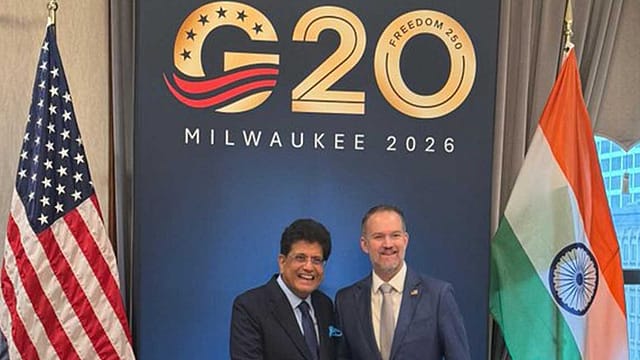
Piyush Goyal received an unusual designation at the opening of the G20 trade ministers’ meeting in Milwaukee: “trade minister for life”.
US Trade Representative Jamieson Greer delivered the quip while telling delegates that building a fairer trading system would remain unfinished long after the current ministers had left office. Goyal, he joked, would be the exception.
The lighter moment opened two days of discussions with a demanding agenda: industrial overcapacity, food security, forced labour and a proposed rethink of one of the foundations of international trade.
Greer also met the Indian commerce and industry minister on the gathering’s first day, as New Delhi and Washington continued efforts to advance a bilateral trade agreement and finalise an interim deal.

Losing Memory
16 Oct 2026 - Vol 05 | Issue 42
The making of a medical and social emergency
A Push to Revisit Trade Rules
Greer said governments had responded to years of economic imbalances “mostly with talk”. He wanted ministers to leave Milwaukee with “a clearer sense of urgency” about taking action.
He identified four priorities for the US presidency of the G20: tackling the weaponisation of food, structural excess industrial capacity, forced labour in supply chains and questions surrounding the Most-Favoured-Nation principle.
MFN is a central non-discrimination principle in the multilateral trading system. Greer argued that applying it unconditionally could limit countries’ ability to respond to distortive policies and changing market conditions.
He also challenged the suggestion that contentious issues should be left to the World Trade Organization in Geneva.
“Geneva is just another city on a lake. And so is Milwaukee,” he said.
Steel Framework Takes Shape
The opening day’s principal development came at a session of the Global Forum on Steel Excess Capacity, where participating countries endorsed the “Milwaukee Framework”.
Greer said it would encourage coordinated action against overproduction, covering trade remedies, monitoring of steel supply chains and closer scrutiny of transhipment.
Asked whether countries had agreed to raise tariffs on Chinese steel, he said each government would determine its own measures.
“Well, every country will do what they think is appropriate,” Greer said. “We want to coordinate those measures. The United States has taken robust measures, and it probably makes sense for other countries to do that too.”
He noted that G20 leaders had pledged to address excess capacity in 2016, yet the problem had become a greater distortion a decade later.
India Backs WTO, Seeks Policy Space
India’s stated position emphasises a “rules-based, open, inclusive, transparent, equitable and non-discriminatory multilateral trading system” with the WTO at its core.
New Delhi has also stressed the need to preserve adequate policy space for developing countries, a significant consideration as the US presses for changes to established trading principles.
Alongside the multilateral discussions, Goyal is pursuing bilateral engagements aimed at advancing India’s economic partnerships.
The Commerce Ministry said his discussions with the US would seek progress towards a balanced and mutually beneficial Bilateral Trade Agreement and an interim deal aligned with the joint statement of February 7, 2026.
The negotiations received additional political attention after Prime Minister Narendra Modi and US President Donald Trump spoke by telephone on Wednesday, reviewing cooperation in trade, defence, energy and emerging technologies.
Goyal Courts US Manufacturers
Before the formal ministerial discussions, Goyal met American manufacturing and technology executives at a roundtable hosted by the National Association of Manufacturers.
He urged companies to expand their presence in India, partner with small and medium enterprises and explore joint investments in advanced manufacturing and resilient supply chains.
The engagement reflected a partnership increasingly encompassing investment, technology and innovation alongside trade in goods and services.
Canadian International Trade Minister Maninder Sidhu was also scheduled to meet Goyal and Greer on Thursday as Ottawa pursued an economic partnership agreement and sought to diversify its trading relationships.
Factories, History and an Unfinished Task
The American hosts used Milwaukee’s industrial identity to reinforce their message. Ministers toured a Rockwell Automation plant, which Greer said had been chosen to show the economy the Trump administration wanted to build and “what we’re trying to protect”.
He also recalled John F. Kennedy’s 1959 speech in the same ballroom about American competitiveness, arguing that those concerns remained relevant 67 years later.
Greer acknowledged that the meeting would not resolve every disagreement. Building new trade arrangements would take time, he said, noting the decades between the creation of the General Agreement on Tariffs and Trade and the WTO.
The talks continue on Thursday, ahead of the G20 leaders’ summit to be hosted by the US later this year.
With inputs from ANI