The Seller Is the Buyer & the Buyer Is the Boss: Meet the ‘Daddy’ of Swara Baby
Every IPO asks investors to understand a business.
Swara Baby Products' draft red herring prospectus asks them to understand something else as well: how the business came to be owned the way it is.
On the surface, the filing looks like that of a fast-growing manufacturer. The company plans to raise ₹1,000 crore through a ₹500-crore fresh issue and a ₹500-crore offer for sale. It describes itself as India's largest contract manufacturer of disposable hygiene products, citing an industry report that estimates it held a 37% share of India's contract-manufactured baby diaper market and a 36% share of the adult diaper market in FY25.
Those are the metrics investors are expected to focus on.
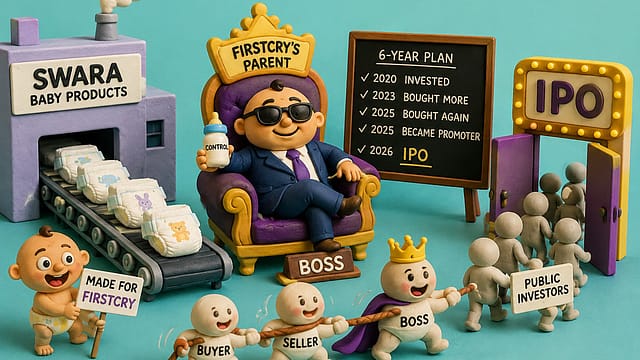
But tucked away across the capital history, shareholding tables and related-party disclosures is another narrative—one that explains how Swara reached this point. Read chronologically, the prospectus reveals a six-year ownership transition that transformed the company long before it filed for an IPO.

Greening the Future
23 Jul 2026 - Vol 05 | Issue 30
Securing a sustainable India
That story is just as important as the financial one.
From investor to promoter
When Swara was incorporated in 2016, the company was promoted by founder Alok Birla along with a group of individual shareholders and promoter-linked investment entities.
The company that would eventually control Swara was nowhere on the shareholding register.
That changed in 2020, when Brainbees Solutions, the parent company of FirstCry, subscribed to compulsorily convertible preference shares and acquired a relatively small equity stake at ₹52.92 a share.
At first glance, it looked like a strategic investment by one of India's largest baby and parenting retailers.
It gradually became something much bigger.
In April 2023, Brainbees acquired substantial stakes from promoter entities at ₹305.71 per share. Less than two years later, in March 2025, it purchased another block from Anadya Bon Merchari LLP at ₹603.32 per share, almost doubling the valuation implied by the earlier transaction. By December 2025, its preference shares had converted into equity and Brainbees was formally classified as Swara's promoter.
By the time the draft prospectus was filed, Brainbees—the company behind FirstCry, owned 76.59% of Swara. Founder and Managing Director Alok Birla, meanwhile, held just 1.4%.
Look at each transaction individually and nothing appears remarkable. Together, however, they reveal how FirstCry's parent quietly moved from being a minority investor to Swara's controlling shareholder. Over six years, it steadily increased its ownership, acquired promoter holdings in stages and eventually assumed control before the company ever approached the public markets.
The public issue now allows Brainbees to monetise part of that investment through an offer for sale of shares worth ₹300 crore.
Strategic investors selling a portion of their holdings through an IPO is not unusual. What stands out in Swara's case is that the ownership transition had largely been completed before public investors were invited to participate.
The customer that owns the company
The relationship becomes even more interesting beyond the shareholding table.
Brainbees is also Swara's largest customer.
According to the DRHP, it contributed 27.03% of revenue in FY24, 23.45% in FY25 and 22.64% in FY26, largely through the manufacture of BabyHug diapers and other private-label hygiene products sold by FirstCry.
It has also extended unsecured loans to Swara that are repayable on demand.
The company says these related-party transactions have been undertaken at arm's length and reviewed by auditors. That disclosure addresses compliance.
The bigger question is structural.
Swara's largest shareholder is also its largest customer. The arrangement brings obvious commercial advantages. It provides predictable demand, manufacturing scale and close operational integration. At the same time, it leaves a significant portion of the business linked to a single related party.
As Swara enters the public markets, investors will inevitably watch how that relationship evolves—whether the company is able to diversify its customer base over time while preserving the benefits of its largest commercial partnership.
Building beyond baby diapers
Operationally, Swara has grown rapidly.
Revenue increased from ₹749.96 crore in FY24 to ₹1,163.90 crore in FY26, while EBITDA rose from ₹153.59 crore to ₹192.77 crore during the same period.
Profitability, however, has not been entirely linear. Profit after tax declined in FY25 before recovering in FY26, with the company attributing the temporary pressure to higher raw material costs. Material consumption accounted for nearly 70% of revenue in FY26, highlighting the business's sensitivity to commodity prices.
The company is also trying to broaden its business beyond its core category.
Baby diapers continue to account for nearly four-fifths of revenue, but adult incontinence products are becoming a larger contributor. Acquisitions such as K.A. Enterprises (Hygiene) and Solis Hygiene point to an expansion into feminine hygiene and adjacent segments, while the incorporation of Swara Corp in the United States signals ambitions beyond the domestic market.
The IPO proceeds reflect that strategy. The fresh issue will fund a new manufacturing facility at Pithampur, repay debt and support future acquisitions.
More than a manufacturing IPO
Swara's listing comes at a time when India's public markets are seeing an increasing number of companies backed by strategic investors. What makes this IPO distinctive is that the ownership story is unusually visible in the prospectus itself.
The DRHP documents not only the growth of a manufacturing business but also the steady evolution of its ownership. Long before the company approached the public markets, control had already shifted through a series of investments, acquisitions and share purchases that reshaped the company over six years.
Investors will, understandably, spend much of their time evaluating revenue growth, margins, capacity expansion and the opportunity in India's hygiene market.
But Swara's prospectus suggests another set of questions deserves attention too: how the company manages related-party relationships, whether it can diversify its customer base and what independence looks like once it is publicly listed.
Every IPO tells investors where a company wants to go.
Swara Baby Products' also explains, perhaps more clearly than most, how it got there.