India's Next Energy Frontier Lies 3,000 Metres Under the Sea. Here's What ONGC Is Looking For
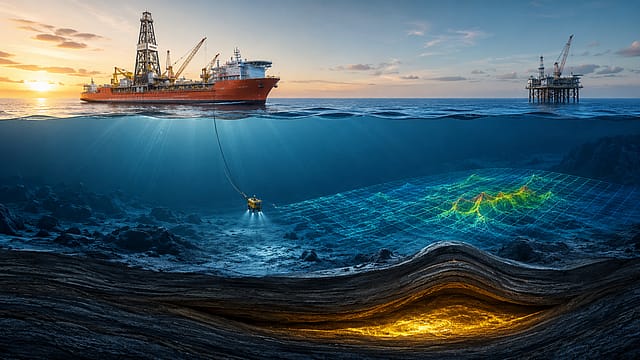
ONGC has begun drilling its first deepwater well in the Mahanadi Offshore Basin under the Samudra Manthan mission. The government believes the country's next big energy discoveries could lie thousands of metres beneath the sea.
India imports the bulk of the crude oil it consumes, making the country vulnerable to volatile global prices and geopolitical shocks. Now, it is looking for answers in an unlikely place. Nearly three kilometres beneath the sea.
With ONGC beginning deepwater drilling in the Mahanadi Offshore Basin, the government has kicked off one of India's most ambitious offshore exploration programmes in decades. If the mission succeeds, it could unlock new domestic oil and gas reserves, reduce India's dependence on imports and strengthen the country's long-term energy security.

Zeroing In on ECI
09 Oct 2026 - Vol 05 | Issue 41
Constitutional legitimacy versus political opportunism
Here's what the mission is all about.
What has ONGC announced?
ONGC has started drilling an exploratory deepwater well, MN-DW18-1-H-D, in the Mahanadi Offshore Basin under its Samudra Manthan mission. The well is the first of four planned deepwater exploration projects that will systematically evaluate the basin's hydrocarbon potential using advanced offshore drilling technology.
Why is this drilling significant?
Union Petroleum and Natural Gas Minister Hardeep Singh Puri has called deep waters India's next energy frontier. According to him, the campaign marks the beginning of one of the country's most challenging offshore exploration efforts. Every prospect evaluated, every well drilled and every discovery made has the potential to boost domestic oil and gas production, reduce import dependence and strengthen India's energy security.
Where exactly is the drilling taking place?
The exploration is underway in the Mahanadi Offshore Basin, located off India's eastern coast. It is one of several offshore regions, along with the Cauvery and Andaman basins, where recent exploration activity has strengthened hopes of significant hydrocarbon discoveries.
How much energy could India's offshore basins hold?
According to the Petroleum Ministry, India's eastern and western offshore basins, extending into water depths of up to 3,000 metres, are estimated to contain more than 5,600 million metric tonnes of oil equivalent (MMTOE) in hydrocarbon resources. While these are estimates rather than confirmed reserves, they underline the enormous potential that deepwater exploration could unlock.
Why is India focusing on offshore drilling now?
India remains heavily dependent on imported crude oil and natural gas, making the economy vulnerable to international price swings and geopolitical disruptions. Discovering commercially viable domestic reserves would not only strengthen energy security but could also reduce import bills and improve the country's long-term energy resilience. Recent global energy disruptions have only reinforced the importance of expanding domestic production.
What is the Samudra Manthan mission?
The Samudra Manthan mission is ONGC's flagship deepwater exploration programme aimed at unlocking India's offshore hydrocarbon potential. The current campaign begins with the Mahanadi Basin and will involve four exploratory wells designed to assess deepwater reserves using modern drilling technologies.
What policy changes have enabled this push?
The government says the programme builds on a decade of reforms designed to encourage exploration and investment. These include the Hydrocarbon Exploration and Licensing Policy (HELP), the Open Acreage Licensing Programme (OALP) and the decision to open nearly 99 per cent of previously restricted offshore "No-Go" areas for exploration. Together, these reforms are intended to accelerate the search for new oil and gas reserves.
What happens next?
The drilling is exploratory, which means there is no guarantee of a major commercial discovery. But every successful well will improve India's understanding of its offshore geology and could pave the way for future production. For a country seeking greater energy independence, the stakes are high. India's next major oil and gas discovery may not be hidden beneath deserts or forests. It could be waiting 3,000 metres beneath the sea.
(With inputs from ANI)