Bhai Dooj Has a Korean Gatecrasher: Pepero
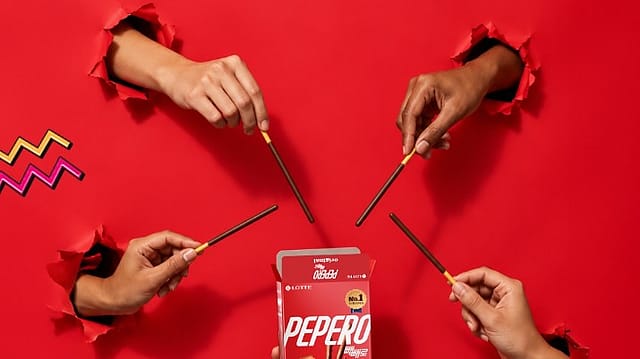
If you are buying sweets for your brother this Wednesday, nobody needs to tell you what day it is. If you are buying chocolate biscuits for the friend who still has your phone charger, Lotte would like a word. It has given the purchase a date, November 11, and the recipient a job title, Pepero Pal. The charger can stay where it is. The point is to give your friend a box.
The best thing about the idea is the proof, which requires four biscuits and no PowerPoint. Put them side by side and you get 11/11. The worst thing about it, if you work for Lotte, is that four Pocky sticks do exactly the same trick.
Japan’s Glico calls November 11 Pocky & Pretz Day. South Korea has Pepero Day. And in India, on November 11 this year, Bhai Dooj arrives three days after Diwali. Plenty of households already have a reason to get the good plate out. Into this unusually crowded Wednesday comes Lotte India’s creator campaign, asking people to pick a pal and exchange a snack. It is a modest request until you consider what the company is really after. It would like you to remember to do it again next year.

The Era of Forever Wars
30 Oct 2026 - Vol 05 | Issue 44
Coping with an explosive Middle East
Japan has the older biscuit. Korea has the earlier day
Glico introduced Pocky in 1966. One end of the stick was left bare so you could hold it without getting chocolate on your fingers. A handle on a biscuit is the sort of sensible invention that makes you wonder what everyone else had been doing with their thumbs. Lotte brought out Pepero in 1983. The biscuits came in that order. Their days came in the other.
There are several stories about how Pepero Day began. One retold by Korea.net has schoolgirls eating the sticks in the hope of growing tall and thin like them. The story tells you how easily the shape could acquire a meaning that had little to do with the recipe. By the late 1990s, Lotte was promoting the occasion. The current campaign would prefer you to think about the person you are sharing with.
Glico put Pocky & Pretz Day on the calendar in 1999, the eleventh year of Japan’s Heisei era. For the people planning the promotion, that was two more ones to work with. Glico eventually launched two rockets, each 3.3 metres long, for the occasion. Both passed the target altitude of 1,111 metres. This year, Glico is putting puzzles on Pretz packs in Japan. It plans to release the eleventh and hardest puzzle at 11:11 on November 11. Once you have committed to a number this thoroughly, an ordinary lunchtime release would probably feel like defeat.
Lotte’s global campaign comes with a chorus
The K-pop group Stray Kids, which appears in the global Pepero Day film, has released a track titled “November 11th”. The two companies are making their own claims on the same date. Glico’s puzzle is for Japan; there’s no evidence it is a reply to Lotte’s India campaign. A date that looks like your biscuit is an unusually cheap way to explain why the day exists. Anyone who makes a biscuit that looks like yours gets the explanation for free.
The resemblance has cost the companies rather more than a few lines of ad copy. Glico sued Lotte in the United States in 2015 over the appearance of the stick. The US appeals court sided with Lotte: the bare end gives you somewhere to hold it, and the shape helps you fit enough sticks in a box to pass around. Those practical features couldn’t be protected as trade dress in that case. A judge can tell you why the stick is useful. Which brand comes to mind when you see four of them in a row is still up for grabs.
“Four sticks are enough to explain the date,” says Ashita Aggarwal, professor of marketing at SP Jain Institute of Management & Research. Pocky can line up four sticks too. Pepero has a better chance of making the association its own if the date reminds you of a particular friend and Pepero is the box you sent them.
The biscuit has a shorter commute than the idea
Pepero in India is easy to mistake for an import riding in on the Korean wave. The biscuit had a more prosaic route. Lotte opened its first Pepero production line outside South Korea in Rohtak, Haryana, in 2025. When the company launched the snack in India that July, the original single pack was priced at ₹20. Crunchy was ₹30. The launch prices made the proposition easier to try. You could like a Korean band, see the snack in a reel and still have enough money left to buy one for the person who sent it to you.
The price gap with Pocky gives that second box a fighting chance. Zepto, for instance, lists a 30 g Pepero Original at an MRP of ₹50 and a 47 g Pocky Chocolate at a listed price of ₹169 in the snapshots I checked. Those are different packs, and app prices and availability vary. Still, for someone deciding what to send, the outlay matters. Pocky has a recognizable shape and the distinction of being the older brand. Lotte can make the gesture cheaper to try. If the occasion takes off, Glico has every reason to see whether a smaller pack or a local promotion would make it easier to join in. There’s no sign it has made that move for 11/11 in India.
Lotte also has a way into shops that predates the biscuit. It said in its 2024–25 annual report that Choco Pie was available in 6.7 lakh outlets at the end of that financial year. That figure belongs to Choco Pie. For Pepero, it tells you the company already knows how to get a sweet snack a long way from a big-city supermarket. A K-pop song can travel across borders in seconds. It takes a different set of relationships to have the biscuit there when someone wants it.
The friend who missed the mithai list
The cleverest part of the India campaign may be its choice of recipient. Cadbury Celebrations already knows how to turn a visit or a family squabble into a reason to take chocolate along. This Diwali, its film made a gift out of neighbourly nok-jhok, and the company introduced a Milky Mithai range. Amazon Now even suggested a Celebrations pack for Bhai Dooj.
Italy’s Ferrero had a head start at Diwali: a round chocolate in gold foil already looked at home in a mithai box. A Food Bazaar executive likened it to a laddoo. Mumbai’s Sassy Spoon took the resemblance literally, coating a Rocher in motichoor and serving it with rabdi mousse. That was the restaurant’s creation. Ferrero’s own Diwali pitch stuck with the chocolate in gold foil.
Sweden’s IKEA took the festival into its catalogue. Its made-in-India AROMATISK collection drew on Indian block printing and embroidery. Diwali gave both brands an occasion people already knew. Lotte has brought an occasion over with the biscuit.
Pepero is looking for a person the usual gift list can miss. Think of the colleague who covers your call so you can make a train, or the school friend to whom you send a reel every Thursday without ever saying hello. The relationship may be close enough for a present and too casual for anything that looks like a hamper. A packet of chocolate sticks can get through that gap without making anybody wonder what you want.
Lotte has already tried that idea in India. In February it gave Valentine’s Day a one-letter edit and called it Palentine’s Day. Its own social post saluted colleagues who fix decks and share chai breaks, and named the delivery apps it used to get the snack to them. In October, a Dentsu Creative film sorted the gang by how they eat a Pepero: the person who saves the chocolate for later, the one who starts with it, the one who polishes off several sticks in one go. The November push gives all that friendliness a job. If you liked the reel about your pal, the next move is to send the pal something.
There is a catch. A gift has to feel as if the sender thought of the recipient. If the first words to arrive are “Celebrate This Pepero Day with Your Pepero Pals!”, the recipient may reasonably suspect that someone in marketing thought of them first. The campaign will have done its job when people can drop the script and keep the gesture.
The calendar invite is the easy part
Lotte and Glico aren’t the only companies to have looked at 11/11 and seen business. Alibaba turned China’s Singles’ Day into a shopping event in 2009 with 27 merchants. It gave shoppers a reason to wait: the deals would be there when the date came around. Pepero’s ask is more delicate. There is no particular reason a friend should be nicer to you on the eleventh than on the twelfth. The pleasure has to come from knowing that somebody remembered you.
Even in South Korea, Lotte has company. November 11 is also Garaetteok Day, an occasion the government established in 2006 to honour farmers and rice. Garaetteok, a long, cylindrical rice cake, also has the right shape for the date. It’s a useful reminder for anyone inclined to declare a winner: people can pass around a rice cake and still give someone a biscuit.
This year’s overlap with Bhai Dooj could work in Lotte’s favour. People are already buying sweets, sending things and thinking about whom they might have left out. It could also make the results harder to read. An extra Pepero pack in a festive basket might mean the idea travelled. It might mean someone fancied a biscuit. “This year, Bhai Dooj has already put sweets on the shopping list,” says Aggarwal, adding that it's interesting to observe what people do when the two dates separate. Does anyone remember November 11, think of the same friend and send another box of Pepero without a discount or a post telling them to? For now, Lotte has announced a campaign. "India hasn’t promised it an anniversary," she adds.
The company can put the date in a song, on a box and in your feed. It can make the biscuit in Haryana and, where an app carries it, get a box to your friend before the tea goes cold. The bit Lotte can’t do for you comes just before you pay, when you have to type in somebody else’s address. If you remember whose address it was next November, Lotte has a day.