Deepinder Goyal's Temple and Gaurav Gupta's Gabit: The Zomato Connection in Health-Tech
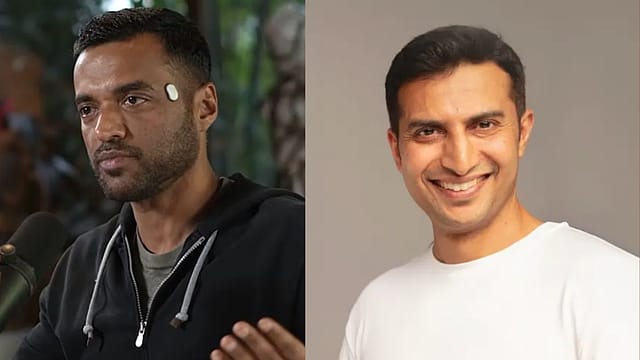
When Deepinder Goyal was building Zomato, the opportunity was to change how people discovered restaurants and ordered food. Nearly two decades later, the entrepreneur is pursuing a rather different proposition: helping people understand what is happening inside their bodies. His latest venture, Temple, is a wearable technology company attempting to push the boundaries of personal health monitoring. But there is an interesting connection behind this move. Before building Temple, Goyal had backed another health-tech venture founded by a former Zomato colleague, Gaurav Gupta.
Gupta, who was elevated to co-founder at Zomato in 2019, founded Gabit in 2022 with his wife Arpana Shahi. The company is building an integrated health and wellness platform around wearable technology, nutrition, fitness and skincare. Goyal was among the investors who backed the venture in its early days. He is now building his own wearable, Temple, which began with an attempt to monitor physiological signals associated with blood flow in the brain and has since expanded into a more ambitious proposition involving artificial intelligence.

The Era of Forever Wars
30 Oct 2026 - Vol 05 | Issue 44
Coping with an explosive Middle East
The connection is interesting because it is not merely two former colleagues independently discovering the same business opportunity. Goyal backed Gupta's venture before setting out to build one of his own. Together, Gabit and Temple offer a glimpse into where some entrepreneurs from India's consumer internet ecosystem see the next opportunity: not simply in making everyday consumption more convenient, but in using technology to understand and influence how people live.
The Zomato alumni connection
Gaurav Gupta joined Zomato in 2015 and rose through the ranks, becoming chief operating officer in 2018 before being elevated to co-founder in March 2019. During his six-year stint, he worked across several businesses, including table reservations, advertising, international operations and the company's nutrition business. He left in September 2021, two months after Zomato's stock-market listing.
His next venture was considerably different from the food-delivery business he had helped scale. Founded in 2022, Gurugram-based Gabit set out to bring different aspects of personal wellness onto a single platform. Its proposition included personalised meal and fitness plans, skincare products and technology-led tools to help users understand their habits.
The company formally emerged from stealth in January 2024. Its early offering included FitBot, an AI-powered personal trainer; Food Score, designed to help users understand their eating habits; and SkinBot, which assesses skin quality. The idea was to use data and technology to make recommendations more personalised rather than offer consumers another collection of generic wellness products.
Goyal's involvement preceded the public launch. In January 2023, Gabit issued shares to several angel investors, including Goyal, Vikram Chopra of Cars24, Zomato CFO Akshant Goyal and former Zomato co-founder Mohit Gupta. Its $9.5 million seed round in 2023 also included Norwest Venture Partners and Kunal Shah. The investment is significant because it establishes a direct financial connection between Goyal and Gupta's health-tech ambitions, rather than just a shared professional history.
Gabit has since developed its wearable offering, with a titanium smart ring at its centre. The ring claims to track more than 150 health markers across sleep, recovery, activity, stress and nutrition. Its companion app provides AI-driven insights, customised fitness plans and habit coaching. The company has also expanded into nutrition and skincare, attempting to turn the data collected by its wearable into everyday interventions.
In December 2025, Gabit acquired Swedish nutrition brand Näck to strengthen its supplements and nutrition business. It raised approximately ₹36.2 crore in a fresh funding round in 2026, taking its disclosed total funding beyond $12.7 million, excluding an earlier undisclosed round involving actors Ranbir Kapoor and Badshah, according to Inc42. Gabit's business is therefore not limited to selling a smart ring. It is attempting to build a wider consumer wellness ecosystem around the device.
From investor to entrepreneur in health-tech
For Goyal, health technology is not an entirely new interest. His investment in Gabit was an early indication of his willingness to back businesses that use technology to understand and influence consumer health. Temple, however, represents a more direct and considerably more ambitious commitment.
Goyal stepped down as Eternal's managing director and chief executive officer effective February 1, 2026, with Blinkit head Albinder Dhindsa taking over. He remained vice-chairman of Eternal. Goyal had said that he wanted to pursue ideas involving high-risk experimentation, which he felt were not suited to a listed company. Temple became the vehicle for that ambition.
The venture emerged from his interest in longevity research and what he calls the Gravity Ageing Hypothesis. The hypothesis proposes that gravity's long-term effects on cerebral blood circulation could have implications for ageing. In simple terms, it explores whether the effort required to maintain blood circulation to the brain, which is positioned above the heart, has consequences over a person's lifetime. This remains a research hypothesis, not an established scientific explanation of ageing.
Temple's original proposition was to develop a wearable that could monitor physiological signals associated with blood flow in the brain. The device uses optical sensors and sits near the temple, over the superficial temporal artery. Its proprietary BrainFlow metric is intended to track changes in signals associated with cerebral circulation. The company has also introduced Entropy, a metric Goyal describes as representing the body's real-time physiological strain or the cost of keeping itself alive.
The device tracks conventional parameters such as heart rate, heart-rate variability (HRV), sleep and VO2 max, while the company is working on additional capabilities including chewing detection, snoring patterns, sleep positions, jaw clenching, REM sleep and continuous core body temperature monitoring.
Temple's ambitions have expanded further. On November 6, Goyal unveiled Temple 01 as a screen-free, microphone-free AI companion, describing it as "humanity's last personal device". Instead of using a conventional microphone, the device is designed to use motion sensors to detect vibrations generated by the wearer's voice and convert them into text. Temple calls this a roomdeaf audio interface, claiming it can capture the wearer's voice without picking up conversations happening around them.
The proposed applications include recording thoughts, setting reminders, remembering details from conversations, sending messages and logging meals, workouts and health observations. The company says conversations will be encrypted and will not be accessible to external model providers. Temple 01, combining AI and health features, is expected to ship in early 2027.
This takes Temple beyond the conventional wearable category. Goyal is attempting to combine continuous health monitoring with a new way of interacting with AI. Whether consumers will embrace a device that performs both functions remains to be seen, but the ambition is much larger than building another fitness tracker.
Two different approaches to the same opportunity
What connects Gabit and Temple is the belief that consumers will increasingly want more information about their bodies, and that wearable technology can turn this information into actionable insights.
The conventional fitness tracker measures activity. The next generation of health wearables wants to understand sleep quality, recovery, stress, nutrition and other physiological signals. The commercial opportunity lies not merely in collecting data, but in converting it into recommendations that consumers can use.
Gabit approaches this through an integrated wellness ecosystem. Its smart ring supplies data, while its app, coaching, nutrition and skincare offerings attempt to turn that information into everyday interventions. It is building a consumer wellness brand with multiple products and services.
Temple is taking a different route. It is betting on a new sensor location, proprietary physiological measurements and an AI interface that could remain with the user throughout the day. Its proposition is closer to a research-led technology platform whose hardware could evolve into a broader personal computing interface.
Both, however, face a crowded market. International players such as Apple, Garmin, Whoop and Oura have already established themselves in wearable technology, while Indian companies such as Ultrahuman have demonstrated that consumers are willing to pay for specialised health-tracking devices. The challenge for newer entrants is to show why their measurements are more useful, their technology more reliable and their platforms worth returning to.
For Gabit, that means building a sustainable business beyond the initial purchase of a smart ring. For Temple, it means proving that its distinctive sensing technology offers something consumers cannot already obtain from established devices.
The science behind Temple comes under scrutiny
For Temple, the immediate challenge is not just competition. It is credibility.
The device has attracted criticism from medical professionals, particularly over its claims about monitoring cerebral blood flow. Hepatologist Dr Cyriac Abby Philips, popularly known as The Liver Doc, has been among its most vocal critics. He has questioned whether a sensor placed near the temple can reliably establish what is happening to blood circulation inside the brain.
The objection is partly anatomical. The superficial temporal artery, where Temple's sensor sits, is outside the skull and supplies blood to the scalp and face. The brain receives blood through the internal carotid and vertebral arteries, which supply an extensive network of vessels. A signal detected from an artery near the scalp cannot automatically be assumed to represent blood flow throughout the brain.
Doctors have also pointed out that cerebral blood flow is not uniform. It varies according to the activity of different brain regions and the body's physiological requirements. A single reading cannot, by itself, provide a complete picture of brain function or establish whether someone is developing cognitive decline or a neurological condition.
The Gravity Ageing Hypothesis has also been challenged. Doctors have argued that the brain has sophisticated mechanisms to regulate its blood supply, including cerebral autoregulation. While gravity influences circulation, there is no established evidence that its everyday effects progressively damage the brain or cause it to age faster.
There are further questions around Entropy. Goyal has described it as a measure of the body's real-time physiological strain, but medical professionals have questioned its biological basis, methodology and whether the metric has been independently validated. A proprietary score can be useful if it reliably measures something meaningful. But its interpretation must be supported by evidence, not just an appealing explanation.
Temple has published preprint research comparing its BrainFlow index with transcranial Doppler measurements. One study involved 23 healthy adults and reported correlations between changes in the proprietary index and blood-flow velocity measurements under specific conditions. However, the index is intended to track relative changes rather than directly measure absolute cerebral blood flow. The researchers have also called for further validation across broader populations.
The distinction between a preprint and an independently replicated, peer-reviewed study matters. The research offers a starting point for scientific examination, but it does not settle whether Temple can reliably measure blood flow inside the brain or whether its readings can be used to draw conclusions about ageing.
The criticism has moved beyond technical disagreement. Philips has compared Temple's claims to those of Theranos, the American health-technology company whose founder Elizabeth Holmes was convicted of fraud over misleading claims about its blood-testing technology. The phrase "desi Theranos" has been used by critics to describe Temple. These are allegations and comparisons made by critics, not established findings of fraud. But they have gained traction online, creating an uncomfortable association for a company attempting to build trust around a new category of wearable technology.
Goyal's response and the ₹85,000 question
Goyal has not taken the criticism quietly. On November 5, he addressed what he called concerned Indian doctors on X, saying Temple had already spent $30 million on development, of which $20 million was his personal investment. He rejected suggestions that the company was a scam and argued that a 14-day, no-questions-asked return policy would expose a product that failed to deliver on its promises.
He also said the company was preparing further research and independent studies, and maintained that its scientific claims could withstand scrutiny. Importantly, he clarified that Temple is a fitness tracker and wellness device, not a medical device. He said its metrics would be clinically validated if and when that happened.
The exchange soon became as much about Goyal's tone as about the technology. Philips continued to question the scientific evidence, while Goyal pushed back against what he saw as unfair attacks. He subsequently apologised for generalising his criticism to Indian doctors as a whole, saying his objections were directed at specific individuals.
The controversy has also drawn attention to Temple's pricing. Pre-orders opened on November 1 at a reported price of ₹85,000, with delivery expected within approximately three months. The company is positioning the device as a premium wearable, with lifetime software access included in the reported early-access proposition.
At this price, consumers are being asked to pay substantially more than they would for a conventional fitness band or smartwatch. The comparison is not entirely straightforward: Temple is attempting to offer a different form factor and measurements that it says conventional wrist-based devices cannot capture in the same way. But the question remains: what exactly is the consumer paying for?
A smartwatch can justify its price through familiar features such as heart-rate monitoring, GPS, sleep tracking and exercise metrics. More specialised devices such as Oura and Whoop have built their propositions around recovery, sleep and physiological insights. Temple wants to go further, promising access to signals associated with cerebral circulation and, eventually, a microphone-free AI companion.
The difficulty is that its most distinctive health proposition is also the one facing the greatest scientific scrutiny. If its brain blood-flow claims remain unvalidated, consumers may find it difficult to understand why they should pay a substantial premium over established devices.
Goyal has acknowledged that his association with Zomato may be working against Temple. Responding to scepticism about the venture, he said being known as the "Zomato guy" made it difficult for people to take seriously his ability to build hardware and science-led products. There is an irony here. His Zomato legacy has helped Temple attract attention, capital and early interest, but it has also brought expectations and scrutiny that a lesser-known founder might not face.
The price debate is therefore inseparable from the question of credibility. Development expenditure is not proof of efficacy, just as a return policy cannot establish whether a physiological measurement is scientifically meaningful. Nor does describing a product as a wellness device automatically settle its regulatory classification. That depends on its intended purpose and the claims made to consumers.
Can the Zomato network build the next health-tech business?
It would be premature to call Temple and Gabit part of a coordinated Zomato alumni movement into health technology. But the relationship between the two ventures is worth watching. Goyal backed Gupta's company before developing his own wearable, and both are now pursuing different versions of a similar consumer proposition: making personal health more measurable and, eventually, more manageable.
There is a certain irony in this journey. Zomato built its business by making it easier for people to discover and order food. Gabit wants to help consumers understand their nutrition and fitness habits, while Temple wants to monitor physiological signals that conventional devices may miss. The entrepreneurs behind these businesses have moved from making everyday consumption more convenient to making everyday health more measurable.
But health is not another convenience category. A food-delivery platform can demonstrate its value through faster deliveries, order volumes and repeat purchases. A wearable making claims about the brain must establish that its measurements are accurate, meaningful and reproducible. Consumer enthusiasm, however strong, cannot substitute for scientific validation.
Goyal's capital, visibility and experience in building consumer businesses may help Temple attract attention and early adopters. Gupta's challenge with Gabit is different: building a sustainable business around its ring, app and wider wellness offerings, rather than relying on the novelty of a connected device. Neither proposition, however, is guaranteed to translate into a durable business simply because consumers are becoming more conscious of their health.
The larger opportunity in health technology is real, but so are the questions around the quality of the data, the usefulness of the insights and consumers' willingness to keep paying for them. For Temple in particular, the immediate task is to demonstrate that its more ambitious physiological measurements can withstand independent scientific scrutiny. Until then, its technological ambition and commercial promise remain ahead of what has been firmly established.
The Zomato connection may explain how these ventures found early capital, visibility and access to a network of entrepreneurs. Whether that network can help build credible health-tech businesses is a different question altogether. In this category, the real test will not be how much data a device can collect, or how ambitious its founder's vision is, but how much of that data can be trusted.