EXPLAINED | Trump Backs Jensen Huang. Why Are Nvidia’s Chips Stuck in Hong Kong?
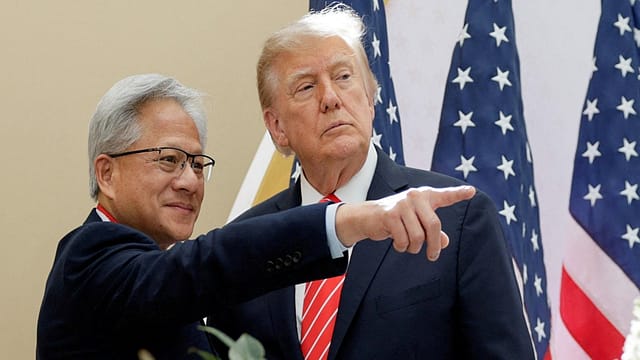
In May, Jensen Huang boarded Air Force One in Alaska. Nvidia’s chief executive was missing from the original list of business leaders travelling with Donald Trump to Beijing. Then came a call from the US president, Reuters reported, and Huang was on the plane. The trip raised hopes that Nvidia could finally sell its H200 artificial intelligence chips in China at scale. On November 5, Reuters reported that roughly 600,000 of those chips were waiting in Hong Kong. Beijing was holding back approval for large shipments into the mainland.
Now Trump is talking about taking Huang to China again. On November 8, as Nvidia announced an investigation into whether its chief executive had been targeted by a foreign intelligence operation, Trump praised Huang and said he would be willing to take him on his upcoming Asia trip. For Nvidia, the last trip showed how far a presidential invitation can get you. Getting a shipment into mainland China takes two governments.

The Era of Forever Wars
30 Oct 2026 - Vol 05 | Issue 44
Coping with an explosive Middle East
What did Trump say about Huang?
Trump called him an “honorable guy” and said he had “done an amazing job for our country”. He said he had yet to speak to Huang about the allegations. Nvidia opened its inquiry after The New York Times linked Huang to a former executive at chip customer Megaspeed whom US officials reportedly believed had gathered information for Beijing. Huang acknowledged being unfaithful to his wife. Beijing rejected the intelligence allegations, which remain unproven. Nvidia’s board said it had no reason at that point to believe US national security or company secrets had been compromised.
Who is Jensen Huang?
He is the 63-year-old engineer who co-founded Nvidia in 1993 and has run it ever since. Born in Taiwan in 1963, Huang spent part of his childhood in Thailand. By his account, he was nine when his parents sent him and his older brother to the United States ahead of them. The boys stayed with an uncle in Tacoma, Washington, before going to boarding school in Kentucky. Huang earned a bachelor’s degree in electrical engineering at Oregon State University and a master’s at Stanford. He worked at AMD and LSI Logic before starting Nvidia with Chris Malachowsky and Curtis Priem.
His fame reaches well beyond Silicon Valley. He is reportedly billed as “Taylor Swift of tech” and the nickname “Daddy Huang” in Taiwan. His Nvidia stake accounts for much of his fortune, put at about $155 billion by the Bloomberg Billionaires Index in a November 9 snapshot cited by India Today.
Why does Trump give Huang so much access?
Nvidia makes the chips that American tech companies use to build and run much of their AI. The company started with processors that could draw many parts of a video game scene at once. AI developers found that the same ability to do many calculations at the same time helped them train models. Nvidia also built software that made the chips easier to use for that work. A company that once sold graphics cards to gamers became central to America’s AI industry.
Huang can also point to manufacturing in the US, a Trump priority. In April 2025, Nvidia said its partner TSMC had started making Blackwell chips in Arizona and announced plans to build AI supercomputers with partners in Texas. The White House claimed the announcement as a win for Trump. In March 2026, Trump named Huang to his science and technology advisory council.
Has Trump always given Nvidia what it wanted?
His administration has tightened and eased restrictions at different times. In April 2025, Washington told Nvidia it needed a licence to export the H20, a chip designed for the Chinese market under earlier US restrictions. Nvidia recorded a $4.5 billion charge for excess stock and commitments to buy more. In July, after Huang met Trump, Nvidia said it had been assured that licences would be granted. Huang told the Associated Press that trade negotiations were for the two governments and that his role was to explain what the rules meant for the industry.
What did Trump actually open up for the H200?
Washington opened a route for individual sales. In January 2026, the US Commerce Department began reviewing applications to export the more powerful H200 to China case by case. Buyers must meet security conditions, including safeguards against military use. Reuters reported in May that Washington had cleared sales to around 10 Chinese firms, including Alibaba, Tencent and ByteDance. That gave some buyers US permission. Beijing could still decide what entered mainland China.
Why do Washington and Huang disagree on chip controls?
Washington wants to limit the advanced computing power available to China’s military. Huang argues that keeping Nvidia out gives Chinese rivals such as Huawei more room to grow. The dispute is over what makes America stronger in the long run. Restricting sales can make powerful chips harder for Chinese developers to get. It also gives them a reason to build AI around Chinese hardware and software.
Why would Beijing hold up chips its own companies want?
Beijing wants Chinese companies to rely less on US technology. The H200 is an older Nvidia model, but it is still valuable for training AI systems. Reuters reported that Beijing let some H200s in while withholding approval for large-scale imports. Chinese companies can still order some less powerful Nvidia chips. In October, Reuters reported that ByteDance, Alibaba and Tencent had ordered more than three million such graphics cards. Nvidia had told customers to expect commercial deliveries to begin in early 2027, according to the report.
Can Indian companies get the same chip?
Eligible Indian startups and researchers can rent computing time on H200 machines through the government’s IndiaAI portal, which also lists Nvidia’s newer B200. They can pay for the hours they need instead of buying a server. The same H200 that a researcher can rent in India is the subject of two governments’ approval decisions on its way to mainland China.
Could Huang go back to China with Trump this month?
Trump says he plans to attend the Asia-Pacific Economic Cooperation summit in Shenzhen on November 18–19. He said he would be willing to take Huang, whose participation is unconfirmed. November 18 is also the date three Republican House committee chairs proposed for a closed-door briefing with Huang about his contacts with a former executive of an Nvidia customer and the company’s security safeguards. They asked him to confirm or suggest another date by November 11.
Nvidia reports results on November 17. In August, it told investors its forecast assumed zero revenue from selling data-centre computing hardware in China. The new forecast will show whether that assumption has changed. The last time Huang flew to China with Trump, the US trade representative said chip export controls had barely figured in the talks. This time, the decision that could move the H200s out of Hong Kong rests with Beijing.