Starbucks India Is Growing. Why Is Profit Still So Hard to Brew?
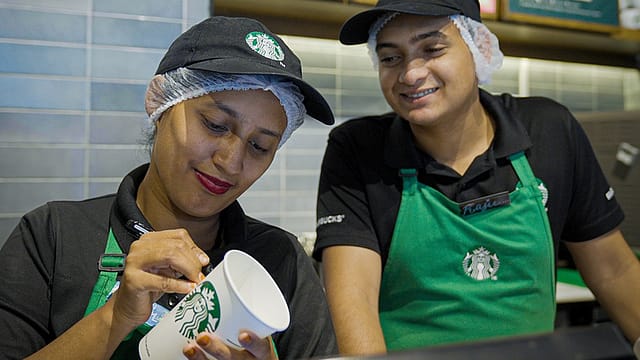
For Tata Starbucks, putting another café into a city where it already operates can offer something that entering a new city cannot: a more efficient business behind the counter.
Sunil D’Souza, managing director and CEO of Tata Consumer Products, explained the logic in an August interview. “You get efficiencies when you have more than five stores per city,” he reportedly said, pointing to delivery and kitchen operations.
It is a useful starting point for understanding India’s café expansion. Each new address gives customers another place to buy coffee. A cluster of addresses can also help the company organise the work required to serve them.
That distinction is becoming consequential for the 50:50 venture between Tata Consumer Products and Starbucks Corporation. It has built a sizeable Indian business and is recovering sales momentum. Turning that progress into net profit remains unfinished work.

Look Who's Talking Regime Change
23 Oct 2026 - Vol 05 | Issue 43
A RECOVERY ALREADY UNDER WAY
Tata Starbucks’ operating revenue rose 7% to ₹1,367 crore in FY26. While its net loss narrowed 27% to approximately ₹99 crore, EBITDA stood at ₹234 crore, according to Entrackr.
The latest quarter presents a stronger growth picture. In its October 26 results, Tata Consumer reported that Starbucks’ revenue increased 15% in the September quarter, supported by strong same-store sales. This was its fifth consecutive quarter of positive same-store sales growth. The network reached 505 stores across 81 cities.
Those disclosures give the business an encouraging direction. Existing stores are contributing to sales growth alongside the wider network.
Same-store sales can increase through more transactions, higher spending per order or a combination of both. The update does not provide that breakdown for India. Nevertheless, improving sales from the established estate gives Starbucks a useful foundation for its next phase.
The company has already moderated its expansion. Tata Consumer’s FY26 board report records 23 net new stores during the year, taking the total to 502 at March-end. It describes additions as calibrated and phased, with profitability and operating efficiency receiving greater attention.
THE BUSINESS BEHIND THE CUP
The difference between positive EBITDA and a net loss helps explain why café expansion requires patience.
EBITDA measures earnings before interest, tax, depreciation and amortisation. It leaves out costs that remain relevant to a business investing in premises and equipment. Lease accounting can also affect the relationship between reported EBITDA and the cash cost of occupying stores.
A full reconciliation is needed to explain the precise gap at Tata Starbucks. The headline figures alone cannot establish how much comes from mature cafés, new outlets or central expenses.
They do show a business making progress. Entrackr reports that total expenses increased 4.7% to ₹1,514 crore in FY26, slower than revenue. Procurement of coffee and related products cost ₹356 crore, while employee expenses reached ₹225 crore.
The work extends well beyond sourcing beans. Stores need staff, equipment, electricity, food supply and premises that customers find convenient.
This is where density becomes commercially useful. A network concentrated around existing operations can spread support costs over more sales. Opening in a new city may eventually create the same opportunity, but requires investment before that cluster develops.
The quality of expansion therefore matters alongside its speed.
HOMEGROWN BRANDS FACE THE SAME ARITHMETIC
Indian challengers are building substantial businesses of their own.
Entrackr’s reporting on filings puts Blue Tokai’s FY25 operating revenue at approximately ₹325 crore, up from ₹216 crore. Its net loss narrowed to about ₹50 crore from ₹63 crore.
Third Wave Coffee reportedly generated ₹285 crore in operating revenue and recorded a ₹94-crore loss in FY25. Its subsequent ₹408-crore funding round will support expansion and its Third Rush Desserts business.
These are FY25 figures, while Starbucks’ latest annual numbers cover FY26. They illustrate different stages of development rather than provide a ranking of current performance.
They also show why café growth cannot be judged through store counts alone. Younger brands need time to build teams, establish supply networks and develop regular customers. Losses during that process do not invalidate the opportunity.
Third Wave’s dessert expansion offers another way to develop it. A customer arriving for coffee may also buy food, increasing the value of a visit. The gain depends on what remains after sourcing, preparation and wastage.
The commercial ambition is to make each location useful across more occasions, while keeping the operation manageable.
STARBUCKS DOES MAKE MONEY GLOBALLY
The parent company demonstrates that a large coffee network can produce substantial profits.
In results announced on October 29, Starbucks reported revenue of $37.9 billion and net earnings attributable to the company of approximately $2.53 billion for the fiscal year ended September 27, 2026. Its reported operating margin was 9.7%. Annual earnings also included a pre-tax gain from the China transaction.
The recovery has an operating dimension. Global comparable coffeehouse sales rose 7.2% in the latest quarter, comprising a 1.8% increase in transactions and a 5.2% rise in average ticket.
The mix matters: higher spending per purchase contributed more than transaction growth. More expensive orders and more visits can both lift sales, but describe different changes in demand.
Starbucks’ global results provide evidence of a profitable model. They offer no timetable for India, whose store maturity, pricing and operating costs differ.
CHINA HAS CHANGED THE OWNERSHIP EQUATION
China offers a more complicated comparison.
In the quarter ended March 29, before the ownership change, Starbucks’ China comparable sales increased just 0.5%. Transactions rose 2.1%, while average ticket declined 1.6%. The company was attracting more purchases without a proportionate increase in sales.
In April, Starbucks completed its joint venture with Boyu Capital. Boyu-managed funds acquired 60% of the Chinese retail operation; Starbucks retained 40% and ownership of the brand, which it licenses to the venture. Approximately 8,000 stores moved towards a licensed operating model.
Starbucks continues to participate through its ownership interest, brand licensing and supply relationships. It also shares the task of developing the business with a local partner.
The change affects the accounts. In the latest quarter, international segment revenue fell 37%, largely because the Chinese stores’ full retail sales were no longer consolidated in the same way. That decline cannot be read as a comparable collapse in customer spending.
China also demonstrates the strength of local competition. Luckin Coffee reported second-quarter 2026 revenue of RMB15.9 billion and operating income of RMB2.1 billion. Its network reached 36,310 stores across its markets.
Yet Luckin’s self-operated same-store sales fell 5.3%. It attributed the comparison partly to unusually high delivery-platform subsidies a year earlier.
A rapidly expanding, profitable challenger can therefore face pressure inside its existing estate. China shows several viable ways to build a coffee business, each requiring careful attention to pricing, frequency and the cost of serving demand.
MAKING THE NEXT STORE COUNT
India already uses a partnership model, so China does not supply an obvious ownership prescription for Tata Starbucks.
The more useful lesson concerns how expansion earns its return. Existing cafés need to strengthen sales, new outlets need time to mature, and the wider network needs to make procurement, staffing and support more efficient.
Starbucks’ improving Indian sales give it room to pursue that work. Homegrown competitors are developing their own combinations of coffee, food, formats and convenience.
The opportunity is substantial enough to support different propositions. What each company must build is a network whose customer appeal and operating economics reinforce one another.
For Tata Starbucks, the next café can contribute in two ways: another destination for customers, and a stronger business around the stores already there.