Piyush Goyal Signals Next Trade Wave: 20 Countries in India’s Sights
India is widening its global trade play.
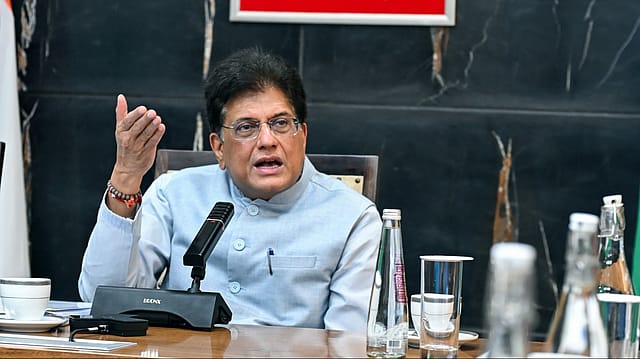
Union Commerce and Industry Minister Piyush Goyal on Friday said the government is in active discussions with at least 20 more countries to open market access—marking the next phase of India’s aggressive trade expansion strategy.
Speaking to business leaders in Coimbatore, Goyal positioned these negotiations as a natural extension of the nine free trade agreements signed over the past three-and-a-half years.
Those deals have already unlocked preferential access to 38 developed economies.
“We are in discussions with, apart from these 38 countries, at least 20 more countries to open market access in all of them,” he said, pointing to regions such as the Gulf Cooperation Council, Eurasia, and Israel as key focus areas.
Zeroing In on ECI
09 Oct 2026 - Vol 05 | Issue 41
Constitutional legitimacy versus political opportunism
The strategy is deliberate. India is prioritising agreements with high-income economies where domestic industries don’t face direct competition—while gaining access to deeper, more lucrative markets.
The result: scale without disruption.
“Two-thirds of global trade is now open for Indian entrepreneurs to seek preferential market access,” Goyal noted, pushing back against industry concerns around zero-duty imports.
He underlined that India has avoided signing FTAs with competing economies, instead targeting markets where Indian businesses can expand without being undercut.
The pitch to industry was clear—step out, scale up.
Calling Coimbatore a “power centre” of South India’s entrepreneurial ecosystem, Goyal credited its MSMEs for shaping policy direction and urged businesses to leverage the expanding FTA network.
The government, he added, has already tweaked MSME norms by excluding export turnover from classification—removing a key growth bottleneck.
Beyond trade agreements, Goyal pointed to structural shifts powering India’s global ambitions.
A ₹2 lakh crore investment has stitched together a single national power grid, ensuring round-the-clock electricity and uniform pricing—critical for sectors like data centres.
“The national grid gives reliability and resilience,” he said, noting how renewable-rich states like Tamil Nadu can now feed power seamlessly into the system.
On the digital front, India’s rapid 5G rollout and low data costs are compounding the advantage.
With over a billion internet users, the country has also emerged as second largest user of ChatGPT—a signal of both scale and digital adoption.
The larger message: infrastructure, policy, and market access are finally moving in sync. And if that alignment holds, India’s export engine may just be getting started.
(With inputs from ANI)