“Fuel, fertilizer and forex”: Nirmala Sitharaman Explains India’s Biggest Economic Challenges Amid West Asia Crisis
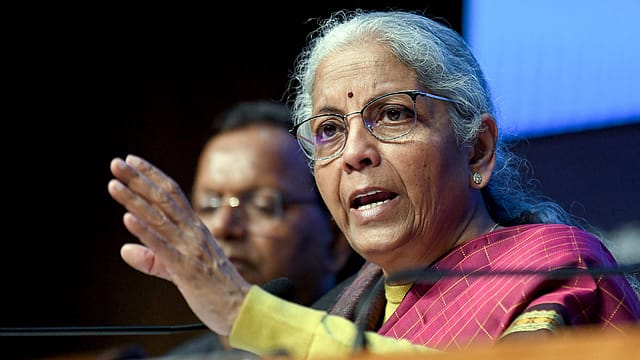
Union Finance Minister Nirmala Sitharaman on Monday outlined the biggest external risks facing India’s economy, warning that volatile global fuel, fertilizer and gold prices are putting pressure on foreign exchange reserves and increasing uncertainty for businesses.
Speaking at the 37th Foundation Day celebrations of Small Industries Development Bank of India in Mumbai, Sitharaman linked the economic uncertainty to the ongoing tensions in West Asia and said the government’s focus remains on protecting citizens, supporting MSMEs and maintaining supply chain stability.
“It is because of high international crude prices,” Sitharaman said while explaining the Prime Minister’s emphasis on conserving foreign exchange. “And the high crude prices are ever changing. It's seriously dynamic. One rate at one point in time, within a week another, within a week another, and so on. Like that it has been for over now 80, 90 days,” she added.
She identified what she called the “three Fs” creating pressure on India’s external sector. “High international crude prices and very fluctuating one. High international fertilizer prices. Considerable increase in the fertilizer prices, high gold prices that is creating some challenges on the external front,” she said.
“To just put it in context, all these three payments will have to be in foreign exchange. There is no rupee trading there. We should please understand the context of these three Fs,” she said.
“The three Fs, fuel, fertilizer, and foreign exchange. And the foreign exchange is for, in this context, purchase of gold,” Sitharaman added.

Exclusive: To the Heavens and Back
19 Jun 2026 - Vol 04 | Issue 76
Shubhanshu Shukla relives the space odyssey that put India into orbit
West Asia Crisis and Its Impact on Businesses
The Finance Minister said the geopolitical tensions in West Asia are having direct consequences for businesses and consumers in India through higher logistics and shipping costs, disruptions in supply chains and pressure on exporters.
“For businesses and common people, it can mean higher fuel cost, delayed cargo, costlier shipping, shortage of inputs, pressure on working capital, and uncertainty in export orders,” she said.
“The approach, therefore, has been and will have to be to protect citizens, support MSMEs, safeguard exporters, keep supply chains moving, and maintain economic stability,” she added.
Sitharaman said the government had reduced excise duty on petrol and diesel by Rs 10 per litre to cushion citizens and businesses from the impact of rising crude oil prices, even though the decision would lead to a revenue impact of more than Rs 1 lakh crore.
She also highlighted customs duty exemptions on key industrial raw materials to help exporters and support supply chain continuity.
SIDBI’s Role Must Expand Beyond Traditional Lending
A major focus of Sitharaman’s address was the evolving role of Small Industries Development Bank of India in supporting India’s MSME and startup ecosystem.
The Finance Minister said SIDBI should transition from being merely a lender to becoming a broader financial partner capable of sharing risks and creating market opportunities for businesses.
“SIDBI's role must now expand from being only a lender to becoming a market maker and risk-sharing partner for India's MSME and startup ecosystem,” she said.
According to Sitharaman, India’s small businesses and startups require more flexible financing structures tailored to the realities of their sectors instead of standardised loan products.
“Standard products cannot serve non-standard businesses,” she said.
She argued that repayment structures should vary depending on the nature of the business and its operating cycle, including for sectors such as agriculture, engineering and tourism.
“Why should all of them be given the same repayment structure? Credit must be designed around the business cycle of the enterprise,” Sitharaman noted.
The minister also encouraged SIDBI to deepen its participation in venture capital and debt markets so that early-stage businesses can access long-term and flexible capital support.
Government Highlights India’s Economic Resilience
Even while acknowledging global economic headwinds, Sitharaman maintained that India’s domestic economic fundamentals remain strong and resilient.
“We must also recognize that India's domestic economic situation remains positive and resilient even today,” she said.
She cited rising GST collections, tractor sales, passenger vehicle sales and life insurance premiums as indicators of economic strength.
“Gross GST collections crossed $22,000,000 crores for the year 2025-26, rising 8.3%,” she said, adding that “domestic wholesale tractor sales rose by 26%. Passenger vehicle domestic sales grew by 25%.”
Sitharaman also criticised what she described as unnecessarily pessimistic narratives around India’s economy.
“There is a section, I would think, of Indians who very quickly want to decry the achievements of our own people... a pessimistic, cynical narrative is generated which is just not right. It's not right is one thing, but it is wrong because it is fear-mongering. India cannot afford fear-mongering,” she said.
The Finance Minister added that the government’s Emergency Credit Liquidity Guarantee Scheme 5.0 is expected to facilitate an additional Rs 2.55 lakh crore in credit support for MSMEs with full government guarantee coverage.
(With inputs from ANI)