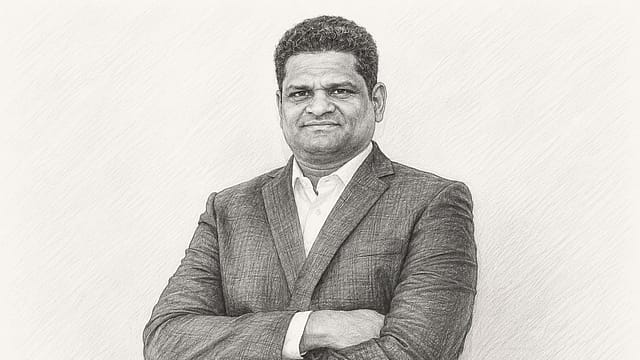
The Founder Who Discourages Founders: Sriram Kannan & the Anti-Story of Routematic
In the final moments of Kantara, the protagonist Shiva doesn’t argue. He doesn’t negotiate. He stomps. The ground answers. The forest tightens. And the air shifts.
Possessed by Guliga Daiva, Shiva steps into something larger than himself—claimed by it, consumed by it, and almost erased inside it. Fire carves a circle into the earth. A boundary. Inside it, there is authority. Outside it, nothing. Two worlds. One line. And then, he disappears.
Back in the real world, Sriram Kannan doesn’t speak like this. He doesn’t believe in drama. Or mythology. Or performance. But when he reaches for a metaphor, this is the one he chooses. Because, in his world, lines matter.
Kannan doesn’t think you should do it. Not because it’s hard. Entrepreneurship obviously is. He still tries to shoo you away from it. Not because founders might fail. Ninety-nine percent chance, they do.
So, what makes him deter people from taking the very plunge he once took? Simple. Most people aren’t built for it.
Read that again. Sriram Kannan says this without drama, without pause. No hedging. No softening. The kind of clarity that isn’t here to convince. It filters.
In an ecosystem that thrives on encouragement, Kannan does the opposite. He warns. He questions. He strips entrepreneurship of its romance and leaves behind something far less flattering.

I.N.D.I.A. Falling
12 Jun 2026 - Vol 04 | Issue 75
The Unravelling of an Alliance
Inside the world of the computer scientist from the Indian Institute of Science, Bengaluru, there are no grand arcs. No defining moments of triumph or collapse.
Why Sriram Kannan Doesn’t Believe in Startup Success, Failure, or Milestones
Ask him about his journey, and he won’t give you the answer you’re looking for. “I don’t see things as easy or difficult,” he says. “It has been interesting.” He stays there. Doesn’t expand. Doesn’t decorate the word. In his telling, a journey isn’t a story. It’s a continuous stretch of problems, decisions, and adjustments, where the destination keeps shifting and the only constant is motion.
Push him, and he still won’t move to the usual markers—success, failure, highs, lows. Those categories don’t seem to hold much meaning for him. The destination, he says, keeps resetting anyway. What once felt like a milestone—₹1 lakh a month, then ₹10, then ₹25—just moves further out. “It just keeps going forward, you’re never satisfied.”
So, he doesn’t measure progress that way. Instead, he flattens the journey. A sequence of problems. A series of calls. Some right, some wrong. Most irreversible. This brings us to a different kind of question. What kind of founder builds a company by refusing the very narrative most founders depend on?
The answer begins with what drives him.
Once you remove the idea of a fixed destination, what remains is the nature of the work itself. And Kannan is clear about what draws him in. “I like complexity,” he says. “Mathematically difficult, business-wise hard.” Not scale. Not valuation. Not even certainty. Just problems that don’t resolve easily.
It shows up early in the way he talks about motivation.
Money, Kannan admits, is there. It would be naive to deny that. But it isn’t the reason he keeps going. What holds his attention is something else—the act of working through a problem that refuses to resolve cleanly. Something immediate. Something messy. Something real.
Take, for instance, transport. It’s not a distant, abstract idea. Not a future-facing vision deck. A present-tense problem, unfolding every day in routes, delays, no-shows, coordination failures. A system that breaks in small ways, repeatedly.
That’s where he chooses to stay. And once you see that, some of his decisions begin to make more sense.
Look at the first real “hard call” he remembers. It didn’t come during a crisis. It wasn’t triggered by a market collapse. The business was growing. On the surface, things were going well. And yet, Kannan had to let people go. “The hardest point is when you have to downsize the team, especially high-performing ones,” he says.
How Sriram Kannan Built Routematic: Systems Thinking, Tough Calls, and Scale
There’s no attempt to dramatize it. No pause to reflect on what it meant. Just the decision, laid out in context—cash flow, working capital, constraints. The explanation stays functional. He doesn’t claim to be emotionless. “Everybody has emotions,” he says. The distinction, for him, is whether you can draw a line and still take the call.
Over time, that line seems to have settled into habit. People who’ve worked with him describe him as steady to the point of opacity. Good news or bad, the reaction doesn’t shift much. “I don’t react much to positive or negative news,” he admits.
And it stays consistent with how he sees the journey itself—not as a series of emotional peaks, but as a continuous system that needs to be managed. That’s why, when he talks about entrepreneurship, he doesn’t reach for the usual language of vision or belief. Kannan reaches for math.
That instinct—to reduce everything to systems, to variables, to something that can be worked through—didn’t stay theoretical. It turned into a company.
Routematic began in 2013 as a software platform, long before “mobility” became a crowded buzzword. Its first client was Cisco. For a while, it stayed what it was meant to be: a SaaS layer solving a specific operational problem.
Then, in 2018, Kannan pushed it into something far more complex: Fleet operations.
The shift wasn’t cosmetic. It meant stepping out of software and into the friction of the physical world—vehicles, drivers, routes, delays, unpredictability. Infosys came on board as the first fleet client. The model expanded from code to coordination, from product to execution.
The bet was harder. It was also clearer.
Over time, Routematic began to look less like a tool and more like infrastructure. Today, it operates across more than 24 cities, serving over 400 enterprise clients and upwards of 350,000 monthly users. What started with 10 trips a day now runs over 10,000 daily trips, with thousands of vehicles on its platform.
The stack has grown with it—corporate mobility software, transport-as-a-service, fleet operations—layered one over the other, all built largely in-house.
That pressure doesn’t just come from within the business. It comes from outside it.
Take the noise around work-from-home. For a company built around daily employee mobility, the shift could have been existential. Fewer people commuting. Fewer routes. Less demand.
Kannan doesn’t dramatize that either. He treats it like any other variable. Something to account for. Adjust to. Work through. Not a disruption to react to—but a condition to operate within. Because in his model, external noise doesn’t change the system. It becomes part of it.
And that approach shows up in what the company does next.
In May 2025, Routematic raised $40 million in a Series C round, one of the largest transport-tech raises in the country that year. Soon after, it rolled out COCO Rides in Pune—an app-based employee shuttle service designed for dense corporate clusters, with capacity to move tens of thousands daily.
From Sustainability to Systems: Why Sriram Kannan Thinks in Iteration, Not Outcomes
Alongside scale, there has been a steady push towards sustainability. The company is targeting a 30% EV fleet share, with electric operations already live across Delhi-NCR, Pune, Bengaluru, Chennai, and Hyderabad.
In July 2025, Routematic launched Pune’s first fully diesel- and petrol-free corporate fleet in collaboration with Infosys. Today, over 400 EVs deployed across Bengaluru and Pune are projected to save nearly 15.7 lakh litres of fuel annually, translating into over ₹15 crore in cost savings.
And somewhere along the way, something else happened. It turned profitable. Not as a milestone to celebrate, but as a necessity to survive. The numbers reflect that shift. From ₹16 crore in FY21, Routematic grew to ₹178 crore in FY25, and is now projecting an operating revenue of ₹350–400 crore in FY26.
This brings us back to the way Kannan thinks: Not in stories but in systems.
If Routematic is what Kannan has built, this is how he explains it to himself. Not as a journey. As a mechanism. “It’s like a combinatorial lock,” he says. You keep turning. Trying combinations. There is no visible pattern. No sequence you can rely on. No signal that tells you you’re getting closer. You don’t know which move works. You only know that stopping guarantees that none of them will.
That framing strips away a lot of assumptions. Effort doesn’t map neatly to outcome. Time doesn’t guarantee progress. And success, if it comes, arrives without announcing which attempt made the difference. It also changes what the real challenge looks like. Not solving the problem. Staying with it. “Every day you spend, you grow one inch and you give back one inch,” he says.
Growth and erosion, happening together. From the outside, that can look like stagnation. From the inside, it feels like accumulation. Something is building, even if it doesn’t show yet. But only if you stay. Leave early, and it looks like nothing ever moved.
That’s why Kannan places unusual weight on something most founders don’t talk about directly: Time spent. Not speed. Not efficiency. Just time. In his model, time is the only variable that compounds without permission. Everything else—markets, funding, outcomes—remains uncertain.
This is also where his relationship with comparison breaks down. Early on, he says, it was unavoidable. The instinct to measure yourself against others—how fast they’re growing, how much they’ve raised—comes almost built-in. “Raising money is like marks,” he says. A familiar scoreboard.
But over time, that framework stops holding. Because comparison assumes that everyone is solving the same problem. On the same timeline. With some shared logic underneath.
No Formula, No Failure: Why Sriram Kannan Filters Founders and Focuses on Staying in the Game
Kannan doesn’t believe that logic exists. “There is no formula,” he says. Not as a rejection. As a conclusion. And once that sinks in, the noise loses its edge. What others are doing stops being signal. It becomes background. Interesting, maybe. Occasionally useful. But not decisive. Irrelevant to the only question he seems to return to: Are you still in it?
That question also reshapes how he sees failure.
The word itself doesn’t sit well with him. It carries weight it doesn’t deserve. Finality it hasn’t earned. He prefers something more precise: Trials. A series of attempts. Most of which won’t work. Not because something broke, but because that’s how the system is designed. One works. The rest don’t. That’s not failure. Call it structure.
Seen this way, entrepreneurship stops being a story of breakthroughs and collapses. It becomes a process of iteration, bounded only by how long you can keep moving. And in that process, outcomes matter less than continuity. In the end, nothing guarantees that the next turn will open the lock. Except the fact that you didn’t stop turning.
If Kannan sounds measured when he explains how things work, he is far less accommodating when he explains who should even try. He doesn’t encourage. He filters. “I am discouraging,” he says plainly. Not as provocation. Not as reverse psychology. As a position. Because, in his view, most people misunderstand what they’re signing up for. They see the outcome. The surface. The version that has already survived. What they don’t see is everything that didn’t. That’s why he has little patience for the way entrepreneurship is often taught, packaged, or even discussed.
The questions, especially from younger founders, tend to follow a pattern. What should I do? How should I start? What steps should I take? He doesn’t answer them directly. Instead, he reframes the test. “Wet your toe,” he says. Try going without a job for three to six months. No safety net. No steady income. No clear plan. See what that does to you. Not as preparation. As filtration. Because if that phase itself feels unbearable, what comes later won’t be easier.
Kannan pushes it further. Can you stay idle? Can you withstand uncertainty without immediate reward? Can you continue without validation? If the answer is no, he doesn’t soften the conclusion. “You are not going to start anything.”
Why Startup Success Stories Are Misleading: Sriram Kannan on Survival Bias, Systems, and Staying in the Game
It’s a harsh line. But it follows the same logic he applies everywhere else. No mythology. No dilution. Just conditions.
This is also where he pushes back against something more subtle—the way success stories are consumed. Founders are often studied as templates. Their decisions broken down, their habits replicated, their journeys mapped into playbooks.
Kannan finds that instinct flawed. Not because the stories are wrong. Because they are incomplete. “You are seeing one among a thousand,” he says. The one that worked. The one that survived long enough to be visible. The other 999 don’t get documented. They don’t get analysed. They don’t become lessons. This makes the entire exercise biased from the start. Like studying only the planes that made it back. And ignoring the ones that didn’t.
So, when someone asks how to replicate success, he doesn’t offer a method.
He offers a warning. What you are studying is not the system. It’s the exception. And exceptions don’t scale. This brings him back to the same point he started with. This isn’t about wanting it badly enough. It’s about whether you are built to stay in it long enough. And whether you are willing to accept that most of what you try won’t work. Not as failure. As structure.
In the end, what Kannan has built isn’t just a company. It’s a boundary. A defined space where things make sense on his terms. Where the rules are internal. Where the noise outside doesn’t interfere with the system inside.
He doesn’t claim universality. In fact, he resists it. “I am not a CEO,” he says. “I am the Routematic CEO.” It sounds limiting. But that’s the point. Because outside that space, he admits, the same instincts may not hold. The same decisions may not translate. The system may not work.
Inside it, they do. And that is enough. Which is why the metaphor he reaches for is telling. Not a founder. Not a builder. Not even an entrepreneur. A boundary.
Back in Kantara, Shiva doesn’t explain the circle. He draws it. He stomps. The ground answers. The line appears. Inside it, there is authority. Outside it, nothing. Two worlds. One line.
Kannan doesn’t disappear into his. He stays inside the system he has built. He stays inside the constraints he understands. Turning, adjusting, and continuing quietly without spectacle and narrative. Just the work. And the circle.