Old Soles, New Rules: Nike & the Battle to Stay Desirable
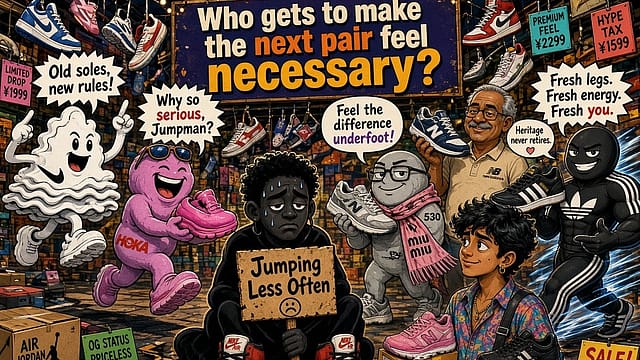
Nike is trying to make the Jumpman jump less often.
On its October 1 earnings call, chief executive Elliott Hill acknowledged that the company had been oversupplying its iconic Jordan retro products. Nike would reduce the volume and frequency of selected launches. One of the most famous silhouettes in sport needed a little less exposure.
There is a fascinating problem for a marketing company: how do you make people miss something you have worked so hard to put everywhere?
For Nike, the answer has become financially urgent. Revenue in the quarter ended August 31, 2026 fell 4% to $11.2 billion. Greater China sales dropped 22% on a reported basis, or 26% excluding currency movements. The company expects another annual revenue decline in fiscal 2027.
The Modi Years
02 Oct 2026 - Vol 05 | Issue 40
A Nation Rebuilt
But the most awkward part of Nike’s predicament is standing in the other shoe shops.
On and Hoka are growing. So are New Balance and Adidas. Nike faces younger specialists with distinctive products and established rivals finding fresh uses for their inheritance. Its competitors are making the age of a brand a poor explanation for the state of its business.
The question is sharper than whether old sportswear companies can woo young consumers. Why does one brand’s past feel like a discovery while another’s starts to feel like repeat telecast?
DAD’S SHOES HAVE PLANS TONIGHT
New Balance makes a particularly inconvenient witness for anyone preparing the obituary of heritage.
The company, founded in 1906, reported global sales of $9.2 billion in 2025, up 19%. A business old enough to have watched several generations discover youth culture is still expanding at a pace many younger brands would happily borrow.
Its June 2026 collaboration with Miu Miu and Coco Gauff offers a useful glimpse of how. The collection brought together a current tennis star, a luxury fashion label and New Balance’s sporting identity. White court clothes, navy piping and a reworked 530 SL sneaker placed the brand in a contemporary conversation about sport and style.
The interesting thing is the combination. New Balance did not have to choose between looking credible on a court and interesting beyond it. Gauff supplies sporting relevance; Miu Miu supplies another vocabulary for wearing it.
Marketing and branding experts reckon that a century of history can be useful material when somebody does something with it. Heritage gives a brand recognition and credibility. "Relevance comes from what the consumer can do with that heritage today,” says Ashita Aggarwal, professor of marketing at SP Jain Institute of Management & Research. “A younger buyer should be able to make the brand part of their own identity, rather than feel they are wearing somebody else’s memories,” she adds.
Adidas presents a different complication for Nike. Its currency-neutral revenue rose 14% in the quarter ended June 2026. More revealingly, its first-half Performance business grew 34%, while Lifestyle grew 4%.
That is a considerably broader recovery than a neat tale about fashionable retro sneakers would suggest. The company’s sporting business is doing substantial work alongside its lifestyle franchises.
For Nike, the competitive pressure comes from both directions. A classic can acquire a new audience, while a fresh performance product gives an established name another claim on the future. Having an archive becomes dangerous when the business asks it to perform both jobs indefinitely.
A successful reissue also contains a trap. Each additional sale encourages the company to believe there must be another customer for the same story. Eventually, the commercial machinery can become better at repeating success than at recognising when repetition has started to weaken it.
The archive has become a very productive employee. Nobody wants to approve its leave.
THE SPECIALISTS WANT YOUR NEXT PAIR
On and Hoka apply pressure through a different route.
Their products give consumers something to notice before they have absorbed an advertising line: On’s conspicuous sole architecture, Hoka’s substantial cushioning and proportions. A distinctive shape can make the product itself an introduction.
The commercial momentum is real. On’s sales reached CHF850.3 million in the quarter ended June 2026, rising 13.5% as reported and 21.6% at constant currencies. Hoka’s sales rose 7.7% to $703.5 million over the same three months.
Neither number establishes that every additional sale came out of Nike’s pocket. What they establish is that consumers have growing alternatives with recognisable identities.
A specialist has a useful opening against an enormous generalist. It can make a focused promise around a particular activity or experience. A shopper may encounter it through running, investigate the product and then carry its appearance into everyday dressing.
The shoe can communicate both a practical choice and a taste choice. Looking different need not require abandoning the reassuring language of performance.
On also says consumers under 34 now account for more than a third of its customer base, with its Cloudtilt franchise resonating with that group. That is evidence of a younger audience, although under-34s are broader than Gen Z.
The challenge for Nike is how easily a rival can win a specific purchase without first defeating the entire Nike mythology. On does not need to replace every association attached to the Swoosh. It needs a convincing answer when someone asks which pair to buy next.
Nike can remain the famous name in the wardrobe while another brand becomes the interesting addition.
For a challenger, that is a perfectly respectable place to begin.
GEN Z HAS NOT FILED FOR DIVORCE
Pronouncing Nike irrelevant to the young would be satisfyingly dramatic. It would also be premature.
Piper Sandler’s fall 2025 survey of 10,969 US teenagers still ranked Nike first in footwear. On ranked fourth and Hoka fifth. The findings describe American teenagers, but they puncture the sweeping claim that a generation has collectively moved on from Nike.
Affection and purchasing exclusivity are different prizes.
A young buyer can admire Nike, recognise its athletes and own its products while finding another brand more appealing for a particular occasion. The competitive danger is fragmentation: several credible names each supplying a reason to enter the shopping basket.
That requires a more demanding response than merely reminding people that Nike exists.
“Consumers do not have to reject a brand to spend less of their money on it,” says Aggarwal. A challenger can win by becoming the preferred choice for one occasion. For the incumbent, the danger is assuming that broad admiration guarantees the next purchase.
This is where the distinction between recognition and desire becomes expensive. Recognition accumulates. Desire needs renewal.
A familiar logo can get a product considered. Fit, comfort, design, price and the pleasure of finding something that feels personal still have to finish the sale.
CHINA DOES NOT OWE THE SWOOSH A COMEBACK
China gives Nike’s rivalry problem its hardest edge.
Greater China revenue declined from $7.55 billion in fiscal 2024 to $5.85 billion in fiscal 2026, a fall of roughly 22.5% over two years. The subsequent August quarter brought the further sharp decline.
An explanation confined to a difficult Chinese consumer market quickly runs into Adidas. In its quarter ended June 2026, Greater China revenue grew 15% at constant currencies. The reporting windows differ, but Nike’s difficulties plainly coexist with growth for another large international sportswear brand.
Chinese competitors complicate the picture further. Anta Sports reported first-half 2026 revenue of RMB43.51 billion, up 12.9%. Its portfolio spans the Anta brand alongside names including Fila, Descente and Kolon Sport.
That makes the contest more varied than an American brand facing a single domestic substitute. A Chinese sportswear group can offer consumers different combinations of performance, fashion, outdoor identity and price positioning across several labels.
Nike has to compete with that variety. Global fame gives it a powerful introduction, but leaves plenty of work for the products and the shopping experience.
Hill’s diagnosis includes some unglamorous basics. He said most partner stores in China had not been refreshed in seven years. Nike is narrowing digital distribution around selected official storefronts and its own channels, and preparing an October collection created locally for China.
Seven years is a long time to ask a shop to keep looking like the future.
Local product creation also raises a more fundamental question about how a global brand listens. The closer design decisions sit to the consumer, the greater the opportunity to respond to particular tastes and uses. A market can recognise a global symbol and still want something more specific beneath it.
Nike’s reset therefore has to reach beyond advertising. A refreshed campaign pointing towards a tired store would simply make the contradiction better lit.
The difficulty is that repairs take place in public. While Nike reduces excess, updates shops and reshapes distribution, competitors are still offering consumers something to buy. A cleaner business tomorrow must be built without surrendering too much relevance today.
INDIA IS ALREADY RUNNING
India now occupies a visible place in Nike’s corporate plans.
On October 1, the company announced a new Bengaluru campus to develop capabilities supporting Nike, Jordan and Converse globally. Existing India employees will move in phases, with expansion planned over several years.
That gives India a role in how Nike operates around the world. Winning the Indian consumer requires its own work.
Nykaa’s February 2026 investor presentation set out a partnership under which Nykaa Fashion would operate Nike.in and the Nike Commerce App, including digital marketing, fulfilment and customer experience. These are consequential parts of the purchase: finding the product, receiving it and getting help when something goes wrong.
Meanwhile, competitors are making increasingly specific sporting pitches.
On September 28, Decathlon announced an Indian launch of 17 new Kiprun running shoes. The range covers different uses, including daily training, cushioned running, mixed terrain and carbon-plated racing.
That is a useful challenge to the power of a famous badge. It invites the customer to begin with the run: the surface, the distance, the desired experience. The brand then has to explain which product belongs on that foot.
Nike has considerable sporting credibility to bring to such a conversation. But credibility becomes more persuasive when a shopper can connect it to a clear benefit and a suitable product.
For an Indian consumer considering a serious running purchase, the contest can therefore be much more precise than global brand stature. Which pair fits? Which one suits the training? Which can be tried, bought and supported conveniently?
The winner of that conversation earns something an imposing worldwide reputation cannot automatically deliver: a locally useful reason to choose.
JUST EARN IT
Nike still has substantial ammunition.
On the October earnings call, Hill reported high-single-digit growth in its performance portfolio and double-digit growth in running. Its problems do not amount to an absence of sporting innovation.
Those gains offer a route forward. Performance can generate fresh product stories, while disciplined management of classics protects what made them desirable. The difficult part is getting both to work across a business of Nike’s size.
On faces its own version of that test as it expands: keeping distinction and premium positioning intact while selling more. Hoka has to keep producing reasons for another purchase. New Balance and Adidas must ensure that today’s successful reinvention does not become tomorrow’s exhausted formula.
Nobody receives permanent ownership of cool.
For Nike, reducing the supply of familiar products may restore some scarcity. But a shopper who cannot find the desired Jordan also has the option of discovering something else. Absence works best when the desire survives it.
“A brand cannot rely on making an old favourite harder to buy,” says Aggarwal. It also needs to make the next product worth wanting. "Reinvention succeeds when the consumer has a fresh reason to choose you, even with more alternatives available.”
The rivals circling Nike offer several such reasons: a different feel underfoot, a distinctive silhouette, a compelling sporting use or an old design made newly interesting.
Nike helped teach the world how much meaning a pair of shoes could carry. Its competitors would now like to carry some of it.