Meesho vs Nykaa: The Battle for Small-Town India’s Beauty Budget
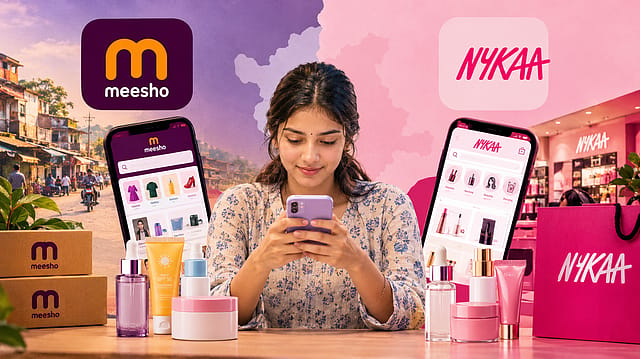
A ₹16 gap on a small bottle of face serum shows where Meesho and Nykaa’s businesses meet.
Public listings reviewed on October 29 showed The Derma Co’s 10% niacinamide serum, in a 10ml pack, at ₹221 on Meesho and ₹237 on Nykaa. A second matching product, the brand’s 2% salicylic acid serum with witch hazel and willow bark, also in 10ml, appeared at ₹223 and ₹237, respectively.
These are listed prices, not completed checkout totals. Delivery charges, promotions, availability and postcode-specific conditions can change the comparison. Two products from one brand cannot establish which platform is generally cheaper. But they do establish an overlap: shoppers can encounter the same branded skincare products on an app associated with value shopping and a specialist beauty retailer.

Look Who's Talking Regime Change
23 Oct 2026 - Vol 05 | Issue 43
Meesho’s latest shareholder letter explains why that overlap deserves attention. It says customers who initially bought branded soap, shampoo, detergent and diapers through Meesho Mall are also buying face serums, sunscreens, conditioners and face rollers.
The emerging contest is for the shopping relationship as those purchases become part of a routine.
FROM SOAP TO SERUM
Meesho Mall hosted approximately 1,800 brands in Q2 FY27. Its net merchandise value grew 81% year on year, and 89% in Tier 3 and smaller cities. About half its customers during the quarter were buying on Mall for the first time.
The qualifications matter. These are Mall-wide figures, rather than beauty-category growth. A first-time Mall customer may already have bought elsewhere on Meesho, or purchased the brand through another retailer.
The revealing disclosure concerns the changing basket. Meesho says earlier essentials purchases built trust, helping customers venture into discretionary products.
For a shopper, that progression can involve a familiar brand appearing in an unfamiliar category. For the platform, it creates an opportunity to become the place where the next purchase is considered.
A customer may arrive for a household necessity and later compare products for a skincare routine. Earning that second decision expands what the shopping relationship can become.
NYKAA HAS AN ANSWER
Nykaa’s proposition includes a clear sourcing assurance. It says products are obtained directly from brands or authorised distributors. The niacinamide serum listing names Nykaa E-retail as the seller and explicitly states that the product was purchased directly from The Derma Co.
Meesho’s corresponding listing displays Mall markers identifying an original brand and authorised seller, alongside the seller’s storefront.
Both are making authenticity part of the purchase proposition. These published assurances are not an independent inspection of the goods eventually delivered.
The competitive issue is how much confidence each platform earns when the customer compares offers.
Nor is Nykaa standing still. In its provisional October 4 update, it expected Q2 FY27 beauty net revenue and net sales value growth in the late twenties. Its store network reached 338 at September 30, with like-for-like store sales growth in the early twenties.
That gives Nykaa physical locations through which customers can encounter its assortment, alongside its digital business.
Comparing that growth directly with Meesho Mall’s 81% would be misleading. The businesses, categories and measures differ. The disclosures support an expanding area of competition, without establishing that one company is taking sales from the other.
ZERO COMMISSION STILL HAS AN ECONOMIC TEST
Meesho describes Mall as commission-free. For participating brands and sellers, that can make the channel attractive. It does not automatically establish the lowest price for shoppers.
The company’s letter also says marketplace revenue benefited as sellers invested more in advertising. Logistics services and promotional decisions form other parts of the commercial relationship.
A seller can face costs while paying no sales commission. Whether savings reach the customer depends on the total cost of selling, the brand’s pricing strategy and the offer available elsewhere.
The two serum listings illustrate how close the contest can be. Their combined advertised prices were ₹444 on Meesho and ₹474 on Nykaa, a ₹30 difference before any checkout adjustments.
For Meesho, sustaining a price advantage while improving the experience would strengthen the proposition. For a specialist retailer, a modest difference creates room to compete through selection, convenience and confidence.
Neither business can rely on the advertised price alone to explain why the customer should stay.
THE CREATOR WHO GETS THE ORDER
Meesho has another route into purchasing decisions: content commerce.
The company says its content-commerce net merchandise value grew 160% year on year in Q2 FY27. Some 2.2 million pieces of content generated orders, up 144%, while more than 400,000 sellers participated in the ecosystem. Creators earn when their content leads to a purchase.
These are platform-wide disclosures. They do not establish how much beauty buying came through creators.
The mechanism nevertheless matters for skincare. A demonstration can make a product easier to understand and give an unfamiliar purchase a recognisable recommender.
Paying for a resulting purchase encourages conversion. It does not, by itself, establish that the recommendation suits the buyer or produces satisfaction later.
The durable commercial test would track what happens after the demonstration: whether the order is kept, whether the customer is satisfied and whether the product is purchased again without another incentive.
A creator can introduce the product. The subsequent experience determines how much that introduction is worth.
THE RETURNS BADGE NEEDS READING
The small print also complicates an easy price comparison.
The Meesho serum pages displayed a seven-day returns badge. Nykaa’s pages specified a 15-day request window, but limited returns or replacements to unused products involving defects, delivery damage, missing items or incorrect deliveries.
Those are different levels of information, rather than proof that either platform offers a better policy. A returns window alone does not explain eligibility, and neither page establishes that a customer can freely try the serum and send it back.
For shoppers, confidence includes knowing who resolves a problem and under which conditions. A saving becomes less persuasive if the customer cannot understand what happens after something goes wrong.
THE ORDER THAT DEFINES THE RIVALRY
Meesho’s beauty opportunity is credible because its existing shopping relationship can extend into more branded categories. Nykaa’s position rests on a specialist proposition that already combines assortment, sourcing assurances and a growing store network.
The available disclosures do not measure customers switching between them. They also leave important questions about Meesho Mall’s beauty scale, repeat buying and profitability unanswered.
The disclosures reveal two platforms seeking a place in the same customer’s skincare spending.
The next stage of this rivalry will be decided by the customer who finishes a bottle, opens a shopping app and chooses where to buy it again.