JCB India’s Sales Fell. So, How Did It Make ₹2,157 Crore in Profit?
“New Zealand will now build with a ‘Made in India’ JCB machine!”
Commerce and Industry Minister Piyush Goyal’s October 19 post on X placed a Pune-manufactured machine at the centre of a trade milestone. As the India–New Zealand Free Trade Agreement comes into force on October 20, the shipment offers a visible example of the manufacturing opportunities both governments want businesses to pursue.
behind the identified machine--JCB-18Z mini excavator--stands a business whose recent financial performance poses a more intriguing question than the flag-off alone.
Crisil Ratings’ July assessment puts JCB India’s provisional FY26 operating income at ₹19,710 crore, against ₹20,201 crore in FY25. Standalone, Crisil-adjusted profit after tax rose to ₹2,157 crore from ₹1,985 crore. That is roughly 2.4% less operating income and 8.7% more profit.

Zeroing In on ECI
09 Oct 2026 - Vol 05 | Issue 41
Constitutional legitimacy versus political opportunism
For a manufacturer associated with digging and lifting, the revealing movement was in the margin. The New Zealand consignment opens a window into how the company built its Indian position—and why selling more of its production overseas matters.
A BRITISH NAME, AN INDIAN INDUSTRIAL BASE
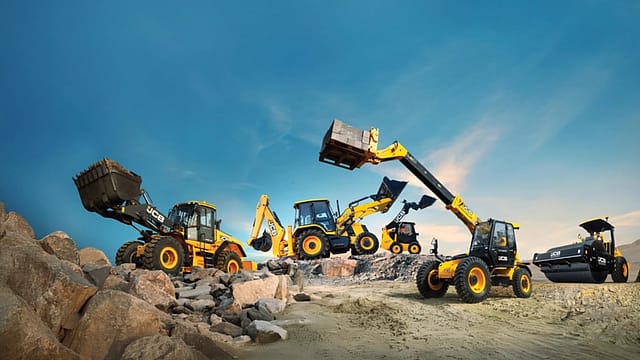
JCB takes its initials from Joseph Cyril Bamford, who began the business in Britain in 1945, making a tipping trailer from surplus wartime materials. Its corporate history dates its pivotal backhoe-loader design to 1953, combining a front loader with a rear excavating arm.
That combination explains much of the machine’s appeal. A contractor can use one piece of equipment for loading and excavation, rather than buying a separate machine for every task. Versatility matters when the work varies and an expensive asset needs enough paid hours to justify its purchase.
JCB entered India through a joint venture in 1979 and is now wholly owned by the British group. Its Indian operations expanded beyond the original Ballabgarh base into Pune, Jaipur and Vadodara.
The manufacturing footprint has also become part of the global business. JCB’s 2022 announcement described the £100 million Vadodara plant as a source of fabricated parts for its worldwide production lines.
India, therefore, supplies more than a large customer pool. It supplies manufacturing capability, components and engineering work. JCB’s India profile describes Pune as the location of its largest design centre outside the UK, employing more than 400 engineers.
That is the industrial foundation beneath the minister’s Made-in-India message: years of investment made it possible to put a locally manufactured machine on an international shipping route.
THE ADVANTAGE GOES BEYOND THE YELLOW PAINT
Crisil puts JCB’s Indian construction-equipment market share above 40%, including approximately 80% in backhoe loaders. Its share in excavators is much lower, though still sizeable, at more than 15%.
Those distinctions matter. Dominance in the familiar backhoe does not establish equal strength across every equipment category.
The physical machine is only one part of the buying decision. A contractor also needs parts, repairs and people who know how to keep it working. A cheaper purchase can become expensive if a breakdown leaves the equipment idle while the job waits.
JCB’s own India profile lists more than 60 dealers and 700 outlets, supported by five parts warehouses. It also says its India-made backhoe loader is more than 95% indigenised and supported by a local supplier base. Those localisation claims apply to the backhoe, rather than every machine in its range.
The commercial inference is straightforward: manufacturing depth and service reach can reinforce each other. More machines create demand for support; dependable support gives buyers a reason to consider the next machine.
Maintaining that advantage requires continued execution. An installed base is valuable only while customers can obtain the service they expect.
HOW PROFIT ROSE AS SALES FELL
JCB India’s operating margin increased to approximately 16% in FY26 from 14% in FY25. Crisil attributes the improvement to premium pricing, input-cost pass-through, product mix and a higher export contribution.
The distinction between revenue and earnings is important. A manufacturer can improve profitability without increasing its top line if the mix of products, prices and costs becomes more favourable.
That does not mean a fall in demand is harmless. Factories, skilled employees and distribution require sustained business. Pricing power can protect margins, but customers ultimately need enough work to justify buying equipment.
The broader industry provides context. ICEMA reported an approximately 2% decline in total construction-equipment sales in FY26, alongside strong export growth. Slower infrastructure execution and project delays weighed on domestic demand.
An infrastructure allocation becomes an equipment order only after projects advance far enough to create work. Land availability, payments and execution schedules can therefore matter to machinery demand as much as announcements of future spending.
JCB’s financial performance shows resilience within that cycle. It does not establish immunity from it.
THE EXPORT BUSINESS WAS ALREADY UNDER WAY
In a recent media interview, JCB India chief executive and managing director Deepak Shetty reportedly said the company expected to export about 18,000 machines in calendar 2026, against roughly 15,000 in 2025—a projected increase of 20%.
He also said JCB India exported to 140 countries and shipped overseas approximately a quarter of its India-made production. Those are management’s disclosures, and the 2026 shipment figure remains a target.
Crisil separately put exports at around 22–23% of FY26 revenue. The two measures describe different things: production units and revenue, across different reporting periods. They should not be treated as interchangeable.
The strategic benefit of exports is diversification. A factory can serve customers whose investment cycles differ from those of Indian contractors. International demand can also support a broader production programme.
Overseas sales bring their own costs and risks: shipping, currency movements, local regulations, dealer support and competition. Reaching many countries demonstrates distribution reach; the quality of that business depends on what each market contributes after serving it.
Shetty highlighted New Zealand’s applications beyond construction, including agriculture and material handling. That broadens the potential customer base, but the eventual opportunity depends on equipment suited to those customers and support close enough to keep it productive.
WHAT THE FTA CHANGES
The agreement provides duty-free access across New Zealand’s tariff lines for qualifying Indian exports from entry into force. Both governments have confirmed October 20 as the commencement date.
That creates a more favourable trading framework. It does not make every product automatically eligible, nor does a zero-duty commitment establish the exact incremental saving on a particular shipment.
New Zealand Customs requires proof of origin and compliance with customs, biosecurity and product requirements. The commercial calculation must still account for the machine’s classification, previous tariff treatment, freight and the final price offered to the customer.
JCB already has a New Zealand product and dealer presence. The significance of the flag-off should therefore be understood around the India-made consignment and the new trading framework, rather than as the brand’s first appearance in that country.
For JCB India, the strongest opportunity is to use its established manufacturing capability within that framework. The agreement can improve access; the company must still win the order.
THE NEXT TEST IS REPEAT BUSINESS
Crisil describes JCB India as debt-free, with existing capacity sufficient for its needs over the next three to four years.
That creates flexibility. Additional demand may be served without immediately undertaking a major capacity expansion. The potential benefit is better use of assets already built, although the return depends on product requirements and execution.
The company’s next challenge is to defend its core franchise while expanding the products and markets that support growth. Its strong backhoe position supplies a foundation; other segments require their own competitive case.
The minister’s post supplied the opening image: a Pune-made machine headed for New Zealand as a trade agreement takes effect.
The deeper story is the business behind it: decades of production, local engineering and support that can put an Indian-made machine to work thousands of kilometres away. The next proof of the New Zealand opportunity will come through customer orders, productive machines and repeat purchases.