India Continues To Grow Fast Even As Conflicts Rage On

The IMF made the projection in the latest edition of its World Economic Outlook (WEO) released on Tuesday. The IMF increased India’s growth rate by 10 basis points or 0.1 percentage point compared with its January forecast. These forecasts are lower compared to what the Fund projected in October. Then, the estimate for 2026 was 6.6%. These figures have bobbed up and down in tandem with uncertainties due to conflicts raging in different parts of the world. The projection for 2027 is identical with that for the current year. India is likely to grow at 6.5% in 2027.
Within South Asia, India is the fastest growing economy and is pushing up the growth of the region. South Asia is expected to grow at 6%, 50 basis points slower than India, with Bangladesh growing at 4.7% in 2026 and Nepal at 3%. Pakistan—which is not considered a part of South Asia in IMF’s classification—is expected to grow at 3.6%. Emerging markets and developing economies are forecast to grow at 3.9%
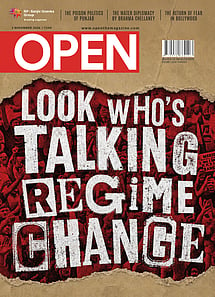
Look Who's Talking Regime Change
23 Oct 2026 - Vol 05 | Issue 43
A WORLD REARMED
The IMF report notes that the world is rearming itself once again. The trend of countries that spent more than two percent of their Gross Domestic Product (GDP) on military spending fell from 65 countries in the late 1980s to around 28 by 2020. That trend has reversed since then. Today 40 countries spend more than 2% of their GDP on defence spending. The trend in terms of global GDP spent on military spending is still cloudy--the data at the country level is clearer—the amount spent is now close to 2% of global GDP. But this figure is rising. The target for such spending set by the North Atlantic Treaty Organization (NATO) by 2035 is 3.5%.
The current defence spending boom is now at par with the one seen during the early 1960s, a decade after the Cold War had set in. The WEO report has a schematic analysis of the economic effects of these booms. But this mechanism is based on what investment and consumption of military hardware does in the short and medium run to individual economies. In the short-run, investment, consumption and output all go up, even if the size of the multiplier depends on multiple factors. In the medium-run, however, public debt is likely to go up.
There is, however, another aspect to this situation. Only a select few countries can reap the benefits of defence spending. These countries need to have domestic manufacturing capacity, a pool of technically equipped manpower and, above all, the ability of their governments to spend more on defence spending by shifting allocations from other sectors. India is one such country even if its spending on defence manufacturing and investment in defence related technologies has picked up only in recent years. India’s defence exports in 2025-26% are pegged at $4.15 billion, rising more than 60% over 2024-25. In the coming years, this number will go up.
But the economics of conflict is a mixed bag. Only a few countries can gain while the majority have to suffer from the consequences of broken supply chains and rapidly rising prices of key commodities. In the Ukraine conflict that began in 2022, prices of wheat, fertilizers and other commodities shot up to the point that many countries could not afford these goods. In the on-going conflict in West Asia, oil prices are imparting a global economic shock where no country is immune. India falls in this bracket of countries as well.