India, Arab League Adopt New Delhi Declaration, Set $500 Billion Trade Goal
India, Arab League Adopt New Delhi Declaration, Set $500 Billion Trade Target and Zero-Tolerance Terror Stance
India and the League of Arab States (LAS) on Saturday unveiled a sweeping upgrade of their strategic partnership, adopting the New Delhi Declaration that couples a hardline stance on terrorism with an ambitious economic and geopolitical roadmap stretching to 2030.
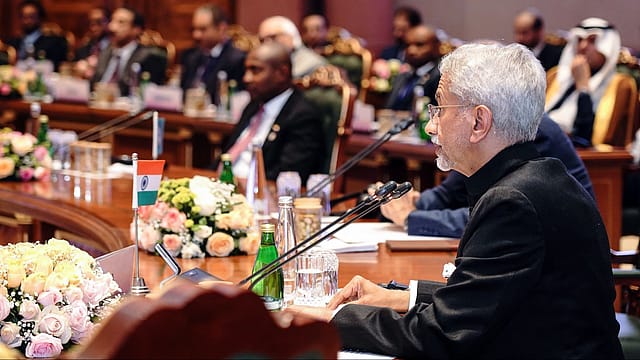
The declaration was adopted at the second India–Arab Foreign Ministers’ Meeting in New Delhi, co-chaired by India’s External Affairs Minister and attended by Arab foreign ministers and the LAS Secretary-General. At its core was a shared commitment to “zero tolerance” toward terrorism and a call for urgent reform of the United Nations Security Council (UNSC) to reflect contemporary global realities.
Arab foreign ministers strongly condemned the recent terrorist attack in Pahalgam that targeted Indian tourists, reaffirming solidarity with India and pledging decisive action against globally proscribed terrorist groups and their proxies, including those listed under the UNSC 1267 Sanctions Committee. Both sides also voiced concern over terrorist groups’ growing use of drones and advanced technologies for recruitment, propaganda, and illicit trafficking.
Beyond security: a broader geopolitical alignment
The declaration extended well beyond counter-terrorism. India and Arab states reaffirmed support for a just and lasting peace in the Middle East, backing a sovereign Palestinian state based on 1967 borders and welcoming the 2025 Sharm El-Sheikh Peace Summit ceasefire in Gaza. They praised the mediation roles played by Egypt, Qatar, the United States, and Algeria.

The Liberation of Bengal
05 Jun 2026 - Vol 04 | Issue 74
A silent revolution ends the reign of fear
The two sides also raised alarm over Houthi attacks on maritime navigation in the Red Sea, underlining that safeguarding the Bab al-Mandab Strait is a shared international responsibility. They reiterated support for the sovereignty and territorial integrity of Lebanon, Libya, Sudan, Somalia, and Yemen, rejecting external interference in internal affairs.
On global governance, the declaration described the current UNSC structure as anachronistic and unrepresentative, calling for expansion in both permanent and non-permanent categories. Arab states also lauded India’s leadership of the Voice of the Global South initiative, agreeing that emerging economies must play a central role in reshaping multilateral institutions.
Trade, energy, and technology: the economic pillar
Anchoring the political convergence is an aggressive economic agenda. India and the Arab League committed to doubling bilateral trade to $500 billion by 2030, up from the current $240 billion, under the Executive Program of the India–Arab Cooperation Forum (2026–2028).
Key measures include biennial India–Arab Partnership Conferences to drive trade and investment, deeper engagement between businesses, especially MSMEs, through trade fairs, capacity-building, and market-access initiatives, exploration of a local currency settlement
mechanism to reduce transaction costs and reliance on foreign currencies, and cooperation in digital payment systems, including possible platform integration.
Energy cooperation remains a central pillar. Both sides agreed to strengthen collaboration across hydrocarbons, facilitate reciprocal investments in the oil and gas value chain, and accelerate the green transition through renewable energy, green hydrogen, and clean technologies. Arab states were encouraged to join the International Solar Alliance and the Global Biofuel Alliance, with the third India–Arab Energy Forum scheduled for 2027.
Space, startups, and the future economy
Looking ahead, India and Arab states agreed to establish an India–Arab Space Cooperation Working Group, which will explore joint remote-sensing missions for climate monitoring, agriculture, urban planning, disaster management, and space research. The first meeting of the group will be held in India in 2027.
They also committed to linking their startup and innovation ecosystems, creating an India–Arab Startup and Innovation Partnership Platform focused on health-tech, fintech, agri-tech, and green technologies, alongside cooperation in artificial intelligence, including ethical deployment and joint research.
India also pressed for the recognition of the Indian Pharmacopoeia in Arab countries to deepen healthcare collaboration, while thanking Arab nations for hosting over nine million Indian nationals, described as a living bridge between the two regions.
The roadmap includes a packed calendar: the first India–Arab Tourism Working Group and a Health Partnership Conference in 2026, a Startup Conclave and Space Cooperation Working Group in 2027, and the third India–Arab Ministerial Meeting in 2028.
Taken together, the New Delhi Declaration signals a shift from episodic cooperation to institutionalised partnership, one that binds security, energy, technology, and global governance into a single strategic arc.
(With inputs from ANI)