How Weak Rupee and Rising Crude Prices Are Impacting Markets
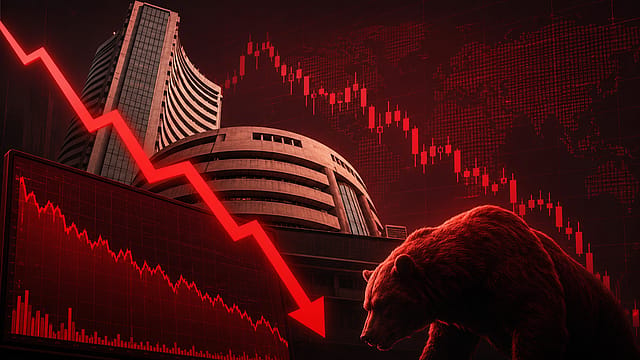
India’s benchmark indices ended the week on a cautious note as investor sentiment weakened amid currency pressure and global concerns.
The Nifty 50 closed at 23,643.50, down 46.10 points or 0.19 per cent, while the BSE Sensex settled at 75,237.99, falling 160.73 points or 0.21 per cent.
The decline came after a recent rally, suggesting markets may be entering a consolidation phase as investors reassess risks.
Why is the rupee hitting a record low significant?
A major trigger for the market weakness was the Indian rupee falling to a historic low of 96 against the US dollar.
A weaker rupee tends to increase import costs, especially for crude oil, which India heavily relies on. This feeds into inflation and pressures corporate margins, making investors more cautious.
Currency weakness also signals broader concerns about capital flows and economic stability, which can influence foreign investor sentiment.
How are inflation and crude oil prices impacting sentiment?
Rising global crude oil prices have compounded concerns. Brent crude surged over 3 per cent to around USD 109 per barrel, driven by disruptions around the Strait of Hormuz.
Higher oil prices directly affect inflation in India, raising fuel costs and transportation expenses, which ripple across the economy.

The Liberation of Bengal
05 Jun 2026 - Vol 04 | Issue 74
A silent revolution ends the reign of fear
At the same time, fresh fuel price hikes have revived inflation fears just as markets were stabilising after a recent rally.
What are experts saying about the current market mood?
Market participants are turning cautious as multiple risk factors converge.
Vinod Nair, Head of Research at Geojit Investments Limited, said, "Investors have turned cautious post the recent relief rally, with rising bond yields, a weaker rupee, and fresh fuel price hikes reviving inflation concerns. Favourable valuations and a solid Q4 earnings print are cushioning the downside."
He highlighted that despite the pressure, strong corporate earnings and reasonable valuations are preventing sharper declines.
He further added, "Globally, surging yields have paused the AI-led rally. Near-term direction is likely to be driven by geopolitical developments -- specifically, any progress on reopening the Strait of Hormuz, with the Trump-Xi meeting positioned as the key catalyst."
Which sectors were hit the most?
Sectoral performance remained mixed, reflecting selective selling and buying.
Metal stocks led the decline with a 2 per cent drop, followed by realty, PSU banks, and financial services, which also saw notable losses. Consumer durables edged slightly lower.
On the other hand, IT stocks gained over 1 per cent, while media and healthcare sectors also saw modest gains. Auto stocks ended nearly flat but in positive territory.
This divergence suggests investors are rotating into sectors perceived as more resilient in uncertain conditions.
What’s happening in commodities like gold and silver?
Interestingly, while equities struggled, precious metals also came under pressure.
Gold prices dropped more than 2 per cent to Rs 1,58,633 per 10 grams for 24 karat gold, while silver saw a sharper fall of around 7 per cent to Rs 2,70,952 per kilogram.
This indicates broader volatility across asset classes, possibly driven by global liquidity shifts and rising bond yields.
How are global markets influencing India?
Weakness wasn’t limited to India. Most Asian markets ended lower, reflecting global uncertainty.
Japan’s Nikkei 225 dropped 2.70 per cent, Hong Kong’s Hang Seng fell 1.73 per cent, and South Korea’s KOSPI saw a steep decline of 6.52 per cent. Other regional indices also closed in the red.
This global sell-off underscores the impact of rising bond yields, geopolitical tensions, and concerns over global growth.
What could drive markets next?
The near-term direction of markets will likely depend on multiple moving parts: the trajectory of the rupee, crude oil prices, inflation trends, and global geopolitical developments.
There is also growing focus on potential fiscal and monetary measures to stabilise the currency and support the balance of payments.
For now, markets appear to be in a wait-and-watch mode, balancing strong domestic fundamentals against mounting global risks.
(With inputs from ANI)