Hero Owns Vida. Why is it Spending ₹1,758 crore More on Ather?
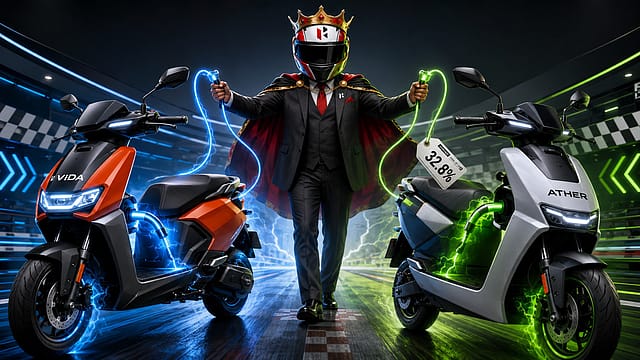
Parents are not supposed to choose a favourite child. Hero MotoCorp has found a more expensive solution. It is raising both.
The world’s largest motorcycle manufacturer has built Vida as its own electric-vehicle brand, armed it with new scooters, given it access to Hero’s distribution machinery and watched it race up India’s electric two-wheeler rankings.
It has simultaneously spent billions of rupees accumulating shares in Ather Energy, the Bengaluru startup that sells electric scooters against Vida.
The latest purchase is the largest declaration of this peculiar dual strategy. Hero has acquired 1.188 crore Ather shares from the Government of Singapore at ₹1,480 apiece through a block deal worth approximately ₹1,758 crore. The transaction raises Hero’s fully diluted holding in Ather from 29.88 per cent to 32.8 per cent, reinforcing its position as the startup’s largest shareholder.

Zeroing In on ECI
09 Oct 2026 - Vol 05 | Issue 41
Constitutional legitimacy versus political opportunism
The purchase follows Ather’s separate preferential allotment of convertible warrants worth ₹960 crore to Hero. The distinction between the two transactions matters. The ₹960 crore will enter Ather. The ₹1,758 crore paid for the Singapore government’s shares will not. It is a secondary transaction that gives Hero more ownership without providing fresh capital to Ather.
Hero is spending that money to enlarge its claim on Ather’s future. It is a striking wager. Vida must defeat its competitors for Hero to succeed operationally. Ather can defeat Vida and still make Hero wealthier. India’s internal-combustion emperor is refusing to nominate a single electric heir.
One Company, Two Electric Futures
Hero first invested in Ather in 2016, six years before launching its first Vida electric scooter.
The timing explains much of the apparent contradiction. Ather offered Hero early exposure to a business it did not yet possess: software-led electric scooters, connected technology, proprietary charging infrastructure and a young urban brand built without the cultural weight of petrol motorcycles.
Hero brought capital, automotive scale and decades of institutional experience. Ather brought access to a future that was still uncertain. The relationship deepened as electric two-wheelers moved from technological experiment to commercial contest. Hero continued buying shares, became Ather’s largest shareholder and retained its holding when the startup went public in 2025.
But Hero did not outsource its electric future entirely.
It launched Vida in 2022 and began constructing a direct challenger. Vida now competes for the same customers, dealerships, market share and mind space as Ather, TVS iQube, Bajaj Chetak and Ola Electric.
“Hero’s investment in Ather is best understood as a strategic hedge on India’s electric two-wheeler transition,” reckons Amit Kaushik, veteran automotive analyst and founder and CEO of MobiDX AI, an automotive analytics and AI startup. Vida gives Hero direct control over its own EV brand, while the Ather stake provides exposure to a digitally native company with strong technology, product credibility and a distinct customer base. "Hero is effectively ensuring that it participates in the value creation even if the market evolves differently from its internal expectations,” he says.
This is not a conventional multi-brand strategy. Hero owns Vida completely. It owns a large minority of Ather, which remains independently managed and publicly listed.
One is Hero’s child. The other is its very valuable neighbour, partly living on Hero’s balance sheet.
The Rival is Winning Too
Hero is not investing in Ather as a consolation prize.
Ather sold 2,62,942 scooters in FY26, an increase of 69 per cent. Monthly registrations reached a record 36,366 units in March 2026, while its market share touched 19.8 per cent in October 2025, according to the company’s annual report.
The Rizta has altered Ather’s scale. The company initially built its identity around the sporty 450 range, appealing to technology-conscious urban riders willing to pay for performance, software and design. Rizta took Ather into the much larger family-scooter market, where practicality, storage, comfort and trust can matter more than acceleration graphics.
The first one lakh Riztas were sold in 11 months. The next one lakh took seven. Vida is also growing rapidly. It crossed cumulative sales of three lakh units in 2026 and increased its year-to-date share of India’s electric two-wheeler market to approximately 11 per cent. It now stands behind TVS, Bajaj and Ather, but ahead of Ola Electric.
Hero, therefore, owns all of India’s fourth-largest electric two-wheeler brand and nearly one-third of the third-largest. The two are no longer pursuing separate corners of an undeveloped market. They are climbing the same table.
“The unusual feature is that Hero is investing heavily in a company that competes with its own electric brand,” underlines Kaushik. This can generate valuable learning and financial upside, but it also creates a strategic tension. Hero must build Vida aggressively without weakening Ather, while Ather must retain enough independence to compete with a shareholder that is also its rival, he adds.
Ather must believe that Hero’s investment will not become an invisible brake. Vida must believe Hero’s affection for Ather will not turn into preferential patience.
Ather is Not Vida Wearing Better Software
The two brands currently occupy different emotional territories.
Hero is one of Indian mobility’s most familiar names. Its historical advantages are scale, distribution, manufacturing, service and the trust accumulated by putting millions of commuters on Splendors, Passions and Glamours.
Vida was created partly to escape the limitations of that inheritance. An electric scooter carrying the Hero badge alone might appear dependable, but it could also look like a petrol-era company changing the engine and retaining the accent.
Ather began with no such burden. It could speak in the language of touchscreen dashboards, software updates, acceleration, charging networks and startup audacity. Its greenness was native. Its technology did not need a translation.
“Hero and Ather solve different branding problems,” says Ashita Aggarwal, professor of marketing at SP Jain Institute of Management and Research. Hero brings scale, familiarity and distribution; Ather brings technological credibility, premium aspiration and the cultural freshness of a startup. Keeping the brands separate allows Hero to address different consumers without forcing one identity to perform two contradictory jobs.
That separation is commercially useful. Hero can stretch Vida towards the mass market using cost, reach and service. Ather can preserve its technology-first personality even as the Rizta takes it into family garages.
But ownership changes perception. “Vida must compete hard enough to look like Hero’s electric future, while Ather must remain independent enough to preserve the startup credibility that made it valuable,” says Aggarwal. If consumers begin to see Ather merely as Hero in cooler clothing, the investment could weaken the very distinction Hero is paying to own.
Brand portfolios work when the brands are sufficiently different to justify their coexistence. The danger begins when consumers discover the family photograph.
Compete in the Showroom, Cooperate at the Charger
Hero and Ather already demonstrate how rivalry and collaboration can occupy the same charging point.
In 2023, the companies created an interoperable fast-charging network that allowed Vida and Ather customers to use both systems. The combined network initially included more than 1,900 charging points across 100 cities.
The arrangement was enabled by the Light Electric Combined Charging System developed by Ather and approved as an Indian standard. Ather had opened its connector technology to other manufacturers, recognising that charging infrastructure becomes more useful when it grows beyond a single brand. The partnership solves a shared industry problem. India’s electric two-wheeler makers need to compete on products without condemning consumers to incompatible islands of charging infrastructure.
Hero’s holding makes such collaboration easier to imagine. It may also provide exposure to Ather’s product development, retail experience and understanding of the premium EV customer, subject to governance protections and the separation required between two competing public companies.
But ownership must not be confused with unrestricted access. Hero cannot simply open Ather’s cupboards and carry its technology home to Vida. Ather has other shareholders, independent directors, founders and public-market obligations. Sensitive information, related-party dealings and conflicts of interest require formal safeguards.
A large strategic shareholder can offer stability and long-term capital. A large strategic shareholder that manufactures competing scooters creates a more complicated room.
Is Hero Slowly Buying Ather?
A 32.8 per cent holding naturally invites speculation about the endgame.
Hero has been investing in Ather for a decade. It is the largest shareholder. Its latest purchase removes a substantial institutional block from the market and expands its economic influence just after committing another ₹960 crore through convertible warrants.
The direction of travel is unmistakable. The destination is not.
“A 32.8 per cent holding gives Hero substantial economic exposure and influence, but it does not by itself establish that a takeover is imminent,” says Kaushik. The immediate logic appears to be optionality. Hero can benefit from Ather’s growth, learn from the evolution of the premium EV market and preserve the possibility of a deeper relationship later.
An eventual acquisition could give Hero a powerful EV platform, recognised products, proprietary technology and a brand it has spent years helping to finance. It could also destroy some of what makes Ather valuable. Startups often gain credibility from being faster, sharper and less predictable than incumbents. Absorption into a large corporation can bring capital and scale while slowly replacing urgency with committees.
Hero may, therefore, benefit from owning enough of Ather to participate in its success, but not so much that Ather loses its independent pulse. The ₹1,758-crore purchase appears to buy precisely that kind of optionality. Hero does not have to acquire Ather today. It only has to ensure that somebody else cannot easily build a decisive position without encountering Hero at the table.
A Hedge Against an Unsettled Market
Electric mobility still contains too many unresolved questions for one confident bet.
Will Indian riders embrace connected premium scooters or push prices relentlessly lower? Will fixed batteries dominate, or will swapping gain ground? How quickly will subsidies recede? Will the strongest advantage come from technology, charging infrastructure, dealership reach, financing or service?
Even the identity of the customer is evolving. Early adopters purchased electric scooters as technological statements. The next wave is judging them as household vehicles. The winner may not be the company with the most futuristic dashboard. It may be the one that creates the least anxiety after the battery warning appears.
“The electric two-wheeler market remains unsettled,” Kaushik says. “Consumer preferences, battery economics, charging infrastructure and brand loyalties are still developing. Backing both Vida and Ather reduces the danger of Hero placing its entire electric future behind one product strategy or brand identity.”
That is the hidden intelligence of Hero’s apparent contradiction. Vida gives Hero command. Ather gives it cover.
If Vida becomes the mass-market electric extension of Hero’s enormous two-wheeler empire, the company owns the entire victory. If Ather’s technology, brand and products outperform Vida, Hero owns nearly one-third of that victory too. And if both succeed, Hero will have built two routes into the same electric garage without forcing them to carry the same name.
Hero’s Favourite Child is Optionality
Hero’s strategy is not free of tension. It must justify allocating substantial capital to a competitor while investing in Vida’s products, marketing, distribution and charging ecosystem. It must manage conflicts between two businesses chasing overlapping customers. It must allow Ather enough autonomy to remain Ather.
Most importantly, Vida cannot become lazy in the knowledge that its parent has insured itself elsewhere. The investment works only if the two brands continue fighting.
Ather must behave like Hero owns nothing. Vida must behave like Hero owns no Ather. Hero, meanwhile, can watch the electric market evolve from both sides of the showroom. For more than four decades, the company’s power came from selling motorcycles at a scale few rivals could match. Electric mobility has disrupted that certainty. New technology created new brands, rearranged the sales table and allowed startups to challenge companies with far larger factories and dealer networks.
Hero’s response has been unusually pragmatic. It built Vida because no incumbent can surrender control of its next engine. It kept buying Ather because no incumbent can be certain it has built the right one.
Hero owns one electric challenger and nearly a third of another. The arrangement looks contradictory only if the future is expected to produce a single winner. Hero is spending ₹1,758 crore to avoid having to guess its name.