Hard-boiled question: Can Pulse Grow Up Without Growing Old?
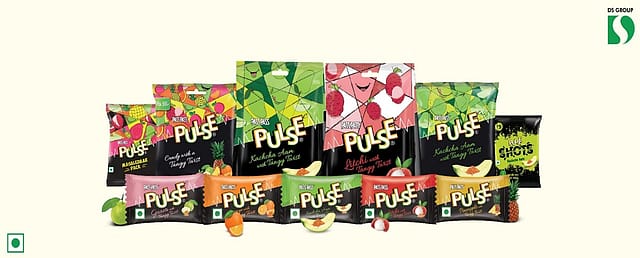
A decade ago, Pulse disrupted Indian confectionery with a single, sharp idea: a tangy, spiced centre hidden inside a hard-boiled candy. It travelled fast, and it scaled even faster. Today, DS Group—the tobacco-to-FMCG company that manufactures Pulse—claims to hold a 19% volume market share of India’s highly-fragmented hard-boiled candy market. If the scale is staggering-- the company reportedly sold 750 crore units of Pulse in FY25-- the pace is equally dazzling: a growth of 15% CAGR over the last three years, well ahead of the category’s 9%.
Naturally, success brings a new set of questions, rules, and problems. What works at Rs 100 crore, naturally, does not work at Rs 1,000 crore, which the company is targeting to achieve over the next few quarters. The company is aware of the challenge. “Today’s consumer is not only cost conscious but also value conscious,” says Jyotiroop Barua, Business Head (Confectionery) of DS Group.
Barua’s dilemma is justified. While Pulse had a dream run for last so many years, it now needs to rejig its roadmap. It’s not easy, though. Reason? Value needs to be delivered, repeatedly. And with value comes SKUs. Not just one flavour and not just through one element of surprise that made the brand famous.
From Hero SKU to Brand System
To begin with, Pulse was never designed as a portfolio. It was a hit product.
In its early phase, growth came from product shock and word of mouth. People discovered the candy, talked about it, and went looking for it again. Advertising followed later. Digital came early. Memes, humour and the centre-filled reveal did much of the heavy lifting, while distribution expanded as demand became visible.
Exclusive: To the Heavens and Back
19 Jun 2026 - Vol 04 | Issue 76
Shubhanshu Shukla relives the space odyssey that put India into orbit
Over time, however, the brand had to change how it behaved. Kachha aam remains the anchor, but flavours like litchi, guava and orange are now being pushed more actively. New formats such as Pulse Shots and Pulse Golmol are meant to widen usage occasions and bring the brand into different moments of consumption. Alongside this, packaging is refreshed periodically to suit different retail environments.
But, at this stage, the game is no longer about discovery. It is about repeat purchase and shelf management.
And here lies the problem. In confectionery, this shift is easier said than done. Consumers want novelty, but retailers want predictability. Brands are expected to deliver both, often in the same box.
Pulse’s urban-rural split of 55:45 shows how widely the brand travels. At the same time, it introduces complexity. What feels fresh in a metro may not translate the same way in a small town. What sells loose at a kirana may not always move in packs elsewhere.
When Impulse Becomes Intent
Along the way, one structural change has forced Pulse to think harder about brand strength.
“With the increasing adoption of UPI, the sale of Pulse Candy has not been negatively impacted. In fact, we have observed consistent growth over the years,” Barua says. The shift towards digital payments has led consumers to be more discerning in their purchases, prioritising quality, he adds.
In effect, buying behaviour has quietly changed. The move from impulse to intent may be subtle, but it is important. Candy is no longer simply being accepted at the counter. Increasingly, it is being chosen. “Impulse categories like candy have always depended on loose change. With UPI replacing cash, that behaviour is disappearing. Candy buying is becoming far more brand-led, not incidental,” says Harish Bijoor, brand & business strategy specialist.
For Pulse, this means recall now has to work harder than reach. Familiarity has to hold even when the novelty wears off.
Staying Young Without Becoming Noisy
This is where Pulse’s recent cultural moves come in.
The brand has leaned into youth platforms, influencers and gamified digital campaigns such as Beat the Bean and Grab the Pulse. At the same time, on-ground properties are repeated year after year to build memory, not just momentary buzz.
Its recent Christmas campaign with a K-pop artist fits into this approach. The collaboration is not about flavour. Instead, it is about relevance, especially at a time when brands across categories are tapping into the Korean wave in India. When asked, DS Group declined to comment on their K-pop collab.
Interestingly, Pulse grew up without the crutches of K-pop. “Pulse was among the first in the category to a Rs 100-crore brand, and its attempt to reinvent itself is understandable,” Bijoor says. The K-pop collaboration, he adds, taps into Gen Z and Gen Alpha at a time when everything from beauty to food is going the K-way.
That said, reinvention always comes with risk. Overexposure can dull a brand built on surprise. Cultural borrowing can feel forced if it is not backed by product truth. So, has Pulse rolled out any Korean-flavoured variant or is it just a gimmick to ride the K-wave? No.
This, then, is the big challenge for Pulse: not to be impulsive and keep a close pulse on what consumers want.
Mass Brand, Adult Business
Even as it experiments, Pulse continues to widen its appeal across age groups. “Pulse is consumed by all, and majority are over 20,” claims Barua.
That detail matters. Pulse is no longer consumed by youth alone. It has widened its reach and appeal across demographics. As a result, expectations have shifted. While the taste can stay playful, the brand behaviour has to mature.
Even while managing Pulse, DS Group has been selective about partnerships. The company recently ended its tie-up with Swiss chocolate brand Läderach, saying the venture “no longer aligns with the core values and long-term vision of DS Group.”
“Pulse did a phenomenal job capturing the mass market with its centre-filled salty and spicy innovation,” says Ambi MG Parameswaran, founder of Brand-Building, a brand consultancy firm. While similar formats existed earlier, Pulse stood out by getting the Indian flavour right, he adds.
Parameswaran also cautions against assumptions that link UPI with death of candy market. “UPI has not killed the Re 1 candy…the category and market will continue to grow,” he reckons.
Looking ahead, Pulse’s next phase may not be shaped by another viral moment alone. It could just as easily come from a quieter decision, a new format, or a small innovation that fits naturally into how people already consume the brand. The challenge now is less about being noticed and more about staying relevant as familiarity sets in.