Geopolitical Fears Drag Markets: Sensex Drops 508 Points, Nifty Slides 0.70%
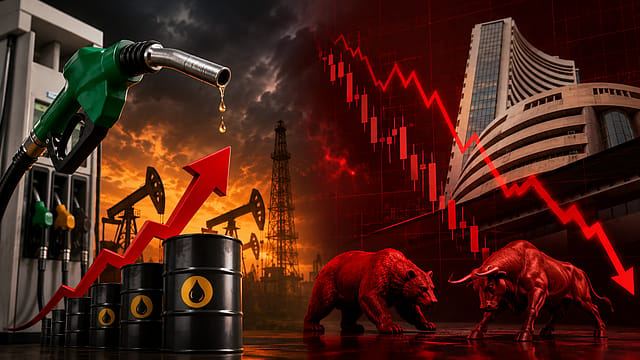
Indian equity benchmarks ended in the red on June 1 as fresh geopolitical tensions in West Asia dampened investor sentiment and triggered broad-based selling across sectors.
The NSE Nifty 50 closed at 23,382.60, down 165.15 points or 0.70 per cent, while the BSE Sensex settled at 74,267.34, falling 508.40 points or 0.68 per cent.
The decline came amid growing concerns over escalating hostilities involving Israel and Lebanon, alongside recent US military strikes in the region. The developments pushed investors towards safer assets and away from equities, reflecting a classic "risk-off" market mood.
How are geopolitical tensions affecting investor sentiment?
According to market experts, the renewed tensions in West Asia have increased uncertainty in global financial markets.
Vinod Nair, Head of Research at Geojit Investments Limited, said, "Recent US strikes and the escalation in cross-border hostilities between Israel and Lebanon have exerted selling pressure on equity markets, reflecting heightened geopolitical uncertainty and a shift towards risk-off sentiment."
The statement highlights how geopolitical conflicts can influence market behaviour by increasing concerns about economic stability, energy supplies and global trade flows.
Is there any hope for a market recovery?
Despite the near-term uncertainty, some analysts believe markets may find support if diplomatic efforts gain momentum.

Open Minds 2026
26 Jun 2026 - Vol 05 | Issue 26
The power of ideas and arguments in 50 portraits
Nair noted, "However, he noted that as the conflict has entered its fourth month, market participants are increasingly expecting some form of diplomatic progress in the near future."
Investors are therefore balancing immediate concerns with expectations that negotiations or international mediation could eventually reduce tensions.
Could India-US trade talks support sentiment?
Apart from global developments, investors are also closely watching progress on trade discussions between India and the United States.
Nair said that on the domestic front, the resumption of India-US trade negotiations focused on an interim trade agreement could provide support to market sentiment going forward.
A successful interim agreement could boost investor confidence by strengthening trade relations and improving the outlook for economic growth.
Which sectors were hit the hardest?
Selling pressure was visible across most sectors, with consumer-focused and banking stocks witnessing some of the steepest declines.
Nifty FMCG emerged as the worst-performing sector, dropping 2.30 per cent. Nifty PSU Bank fell 1.85 per cent, while Nifty Auto declined 1.70 per cent. Nifty Private Bank slipped 0.98 per cent and Nifty Pharma lost 0.54 per cent.
The broad-based weakness reflected concerns about rising energy costs and slowing risk appetite among investors.
Why did IT stocks outperform despite the market decline?
Not all sectors ended lower. Technology stocks stood out as the strongest performers during the session.
Nifty IT surged 2.66 per cent, making it the best-performing sector of the day. Nifty Media gained 1.37 per cent, while Nifty Metal advanced 0.49 per cent.
IT stocks often benefit during periods of global uncertainty because many large technology companies earn significant revenues in foreign currencies, which can act as a cushion against domestic market volatility.
What role did oil and precious metals play?
Energy markets reflected the growing geopolitical concerns.
Brent crude oil prices rose more than 2 per cent and were trading at USD 93.82 per barrel at the time of filing. Rising crude prices are closely watched by Indian investors because India imports a large portion of its energy requirements, and higher oil prices can increase inflationary pressures.
In the precious metals market, gold prices moderated slightly to Rs 1,54,830 per 10 grams for 24-karat gold. Silver prices, however, edged higher to Rs 2,67,810 per kilogram.
How did other Asian markets perform?
Unlike India, several major Asian markets ended the day with gains.
Japan's Nikkei 225 rose more than 1 per cent to close at 67,005. Hong Kong's Hang Seng advanced 0.86 per cent to 25,400, while Taiwan's weighted index gained 1.33 per cent to 45,337.
South Korea's KOSPI emerged as one of the strongest performers in the region, climbing more than 3 per cent to close at 8,788.
The divergence suggests that while global investors remain concerned about geopolitical developments, regional factors and domestic market dynamics continue to play a significant role in shaping market performance.
(With inputs from ANI)