Flipkart vs Zomato–Swiggy: Can a Shopping Giant Crack Food Delivery?
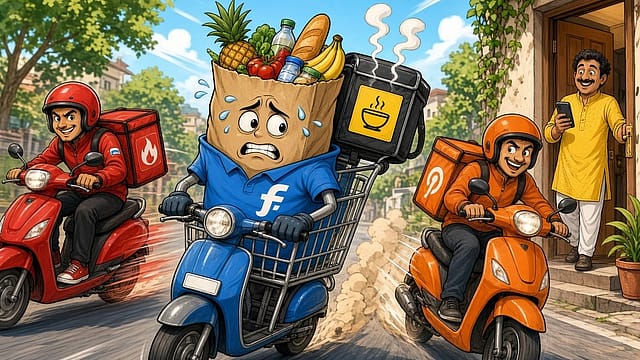
Flipkart’s next contest with Zomato and Swiggy could begin with customers it already has.
The Walmart-owned retailer has reportedly expanded its Eat-in by Minutes food-delivery pilot to more than 8,000 employees. The trial sits within its main app and offers discounts and enhanced SuperCoins rewards.
The arrangement brings together three potential advantages: an existing audience, an established payment relationship and incentives that connect food orders with shopping.
Together, they could make trying Eat-in relatively straightforward. Turning that first order into a routine requires a restaurant and delivery network capable of competing locally.
The central question is how much of Flipkart’s strength in e-commerce can translate into that network—and whether food delivery can, in turn, strengthen its wider business.

Losing Memory
16 Oct 2026 - Vol 05 | Issue 42
The making of a medical and social emergency
THE FIGHT IS MOVING BOTH WAYS
Swiggy and Zomato’s parent Eternal already operate across meals and merchandise through Instamart and Blinkit. Flipkart’s expansion approaches that overlap from the shopping side.
This makes the rivalry broader than competition for restaurant orders. Food, groceries and other purchases create different reasons to open an app. A platform that serves several of those needs may gain more opportunities to retain customers and sell additional services.
For Flipkart, the potential attraction is frequency. Customers replace appliances intermittently; meal orders can recur throughout a week. Someone arriving to order lunch might return for groceries or make another purchase later.
That is a strategic possibility, rather than an established result for Eat-in. More app visits create value only when the additional business earns enough to justify the spending required to attract and serve it.
The global precedents show why retailers pursue this connection—and why measuring its benefits is difficult.
JD.COM SHOWS THE OPPORTUNITY AND THE COST
China’s JD.com offers the closest comparison: a large retailer and logistics operator moving into a market with established food-delivery competitors.
JD launched its food-delivery business in February 2025. In its first-quarter 2026 results, it said the service was helping expand its user base, increase shopping frequency and encourage purchases across categories. It also reported improving economics per order and a sequential reduction in investment.
The proposition resembles the opportunity facing Flipkart. Food can become a way to deepen an existing customer relationship, with benefits extending beyond the meal itself.
But JD’s subsequent results also illustrate the financial demands. In its second-quarter 2026 release, management identified continuing reductions in food-delivery losses as a contributor to improved group profitability. The operation was still consuming money as its performance improved.
For Flipkart, the lesson concerns measurement. If Eat-in brings customers back to shopping, the relevant benefit is the additional profit those purchases generate. Counting meal orders and app visits alone would overstate the commercial case.
Equally, a business with initial delivery losses could become worthwhile if it builds repeat demand and produces demonstrable gains elsewhere. That requires tracking customer behaviour over time.
ALIBABA’S BET IS ON A SHARED CUSTOMER
Alibaba provides a second version of the strategy.
In 2025, it combined Taobao and Tmall, food-delivery platform Ele.me and travel business Fliggy within its China E-commerce Group. An August announcement introduced a loyalty programme connecting benefits across shopping, food delivery and travel. Alibaba explicitly linked these initiatives to greater engagement and retention.
The useful comparison for Flipkart is how rewards might influence where customers spend.
SuperCoins could encourage a shopping customer to sample Eat-in. Food rewards could give that customer another reason to remain active within Flipkart. A familiar account and payment process also reduce the steps required to try a new service.
However, rewards have a cost. Their value depends on whether they produce additional purchases or merely subsidise spending customers would have made anyway.
There is also a limit to how much convenience can compensate for missing restaurants, unreliable delivery or an uncompetitive final bill. Loyalty benefits work best when the underlying service gives customers a reason to return.
Alibaba demonstrates the organisational logic of linking categories. Its strategy does not establish that Flipkart can reproduce the same customer behaviour or economics in India.
EKART MUST SOLVE A DIFFERENT DELIVERY PROBLEM
Flipkart has logistics experience through Ekart and experience with rapid fulfilment through Minutes. Restaurant delivery adds another layer of coordination.
A warehouse can organise inventory and picking around its own processes. A restaurant prepares orders while also serving diners and customers arriving through other channels. Preparation time can change with the dish, kitchen workload and availability of ingredients.
Dispatching a rider too early creates waiting time. Arriving too late can compromise food quality. Peak meal periods concentrate demand, making the balance between available riders and orders particularly important.
TechCrunch reported separate Ekart fleets for Eat-in and Minutes.
That distinction matters economically. Shared technology and customer accounts may provide advantages even when delivery capacity is separate. Savings from shared riders, however, would depend on how operations are actually organised.
An established parcel network supplies experience in managing deliveries. Restaurant service still requires local execution that earns the confidence of customers and kitchens.
AMAZON OFFERS TWO DIFFERENT LESSONS
Amazon’s experience provides a useful check on the assumption that retail scale is sufficient.
In November 2022, the company confirmed that it would discontinue Amazon Food, which it had been testing in Bengaluru. A spokesperson told Reuters the decision followed its annual operating review.
The closure does not prove that an e-commerce company cannot compete in Indian food delivery. It shows that an established shopping business and financial resources do not guarantee a lasting commitment to the category.
In the US, Amazon adopted a partnership approach. In May 2024, it announced that customers could order Grubhub restaurant deliveries through Amazon’s website and shopping app. It also made Grubhub+ an ongoing benefit for Prime members.
That arrangement separates access to shopping customers from responsibility for the restaurant-delivery service. Amazon can add a food benefit to its membership proposition through an existing specialist.
For Flipkart, the comparison clarifies what its reported operating model entails. Building a delivery service offers greater scope to shape restaurant relationships and customer experience. It also brings the costs of establishing and maintaining that service.
The strategic choice concerns how much of the operation a retailer needs to control to obtain the wider customer benefits.
RESTAURANTS AND REPEAT ORDERS WILL DECIDE
Customers can use several food apps. Restaurants can accept orders from several platforms. That gives a new entrant an opening without requiring either group to abandon existing services.
The challenge is becoming useful enough to receive a meaningful share of orders.
A restaurant would have reason to evaluate Eat-in through additional demand, deductions from its billings, settlement reliability and operational workload. A lower commission would be attractive only if the overall arrangement delivered worthwhile business.
For customers, the comparison includes available restaurants, menu prices, delivery charges, fees, offers and reliability. An introductory discount can encourage a trial. Repeat orders after incentives decline provide stronger evidence of a competitive service.
These choices also make food delivery a local contest. National shopping reach cannot substitute for restaurant coverage and rider availability around a particular customer’s home.
A focused rollout could therefore make more sense than spreading resources thinly. The commercial benefit would come from enough nearby orders to use delivery capacity productively while maintaining service.
Incumbents could respond with offers, membership benefits or improved restaurant terms. Their response would raise the cost of winning business, making retention more consequential than an initial burst of discounted orders.
A CHALLENGER CAN MATTER BEFORE IT LEADS
Flipkart would not need national leadership to influence the market. A credible alternative in selected cities could affect promotional spending and give restaurants another channel through which to reach customers.
Whether that influence lasts depends on the business supporting it.
The employee pilot can help test ordering, preparation, dispatch and support. Its promotional conditions and restricted audience provide limited evidence about how unrelated customers will behave at scale.
A wider rollout would face two connected tests: whether meals can be delivered on sustainable terms, and whether those orders generate profitable additional activity across Flipkart.
JD.com and Alibaba explain why a shopping company would pursue the combination. Amazon demonstrates the range of operating choices—and the possibility of withdrawal.
Flipkart’s existing audience gives it a starting point. Its competitive position will depend on the restaurants, delivery performance and repeat purchases it builds around that audience.