Copy, Colour & Colorbar: Can Samir Modi's Beauty Brand Take on the World?
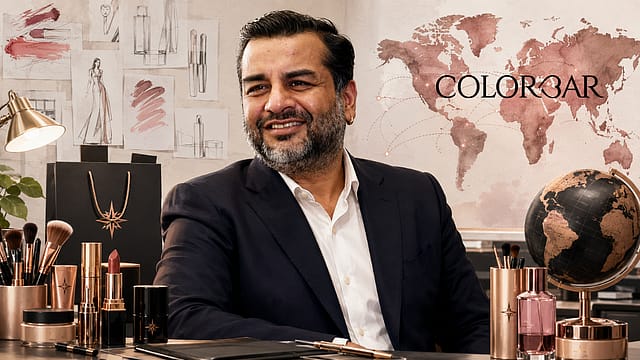
“My philosophy has always been copy, copy, copy.”
It is an unusual admission from a cosmetics company.
Beauty brands prefer talking about innovation, proprietary formulations, breakthroughs and trends they supposedly spotted before everyone else. Colorbar has spent much of its 21-year journey following a less romantic playbook: look at what the world's best cosmetics companies are doing, find the manufacturers making those products and try to bring comparable quality to Indian consumers at a different price.
“Why reinvent the wheel when multinational companies have already done the research and tested it in the market?” says Samir Modi, founder of Colorbar, in an exclusive conversation with OPEN Digital.
The operative word in that strategy is not really copy. It is access.
Over the years, Colorbar has worked with contract manufacturers in Europe that also supply global beauty companies. Modi says that allows the brand to operate within the same manufacturing ecosystem as names such as MAC, Bobbi Brown, Chanel, Dior and Giorgio Armani.
Losing Memory
16 Oct 2026 - Vol 05 | Issue 42
The making of a medical and social emergency
“You could have a MAC pencil and a Colorbar pencil, same standard,” he says.
That has been Colorbar's pitch almost from the beginning: an Indian cosmetics brand that wants to play in the space between mass and luxury, while refusing to think of itself as merely an affordable alternative to an international name.
Two decades later, that proposition is being tested in a beauty market vastly more crowded than the one Colorbar entered.
There was no Huda Beauty or Fenty Beauty when the brand began. India's homegrown beauty ecosystem was smaller too. Today, consumers can move from legacy names to international luxury labels, digital-first Indian challengers and influencer-led brands without leaving their phone screens.
Colorbar, meanwhile, has grown into a ₹300-crore-plus business. Now it is attempting something harder than adding another lipstick to the shelf.
It is trying to decide what Colorbar should become next.
How a warehouse full of makeup became Colorbar
Colorbar emerged from Modi's earlier involvement with the cosmetics category at Modicare. In 2003, after a product line developed with an overseas makeup expert failed to meet his expectations, he began looking more closely at the market.
What he saw was a gap.
Street Wear and Elle 18 occupied the younger end. Lakme and Revlon were established names. Modi believed there was room for a brand aimed at a consumer moving into college and work, earning independently and looking for something more aspirational.
The first attempt wasn't particularly aspirational. Colorbar's early products were manufactured in India and the quality disappointed him. The verdict at home was even less forgiving.
His children told him: “Dad, we won't use it.”
That pushed Colorbar towards the manufacturing model that would eventually become central to the brand.
Modi travelled to Cosmoprof, the international beauty trade fair in Italy, looking for manufacturers. Most weren't interested in an unknown Indian company. One family-owned manufacturer agreed to work with him. It supplied products to some of the biggest names in global cosmetics.
Colorbar had found its way into the supply chain it wanted. The rule that followed was straightforward: work with manufacturers capable of producing for the luxury end of the market.
“Either you make for a luxury brand,” Modi says, “or you don't make for us.”
Getting the products made was one challenge. Getting consumers to buy them was another. Before Colorbar's launch, around 30,000 lipsticks and nail polishes were already sitting in a Chandigarh warehouse. The first store eventually opened at Select Citywalk in Delhi's Saket.
The scepticism was immediate. KK Modi, Samir's father, attended the opening puja, looked around the store and delivered his assessment: “You're a fool. Nobody is going to come into this store. It's a waste of money.” Colorbar opened anyway. Twenty-one years later, the more relevant question is what it does with everything it built after that.
When Copying Turns Into Being Copied
The “copy, copy, copy” philosophy can easily make Colorbar sound like a follower.
The company argues that the reality became more complicated as it matured. Colorbar says its product-development cycle now generates around 250 new SKUs a year. Modi claims some formulations and formats appeared in Colorbar's portfolio before comparable launches from major international brands. Those individual claims require independent verification, but they reveal how the company sees itself today. It no longer wants to be judged simply on whether it can bring global beauty trends to India quickly. It wants to help set them.
“By the time you copy me, I've changed,” Modi says.
The company also places considerable emphasis on its clean-beauty credentials. Modi says Colorbar is vegan and PETA-certified and began listing ingredients on its packaging before Indian regulations required such disclosure.
“We said: consumers have a right to know.”
Colorbar also holds two Guinness World Records and continues to use global manufacturing relationships as an important part of its quality positioning. Yet rapid product creation has produced another problem: Too much Colorbar.
Colorbar Has a Clutter Problem
Walk into a beauty store and choice is supposed to be a strength. Until it stops being one.
Colorbar's portfolio expanded over the years across makeup and skincare, with multiple products addressing different concerns, formulations and levels of coverage. The result, the company now acknowledges, can overwhelm the very customer it is trying to serve.
“Go to our store and ask what skincare to buy,” Modi says. “There's a brightening line, an anti-ageing line, a hemp line, a water line. She walks out confused.”
Colorbar is now doing something consumer companies often find harder than launching products: It is removing them. The skincare portfolio is being reduced to 15 products, with a simpler architecture built around everyday needs and skin types. The foundation range is being cut from five formulations to three: light, medium and high coverage, with 23 shades in each.
This is more than a shelf clean-up. For a company accustomed to producing hundreds of SKUs, simplification represents a shift in how Colorbar thinks about growth. More products do not automatically create a stronger brand. Sometimes they merely create more decisions for the customer.
The bigger experiment, though, sits in the packaging. By 2028, Colorbar wants all its products to move to refillable aluminium cases. The idea is to separate the long-lasting outer case from the product inside it. A lipstick, for example, would sit inside a self-embossed magnetic aluminium shell. Once the colour runs out, the consumer replaces the insert rather than buying another complete package. The outer case stays.
The company sees the move as an answer to one of beauty's less glamorous problems: packaging waste. “India doesn't have the infrastructure to segregate plastic and aluminium mixed together,” Modi says. “So we're not going to call ourselves sustainable and keep making waste.”
Colorbar believes the refillable system can give it both a sustainability proposition and a distinctive product identity in a market where packaging has become an increasingly important part of premiumisation.
Executing it across an entire portfolio will be the harder part. Consumers have to see enough value in retaining the outer packaging to return for refills. Retailers need to accommodate the system. Pricing needs to work. And Colorbar will have to move the idea from prototype to scale across a country where convenience still shapes a large part of beauty purchasing.
If it works, however, Colorbar gets something increasingly difficult to buy with advertising alone: differentiation.
And differentiation becomes even more important as the company looks beyond India.
“I don’t think there is a better person out of India than Samir Modi to actually attempt a global ramp-up for a beauty and beauty-care brand,” says Harish Bijoor, business and brand-strategy specialist.
“Colorbar has established an identity for itself in India. However, as it expands into global markets, the challenges are many.”
For Bijoor, the first challenge is not distribution or manufacturing, but positioning.
“The first big challenge is branding Made-in-India beauty and beauty care. It needs a greater degree of support and deeper thinking around positioning. I believe that needs to be cracked first.”
Made-in-India beauty, he argues, has historically been associated more with massification and a masstige approach than prestige. That creates a positioning challenge for an Indian brand attempting to enter markets where consumers already have established perceptions of global beauty brands.
“Branding becomes the primary task. And branding is not one-size-fits-all, because every country you enter is a different brand market,” Bijoor says.
The opportunity, he adds, remains significant.
“The opportunity ahead in the global beauty and beauty-care market is huge, but only the intelligent will win. The brands that create true differentiation in these markets will win.”
His advice to Colorbar is therefore less about simply expanding its footprint and more about defining what makes the brand worth choosing in each market.
“My unsolicited advice to Samir Modi would be to invest in differentiation, positioning and creating the right foundation for Colorbar’s global expansion. Because the global market, as we know, is not one market, but many.”
The Numbers Need Their Own Makeover
Colorbar's ambitions are running ahead of its financial performance.
According to regulatory filings accessed through Tofler, Colorbar Cosmetics reported revenue from operations of ₹350.5 crore in FY24 and a net loss of ₹54 crore. MCA-filed data sourced from Tracxn shows revenue falling about 6 per cent to ₹331 crore in FY25. The company has spent much of its existence in the red.
FY26 brought further disruption. Modi alleges that senior management spent company money without authorisation, creating a cash-flow problem. He says he subsequently injected ₹130 crore into the business. Colorbar has since tightened internal systems and is reviewing its retail operation and product portfolio.
“The mismanagement helped us,” he says. “It forced us to clean up our systems, tighten our retail environment, make our product line tighter.”
Modi is currently acting CEO as well as overseeing the brand and product functions. For Colorbar, the episode adds urgency to a reset that was already underway. The brand wants to simplify. It wants to invest. It wants to expand overseas. And it wants to go public.
An IPO, Then the World
Colorbar has been working towards an IPO, originally targeted for early 2027.
Modi puts the company's valuation at between ₹2,500 crore and ₹3,500 crore. The plan is to use the next phase of capital to build skincare and fragrances, pursue acquisitions and accelerate Colorbar's international expansion.
Exports, he says, should eventually account for 25 per cent of revenue within five years. The US and Middle East are among the target markets, followed by the UK and Europe. Colorbar is already present in Russia, where Modi says it ranks among the country's top five beauty brands and has its own manufacturing plant.
That is an expansive agenda for a company whose revenue declined in FY25 and whose bottom line remains under pressure.
At ₹331 crore of FY25 revenue, a ₹3,500-crore valuation would put Colorbar at more than 10 times revenue. Public-market investors will have their own view of how much premium to assign to the brand, the category and its growth prospects. An attractive beauty market helps. Profitability will help considerably more.
The global expansion also brings a different set of operational questions.
Bijoor points to D2C as the second major challenge.
“D2C is already a very mature market in many countries. Colorbar might want to step in, but it needs to take a very big call: do you want to win D2C first and then plan your retail foray? Or do you want to become a retail player first and then get into D2C in a differentiated format?”
The problem is that D2C itself is no longer an easy route into international markets.
“D2C is already hugely cluttered globally, so getting into D2C alone is not an option for Colorbar,” Bijoor says.
That leaves Colorbar having to think about how online and offline distribution work together rather than treating D2C as a standalone expansion strategy.
The third challenge sits closer to the product itself.
“Every market may require reformulation and a different set of tests that the product needs to pass,” Bijoor says. “Every country has its own regulatory hoops, so certification becomes the third challenge.”
For a company entering multiple markets, that means international expansion is not simply about putting an Indian brand on an overseas website. Formulations, certifications, regulations, consumer preferences and distribution economics can all change from one market to another.
“I do believe the Samir Modi team will overcome that without much difficulty,” Bijoor adds.
Colorbar's next phase therefore contains an interesting contradiction.
The company is thinking bigger while deliberately becoming smaller in places. Fewer skincare products. Fewer foundation formulations. Less disposable packaging. Tighter systems.
Against that sits a much larger ambition: more countries, more categories, acquisitions, an IPO and eventually a place alongside the global names Colorbar once studied to build its own playbook.
“My goal is to fight the MACs and the Huda Beauties and the Fentys of the world,” Modi says. “I want to make a name for a brand made by an Indian, not made in India. Maybe I'll get there, maybe I won't.”
For Colorbar, that last distinction matters.
It has already spent 21 years proving that an Indian company can source from the same global beauty ecosystem, sell premium cosmetics and build a ₹300-crore-plus brand.
The next test is considerably tougher.
Can Colorbar become a global beauty brand that happens to be Indian?