Can one8 Learn to Win Without Kohli?
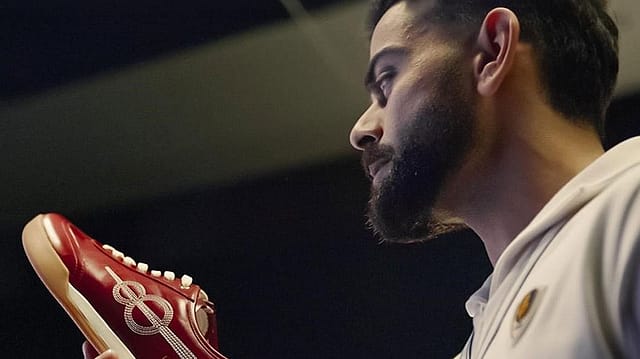
Virat Kohli can persuade people to watch a five-day match. Persuading them to buy a second pair of shoes comes with a different set of difficulties. The first pair will have had several months to express an opinion.
That is where one8’s ambitions become interesting.
Kohli’s stake in Agilitas Sports has risen from 1.8% to 6.4% following the one8 merger. He is now its second-largest individual shareholder after co-founder and chief executive Abhishek Ganguly. Kohli had earlier invested ₹40 crore. The ownership change follows the merger; it should not be mistaken for another cheque written this week.
The Mumbai bench of the National Company Law Tribunal approved the merger on October 23. The larger commercial ambition was announced last December, when Agilitas said it was acquiring the sportswear brand Kohli co-created.
The arrangement has a pleasing sporting complication. Ganguly previously ran Puma’s India and Southeast Asia business. His fellow Agilitas founders, Atul Bajaj and Amit Prabhu, also held senior positions at Puma India. Kohli’s one8 had operated in collaboration with Puma. Some familiar people are now assembling a potential competitor.

Look Who's Talking Regime Change
23 Oct 2026 - Vol 05 | Issue 43
Puma need not declare a national emergency. But it is an unusually well-acquainted challenger. The question is how much advantage travels with those people, and how much must be earned again, one customer at a time.
The factory behind the famous face
Celebrity businesses invite a familiar suspicion: somebody has found a famous person, designed a logo and booked a launch venue.
Agilitas gives one8 a more substantial starting point. In September 2023, it announced the acquisition of Mochiko Shoes, whose manufacturing customers then included Adidas, Puma, New Balance and several other international brands. Its founders bring experience across sales, operations and finance. There is footwear expertise behind the photograph.
That matters. Manufacturing capability can help a business control production, improve consistency and respond when a product needs changing. It also makes this a more credible proposition than assuming Kohli’s followers will obligingly turn into footwear customers.
Still, making shoes for established brands does not automatically reproduce everything those brands possess. Their designs, technologies, sporting associations and customer habits have taken years to develop. A factory can produce an excellent shoe while the brand selling it struggles to explain why anybody should choose it.
one8 is asking customers to consider meaningful purchases. Its website, checked on October 29, listed the Seam Pavilion lifestyle shoe at ₹6,999 and the Boom Rush running/gym shoe at ₹9,999. These are individual product prices, rather than a claim about the cheapest shoe in its range.
At those prices, affection for Kohli will meet several other considerations. Does the shoe fit? Does it remain comfortable? What happens when something goes wrong? Would its owner recommend it to a friend who supports another cricket team?
A customer spending their own money is entitled to be less sentimental than the launch audience.
Jordan did rather more than lend his surname
Michael Jordan supplies the irresistible comparison. Here is a sporting name that became a footwear institution.
There is, however, a considerable amount of Nike inside that achievement.
The first Air Jordan shoe arrived in 1985. Jordan Brand was established as a Nike division in 1997. Its development sits within a company capable of designing, manufacturing, marketing and distributing sports products around the world.
Over time, Jordan also created room for other athletes to tell product stories. Nike’s account of its basketball design process describes signature lines shaped around Jayson Tatum, Luka Dončić and Zion Williamson, including their different movements and playing styles. Michael Jordan remains involved in reviewing products, but the brand has given subsequent generations their own reasons to participate.
That is the useful lesson for one8. Jordan’s name offers an entry into a much larger collection of products, sporting identities and cultural associations.
Even that machinery does not abolish commercial difficulty. Nike reported Jordan Brand product revenue of $7.034 billion in fiscal 2026, down 3% on a reported basis from the previous year. A famous silhouette still has to sell through.
Roger Federer provides another instructive arrangement. He joined On as a co-owner in November 2019, with a role spanning product development, marketing and customer experiences. He entered an existing sports business with founders, products and an organisation around him.
These examples make athlete ownership look promising when sporting knowledge has somewhere useful to go. They offer considerably less support for the proposition that fame can do every job.
For Ganguly and Kohli, the challenge is to turn an athlete’s preferences into benefits somebody else can feel.
Sachin has entered the shoe department
Kohli will not have the Indian cricket legend category to himself.
Sachin Tendulkar launched TEN x YOU on October 10, 2025, through SRT10 Athleisure, co-founded with Karthik Gurumurthy and Karan Arora. Its initial focus included cricket footwear, drawing on Tendulkar’s playing experience. The company’s launch explanation emphasised Indian feet, local conditions and products for different levels of participation.
There is a plausible connection between expertise and product here. A batter who spent decades dealing with different surfaces may have something useful to say about what happens underneath a cricketer’s feet.
The commercial examination begins after that explanation.
How much of the experience survives in the finished shoe? Can customers distinguish the benefit? Does the product remain attractive when displayed beside familiar alternatives?
Tendulkar’s presence also makes life more demanding for one8’s advertising. “A great cricketer helped make this” is becoming a proposition with company. The differences will need to become more specific.
That could be healthy for the category. Celebrity sportswear becomes more interesting when competing founders have to explain their products in detail. Indian customers might eventually receive rather more than a choice between jersey numbers.
A table for the fans
The restaurant business supplies a less comfortable comparison.
A celebrity restaurant can begin with an advantage most independent restaurateurs would dearly like: people have already heard of the person above the door. Curiosity may secure the first booking. Dinner then takes over.
Tendulkar’s restaurant history illustrates the difficulty. Contemporary reporting in October 2009 documented the closure of Tendulkar’s in Mumbai, following the earlier closure of Sachin’s. Sporting reverence had not guaranteed a durable restaurant business.
Kohli’s restaurant association deserves a fairer examination than the easy joke about empty tables.
On October 22 this year, One8 Commune’s operator reported that the chain had 13 outlets. That establishes a business with a footprint beyond a solitary celebrity opening. It does not establish how often customers return, what attracts them or how profitable each location is.
There have also been difficulties. The Bengaluru outlet closed earlier this year. Its operator attributed the closure to building compliance requirements and disputed reports linking it to unpaid dues. Reporting also said Kohli had withdrawn his association with that outlet beforehand.
That hospitality operation should be kept distinct from Agilitas’ sportswear business. Its relevance is the lesson about execution: a famous name cannot resolve every problem that comes with running an establishment.
Restaurants and footwear share an inconvenient feature. Customers get to experience what they bought. The publicity eventually has to live with the result.
one8 has already begun looking beyond one man
It would also be inaccurate to describe one8’s entire plan as waiting for Kohli to carry it.
In April, Agilitas announced Smriti Mandhana as a one8 co-creator, with a role in developing women’s cricket performance products and high-intensity training wear. The company described her involvement as extending into product development.
That is a potentially important move. Women’s performance products give the brand a customer and a set of needs beyond Kohli’s personal following.
The test will be whether Mandhana’s contribution becomes visible in the product. Adding another recognisable athlete increases attention. Building something that answers an overlooked need gives that attention somewhere to settle.
Marketing and branding experts reckon that a celebrity can give a new brand a hearing. The product has to earn the next purchase. "The strongest sign of progress would be customers recommending one8 for something specific it does well, even when Kohli is absent from that conversation,” says Ashita Aggarwal, professor of marketing at SP Jain Institute of Management & Research.
Ganguly has himself offered a demanding measure. In a July interview, he reportedly said: “The success of any brand will be if I can make the consumer buy it four times within the first year.”
That is an ambition worth remembering. Four purchases require a continuing relationship with the range. A launch can introduce the brand; subsequent purchases reveal whether customers have found a place for it in their lives.
Puma gets a vote, too
Established rivals have plenty of ways to make that relationship difficult.
Puma can draw on its own products, distribution and sporting associations. Other competitors can defend particular activities, price points or styles. None needs to win a popularity contest against Kohli to sell a comfortable, desirable shoe.
These are competitive possibilities, rather than evidence of a coordinated response to one8.
For the challenger, the useful questions are unusually concrete. Which product has the clearest advantage? How much business arrives without a discount? What do returns reveal? Do customers come back for the same benefit, or merely for the next celebrity appearance?
The next stage of this story needs answers from customers alongside the founders.
Kohli’s larger ownership stake makes his commitment more substantial. Ganguly’s experience and Agilitas’ manufacturing base give the venture credible resources. Jordan demonstrates how far an athlete-inspired brand can travel when successive products and generations give it fresh life.
one8 has enough behind it to deserve serious attention. It also has enough ambition to deserve serious scrutiny.
Kohli can make millions care about the launch. The particularly valuable customer will be the one who wears out a pair, opens the shopping app and orders another without checking what he posted that morning.