Blinkit Wants Your Whole Shopping List. Can Its Economics Keep Up?
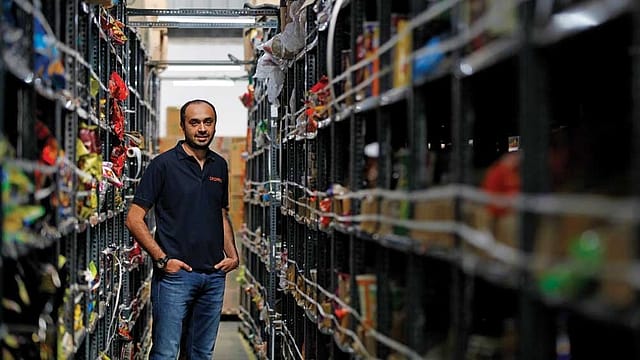
The next item on Blinkit’s shopping list is a larger share of yours.
In Eternal’s Q2FY27 shareholder letter, Albinder Dhindsa spells out the ambition: bring most of what a household buys within ten minutes. The boundary between quick commerce and e-commerce, he argues, will matter less over time. If choice and price are comparable, customers would prefer their purchases sooner.
That proposition expands Blinkit’s competitive arena. Groceries and urgent top-ups help establish a habit. A wider assortment gives the company more opportunities to turn that habit into spending across the household budget.
The September-quarter numbers show both the momentum and the work ahead. Blinkit’s net order value rose 79.3% year on year to ₹20,940 crore. It added 308 net stores, taking its network to 2,751. Adjusted EBITDA reached ₹184 crore, against a ₹156 crore loss a year earlier. Its adjusted EBITDA margin was 0.9% of net order value.

Losing Memory
16 Oct 2026 - Vol 05 | Issue 42
The making of a medical and social emergency
That is evidence of improving operating economics on the company’s chosen measure. It is not a net profit margin, and it leaves little room for complacency as Blinkit expands the range of things it promises to deliver.
A BIGGER BASKET, A HARDER BUSINESS
In Delhi-NCR, Blinkit says its assortment has grown from about 80,000 stock-keeping units in Q4FY26 to roughly 100,000. That describes the assortment across the market; it should not be read as the inventory available at every individual dark store.
The growth is proceeding in two directions: more choice within existing categories and entry into additional ones. The first can deepen a familiar purchase. The second can change how a customer thinks about the app.
A household that starts by ordering milk might later look for a charger, a gift or another purchase previously assigned to a different retailer. The opportunity is to capture more shopping occasions without having to acquire that household afresh each time.
Yet each new category changes the operational requirements. Dhindsa acknowledges that large appliances need different storage and handling; fragile and expensive items require appropriate packaging and security; sourcing and returns vary by category.
The business therefore has to decide which products belong near which customers, how much stock to hold and whether demand can justify the space. Slow-moving inventory can consume capacity that could otherwise serve frequent purchases. More selection can attract spending while also tying up cash.
The strategic question is how far Blinkit can widen choice while preserving the local availability and dependable execution that make speed useful.
SMALLER CITIES, DIFFERENT OPPORTUNITY
Eternal’s letter also challenges a familiar assumption about quick commerce: that its economics depend overwhelmingly on affluent metropolitan households.
According to management, new stores in smaller cities reach 1,000 daily orders in similar time to new metro stores, sometimes faster. Average order values are within 85–90% of metro levels, while customer retention is comparable. Management cites purchases including premium beverages, branded diapers and gaming consoles. These are company observations from its operating network, rather than independently established conclusions about every smaller city.
The important possibility is that quick commerce can solve an availability problem as well as a waiting problem. Where organised retail offers limited choice, putting products within local reach can unlock purchases previously deferred, ordered from elsewhere or never made.
That changes the expansion argument. A metro store may compete for spending already served by several retailers. A smaller-city operation may help build access to a broader range of goods.
There are limits. Blinkit acknowledges that some cities will remain subscale. Demand in successful locations cannot establish the economics of the next hundred. Population density, purchasing power, sourcing and delivery costs still have to work together.
THE EXPANSION TEST
Management now expects to cross 3,500 stores by March 2027, compared with its earlier guidance of 3,000. Current plans point to about 5,000 by March 2028.
Eternal says newer cities and categories are meeting its margin and payback expectations. It also expects improvements in mature operations to more than offset the early burden of new stores, allowing adjusted EBITDA margins to improve during expansion.
The supporting disclosure is significant: mature cities operate above a 5% adjusted EBITDA margin, according to management. Cities accounting for around 96% of Blinkit’s net order value are contribution-positive, while those generating about 70% are adjusted EBITDA-positive. These are different profitability measures and should not be treated interchangeably.
The argument is that operating density improves economics over time. Whether those mature-city results can be reproduced across a much larger network is the central test of the plan.
Customer selection is part of that calculation. Dhindsa says discount-led shoppers use the same finite store capacity as regular customers and may disappear when incentives end. Blinkit is prioritising customers who buy frequently, purchase across categories and are profitable to serve.
This is a useful qualification to the expansion narrative. Store count measures reach; repeat spending and returns on the network determine the quality of that reach.
A BATTLE MOVING IN BOTH DIRECTIONS
Blinkit’s move towards broader e-commerce also brings it closer to established retailers that are accelerating their own delivery operations. In June, Reuters reported that Amazon and Walmart-owned Flipkart were expanding their quick-commerce businesses, including a push into smaller cities.
The competitive boundary is moving from both sides. Blinkit wants a broader shopping role; established e-commerce operators want more purchases delivered within minutes. Existing customers, sourcing capabilities and logistics networks give those rivals resources with which to respond.
Blinkit has also chosen restraint in one potentially contentious area. Dhindsa says private labels currently fail its tests for generating incremental demand or improving economics after the full costs of brand-building are considered. The company prefers to support brands on its platform and earn advertising revenue rather than compete with them through an own-label portfolio.
That may strengthen its appeal to suppliers, although advertising and access to visibility will themselves warrant scrutiny as the platform becomes more important to sales.
THE CASH BEHIND CONVENIENCE
The expansion also needs funding beyond the cost of opening stores. Eternal’s cash balance fell ₹1,813 crore during the quarter to ₹16,475 crore. Management attributes the decline mainly to seasonal working-capital changes, including festive inventory at Blinkit and the timing of restaurant settlements in food delivery.
The entire decline should therefore not be described as Blinkit’s operating cash burn. It nevertheless illustrates a feature of holding inventory: the goods have to be financed before the customer buys them.
Revenue comparisons need similar care. Eternal reported 76% growth in consolidated adjusted revenue, while its like-for-like measure grew 58%. The difference reflects the shift towards inventory ownership in quick commerce, where reported revenue includes the full value of goods sold.
For assessing Blinkit’s progress, order value, margins, customer behaviour and capital requirements together offer a more useful view than a revenue headline alone.
Blinkit has shown that fast delivery can support a large and growing business. Its next ambition asks more of the model: greater choice, wider reach and improving returns at the same time. The shopping list can grow quickly. The economics have to travel with it.