Daniela Amodei & the Brother She Chose for a Cofounder
In the first days of January 2021, Daniela Amodei was eight weeks pregnant, out of a job she had chosen to leave, and pitching the former chief executive of Google in her brother’s backyard. It was raining. They had put up what they called the “party tent”. Everyone wore a mask.
Years later, Daniela could place Eric Schmidt under that tent. She could date the meeting to the first few days of January. On one detail, though, her memory caught. Who knew about the baby? “I think only Dario knew of all the co-founders,” she said. Then she reconsidered. “I’m actually not sure he knew yet.”

The Wealth Issue 2026
06 Nov 2026 - Vol 05 | Issue 45
Portraits of Dreamers and Doers under 35
Dario was four years older and had known her longer than anybody else making the pitch. When he told the story of their childhood, he said they had decided early that they wanted to work together someday. They had left OpenAI the previous month with five colleagues. Now it was someday, Schmidt was in the backyard, and the seven were considerably clearer about the work they wanted to do than about the company they would need to build to do it.
Schmidt would invest. Daniela would have her son. When she spoke to Oprah Winfrey five years later, she described what happened in weeks when she and Dario were both home. Her brother came over, played with her children and stayed to watch a film or play video games. They made time, she said, to be siblings. By then, quite a few people had a claim on their time as president and chief executive of Anthropic.
There is an easy assumption to make about how a woman who studied English literature came to build an AI company with a brother who had a doctorate in biophysics. Their old house on Delano Avenue in San Francisco offers a reason to reconsider it. In 2016, Dario was a researcher at Google. Greg Brockman, who had helped start OpenAI and had tried to recruit Dario, began coming round the house the siblings shared. Brockman already knew one of the Amodeis rather well. He and Daniela had worked together at Stripe.
Before Daniela went into business with her brother, she had worked for somebody else’s. Two of them, in fact.
WHAT DANIELA LEARNT FROM TWO IRISH BROTHERS
Stripe had about 40 people when Daniela joined in 2013. Today, a job at the payments company Patrick and John Collison founded might look like an obvious career move. Daniela’s route there ran through literature, politics and music at the University of California, Santa Cruz, then international development, political campaigns and a job as a congressional aide in Washington. She came home to San Francisco and joined a company she says hardly anybody had heard of.
Her first responsibility was recruiting. Later she led risk operations. One job required her to persuade people to join a little payments business; the other required her to exercise judgment about what that business could safely take on. Both gave her a close view of the Collisons while their company was small enough for employees to see how the brothers worked together. Years later, asked at Stanford how she managed to run a business with Dario, Daniela reached back to Stripe for the answer. Watching John and Patrick, she said, had given her “training wheels”.
What she took from them was surprisingly practical. Affection settles very little on a Tuesday morning when two people have the authority to make a decision and everybody else is waiting to learn which one will make it. Daniela credited the ease with which she and Dario could act together to how clearly they understood what each owned. Dario looked several years out: where the science was going, what a model might soon be able to do, which research to pursue. Daniela worked with the senior team on whom to hire, what customers needed and how to build a business around a technology that kept changing under their feet.
There are other siblings who built on that scale. Sam and Bud Walton’s retail venture became Walmart, which crossed a trillion dollars in public market value in February 2026, long after both brothers had died. That same month, a private tender offer valued the Collisons’ Stripe at $159 billion. The Waltons supply the historical precedent. The Collisons gave Daniela something considerably more useful: she had been on the payroll when theirs was still an experiment.
Leaving Stripe after five years was difficult, she later told students. She liked the company. Payments interested her. But the reason she had gone into public service still exerted a pull, and she could see a chance at OpenAI to work on something whose consequences would reach beyond its customers. She joined in 2018. Her responsibilities there included managing people working on natural-language processing and music generation. The literature graduate got to see an early language model try its hand at French.
French was only part of what startled her. The same model, GPT-2, could turn from writing to mathematics. Looking back years later, Daniela could laugh at how poor its answers were by subsequent standards. What she remembered from seeing it then was the strangeness of one machine attempting all three. She had come to OpenAI with a question about what technology could do for people. Soon she and Dario had a harder one to answer together: were they prepared to leave their jobs over how such a machine ought to be built?
THE FIRST THING HER BROTHER TAUGHT HER
Asked once for an example of an early collaboration with Dario, Daniela was offered a few possibilities. Had they built a pillow fort? Ganged up on their parents?
“He taught me to drive,” she said.
It’s a better answer than the pillow fort. Four years is a useful age gap when one of you is old enough to drive and the other is ready to learn. It was also, by Daniela’s account, ample opportunity to get on each other’s nerves. At Stanford she offered some advice to people contemplating a co-founder: go on holiday together first. Find out what the other person is like when things go wrong. She and Dario had spent decades quarrelling and getting over it. As she reminded her audience, “He’s my brother, and I used to steal his toys.”
The adult version of that familiarity proved useful before either sibling had a founder’s title. According to The Information, Daniela sometimes helped ease friction between Dario and Brockman at OpenAI. She knew one man from childhood and the other from Stripe. Each had a relationship with her that existed independently of his dealings with the other. In a room full of people equipped to judge the merits of a piece of research, Daniela could also judge how an argument was likely to land with the person hearing it.
By December 2020, keeping people on speaking terms was a different proposition from keeping them at the same company. Daniela, Dario and five colleagues left. On their last day they held a video call to celebrate. Daniela remembers the venture as both frightening and exciting. The pandemic had confined them to their homes; they had given up their jobs; and the particular shape of what they would build remained undecided. Within weeks came the rain, the tent and the meeting with Schmidt.
One question that occupied the founders for a month or two sounds dry enough to skip in a family story. Should they set up a nonprofit, a conventional corporation or a public benefit corporation? In hindsight, Daniela said, the last choice seemed obvious. It hadn’t seemed obvious in the backyard. They were trying to decide how much room the people running this business ought to retain for decisions that might cost its owners money.
Five years later, at Nasdaq, that was among the first things Daniela wanted those owners to understand.
THE QUESTION SHE ASKS A POTENTIAL HIRE
To see what Daniela brought to the partnership, consider a question candidates could encounter at Anthropic. She described it in an interview with Vanta’s Christina Cacioppo: tell us about an unusual belief you held and a time you defended it when doing so was uncomfortable. Changing your mind could make for just as good an answer. What interested her was whether the candidate could explain why.
It’s an exacting question to ask at a company run by seven people who had believed something strongly enough to leave their employer together. It would have been easy to hire for agreement with the original seven. Daniela was describing a way to find somebody who might disagree with them and still be worth listening to. Most employees would never have what she had with the chief executive: four decades of practice telling him he was wrong and seeing him again the following day. A company has to make that possible for strangers, too.
There was a commercial side to her judgment as well. Asked how Anthropic had known that businesses would be the right customers for Claude, Daniela declined some of the credit in the question. They hadn’t known for sure. But reliability, the preoccupation that could slow a research lab down, turned out to be something a buyer might pay for. A company putting its own files, staff or customers within reach of a model had good reason to ask how often it made things up. Daniela had spent enough time with buyers to observe that none had ever asked her to make Claude do that more often.
Dario had a way of describing the pace of change that found a second life at home. At a company gathering, he spoke about how quickly AI was going to advance and remarked that things would never be chill again. Employees put the phrase on sweatshirts. According to Daniela, the company gave them to new parents for their babies. A pronouncement from her brother about the future of intelligence had found a constituency in no position to dispute it.
WHO SHE SAW FROM THE NASDAQ STAGE
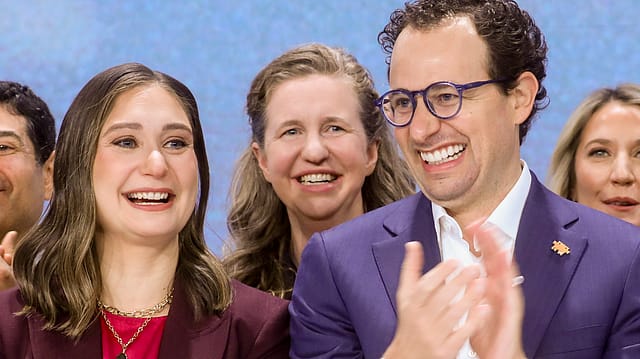
On November 19, 2026, Daniela stood at Nasdaq as the company she had helped pitch from under a tent made its stock market debut. The offering had priced at $83 a share, valuing Anthropic at about $1.5 trillion on a fully diluted basis. In remarks she shared publicly that day, she acknowledged the company’s reputation for doing things in an unusual order. “In some ways, we built ourselves backwards,” she said. The safety team had arrived long before the first product.
She had a Fortune 500 statistic available and used it. Then she gave the audience a school principal in São Paulo who kept her pupils’ grades by hand in a forty-page workbook. According to Daniela, the principal photographed the pages and asked Claude to help her work out what individual children needed. A task that had taken thirty days took minutes.
Any executive on that stage could have done the arithmetic on the principal’s time. Daniela did it a second time, from the other end of the classroom: “For a kid who’s falling behind, it’s a month less waiting to be noticed.”
It was the most revealing choice in her speech. Her brother’s work asks how much more capable a machine might become. Daniela had picked out someone who might never touch the machine and asked what its greater capability could mean to them. There, in a forty-page grade book, was a line back to the young woman who had liked her job in payments and still felt the tug of the work she had gone to Washington to do.
Towards the end she addressed the people uneasy about AI. Some of them, presumably, had no intention of buying a share or opening an account. She told them their voice counted, too. It’s a promise on which those people are entitled to hold her to account. And it’s a fair description of the job Daniela chose for herself in a roomful of people who could build the technology: to notice who else was going to have to live with it.
An interviewer once invited Daniela to reflect on the privilege of running Anthropic with somebody she had known all her life. She accepted the premise, then corrected the arithmetic. She had known Dario all her life. He’d had four years without her.
“Poor guy.”