Andrew Harding Doesn’t Trust Numbers Blindly
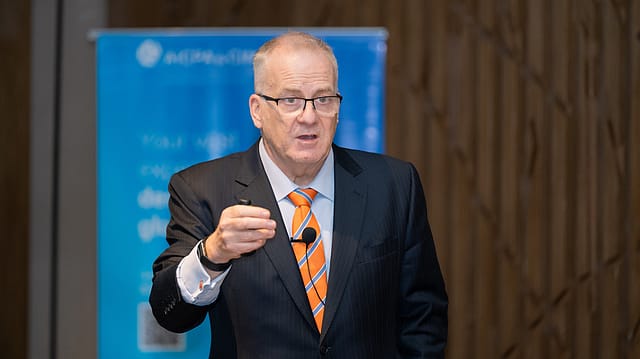
For decades, numbers have been treated as business gospel. They close debates. They justify decisions. They give leaders the comfort of certainty. In boardrooms, they are often treated as the final word—the closest thing business has to truth.
Andrew Harding has spent a career around those numbers. And he doesn’t quite trust them. Not because they’re wrong. But because they’re rarely enough.
As the chief of management accounting at the Association of International Certified Professional Accountants (AICPA & CIMA), Harding sits at a unique intersection: where numbers are produced, interpreted, and acted upon. His vantage point is global. He has seen how finance evolved in developed economies, and how markets like India are now moving through that same transition—faster, louder, and under far more scrutiny.
“I believe India will see a change in the way its CFOs operate,” he says. As the Indian economy expands and governance expectations rise, the CFO mandate, in his view, will rise in the same way.
This isn’t a theoretical shift. Harding has seen it play out before—often triggered by failure. “Lehman Brothers was thought to be the gold standard. And it fell apart,” he says. It was operating in the short term, without a resilient business model or the ability to anticipate the future.
That collapse did more than wipe out a firm. It exposed the limits of a system that relied too heavily on numbers to validate decisions, rather than question them. “What we see at the moment are shocks that we have very little warning about—unpredictable, huge shocks,” he says.
The Great Indian Male Makeover
03 Jul 2026 - Vol 05 | Issue 27
The craze for a perfect look is reshaping masculinity
In that environment, numbers don’t disappear. But they stop being enough on their own. “This is the world of the CFO in 2026,” he says. “And it’s only going to grow in importance.” Excerpt:
Numbers are meant to bring clarity. But you’ve argued they can also create false certainty. Where does that shift happen?
I think we see governance lagging in all sorts of places. It’s not something which is unique to India—it comes with rapid change and rapid development. Governance is about standards and codes, but it’s also about people—their experience, their understanding—and the processes you build around it. The difficulty we’re seeing right now is that those processes need to be completely rethought.
So, what should leaders be looking for beyond the numbers?
Data tells you what happened and provides insight. It rarely tells you why—and almost never tells you what to do next. I trust data when it is timely, when I understand how it was collected, and when it is being used to interrogate a hypothesis rather than confirm one. I become sceptical when data is presented without context, or when everyone in the room is too comfortable with what it shows. Spreadsheets are a tool. I want teams to tell me the story—what the data means and what options I have as a result.
Are businesses over-relying on data today?
Good businesses don’t choose between data and intuition—they use both. Data provides direction, but judgement gives it meaning. The most effective leaders balance analytical rigour with informed judgement. The harder discipline is knowing when measurement itself becomes the problem.
Accounting has long been seen as unglamorous. Why is it now at the centre of business conversations?
I’m not surprised. In developed economies, the CFO mandate has been very strong for years, largely because of trust. The outputs from finance are often regarded as the single source of truth. Over time, that has been questioned—whether information should come from other functions—but it has consistently reverted to the CFO.
And India is going through a similar shift?
Yes. As the Indian economy expands, as more capital comes in, and as governance becomes more important, you see the CFO mandate rise in the same way.
What does that change in how a CFO operates?
What CFOs do starts to change. It’s not about last year’s annual report. It’s not about tax. It’s about the future of the business. It becomes a strategic role—generating options, making the right choices, and building a business that is sustainable and resilient. One that can stand shocks and still be here 10 or 20 years from now.
You’ve seen multiple cycles globally. Where do numbers tend to fail leaders the most?
They fail when businesses focus too much on the short term. That’s what we saw in the global financial crisis. Institutions like Lehman Brothers were seen as the gold standard, but they didn’t have resilient business models. They weren’t anticipating the future. They didn’t have that management accounting mindset.
What has changed since then?
The nature of shocks. Today, disruptions come with very little warning. That makes managing risk, building resilience, and developing scenarios far more important than before.
Integrity and trust—are they the profession’s biggest challenges today?
Integrity and trust are always important. But I don’t think every corporate failure is down to finance. Bad business models fail. That’s part of how a healthy system works. What matters is creating an environment where ethics are expected, valued, and enforced.
Do we still react only after crises?
Too often. These conversations should happen before things go wrong. There are examples around the world of systems that work. The opportunity is to learn from them and adapt them locally.
If you took away dashboards and KPIs, how would you judge whether a business is healthy?
You can recognise it through clarity of purpose, disciplined decision-making, and resilience. Long-term value creation depends not just on financial performance, but on how well organisations adapt, innovate, and build trust.
What’s one financial mistake you’ve personally made?
Selecting sterling for my credit card payment rather than local currency. That results in two charges—and it’s a mistake I keep making.
What’s one myth about money you wish would die?
That profit and value are the same thing. They are not. Profit is a short-term measure; value is long-term. Organisations that optimise for short-term returns often destroy more value than they create.
India runs on jugaad. Accounting runs on precision. Who wins?
Both. Jugaad gets you to the solution. Precision proves it’s the right one. A business can survive on improvisation for a while, but it scales only when creativity is backed by control, data, and accountability.
What do Indian entrepreneurs get right about money?
They focus on cash flow, resilience, and sustainability. They tend to ask a simpler question: will this generate value and cash?
If India’s business culture were a balance sheet, what would stand out?
Relationships. Trust, networks, reputation. Deals may begin with contracts, but they are sustained by relationships.
At what point does financial discipline start killing ambition?
When cost is focused on but value is not understood. Value creation and resilience are everything.
What’s more dangerous—a founder who doesn’t understand finance, or one who thinks they understand it too well?
Understanding finance is crucial. But never assume you know it all. Many startups fail because founders don’t understand fundamentals like cash flow.
When you walk into a room of CEOs, what tells you someone gets it?
It’s in the soft signals—the eye contact, the smile.
Ten years from now, does accounting become more human or more machine?
Both. Routine work will be automated, freeing up time for higher-value work. But judgement, ethics, and communication will become more important, not less.
In one sentence—what separates companies that survive from those that disappear?
A focus on resilience and long-term thinking—using finance as a strategic function, not just a reporting one.