After 2,900-Point Rally, Sensex Tumbles: Profit Booking, Oil Surge Drag Markets Lower
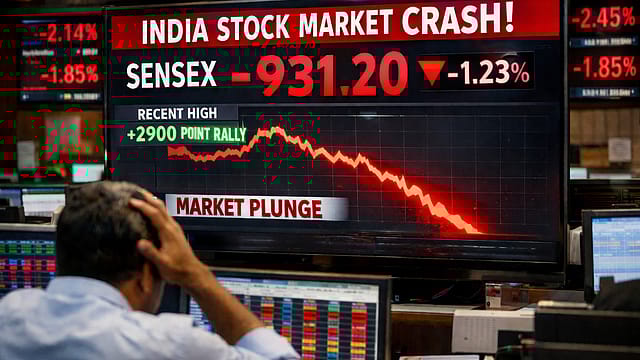
The Indian stock market closed sharply lower on Thursday, April 9, erasing a chunk of Wednesday's euphoria. The Sensex settled at 76,631.65, down 931.25 points or 1.20%, while Nifty dropped nearly 222.25 points or 0.93% to close at 23,775.10. Here is what drove the selloff and what it means going forward.
What Broke the Five-Day Winning Streak?
Renewed geopolitical tensions in West Asia were the trigger. Optimism around a temporary Iran-US ceasefire faded rapidly as reports of violations surfaced, pushing crude oil prices back towards $98.44 a barrel at 0856 GMT, according to market trackers.
Why Did Wednesday's Big Rally Work Against Thursday?
The Sensex had surged over 2,900 points on Wednesday, a 4% single-day move. Such sharp gains almost always invite profit-booking, and Thursday's weekly Sensex expiry amplified the intraday volatility further. Plus, the rupee fell 9 paise to 92.63 against the dollar amid geopolitical tensions and rising crude prices in the market.
Which Sectors Dragged the Indian Stock Market Down?
PSU and private banks, oil and gas, and infrastructure stocks bore the brunt. These rate and crude-sensitive sectors are particularly vulnerable when oil prices spike and global sentiment turns risk-off. Heavyweights like HDFC Bank (-1.2%), ICICI Bank (-1%), and Infosys (-2%) saw significant selling pressure.

Open Minds 2026
26 Jun 2026 - Vol 05 | Issue 26
The power of ideas and arguments in 50 portraits
Biggest losers on the Nifty included L&T, Interglobe Aviation, Eternal, Shriram Finance, and Jio Financial.
Were There Any Bright Spots?
Metals and power buckets showed relative resilience, closing with minor gains. On the Nifty, Dr Reddy's Labs, Hindalco, Bajaj Auto, Bharat Electronics, and ONGC were among the top gainers, per Moneycontrol data.
What Did Foreign Investors Do?
Foreign Institutional Investors reportedly remained net sellers on Thursday, adding consistent pressure on benchmark indices. Sustained FII outflows remain a key risk variable for the Sensex and Nifty in the near term.
How Did Broader Markets Hold Up?
Notably, the Nifty MidCap (added 0.3%) and SmallCap indices closed flat, suggesting domestic retail participation is providing a floor beneath the headline indices.
What Should Investors Watch Next?
Crude oil trajectory and West Asia developments are the immediate watchpoints. Any fresh escalation could put the Sensex under renewed pressure, while a de-escalation may revive the stock market's bullish momentum swiftly.
(With inputs from yMedia)